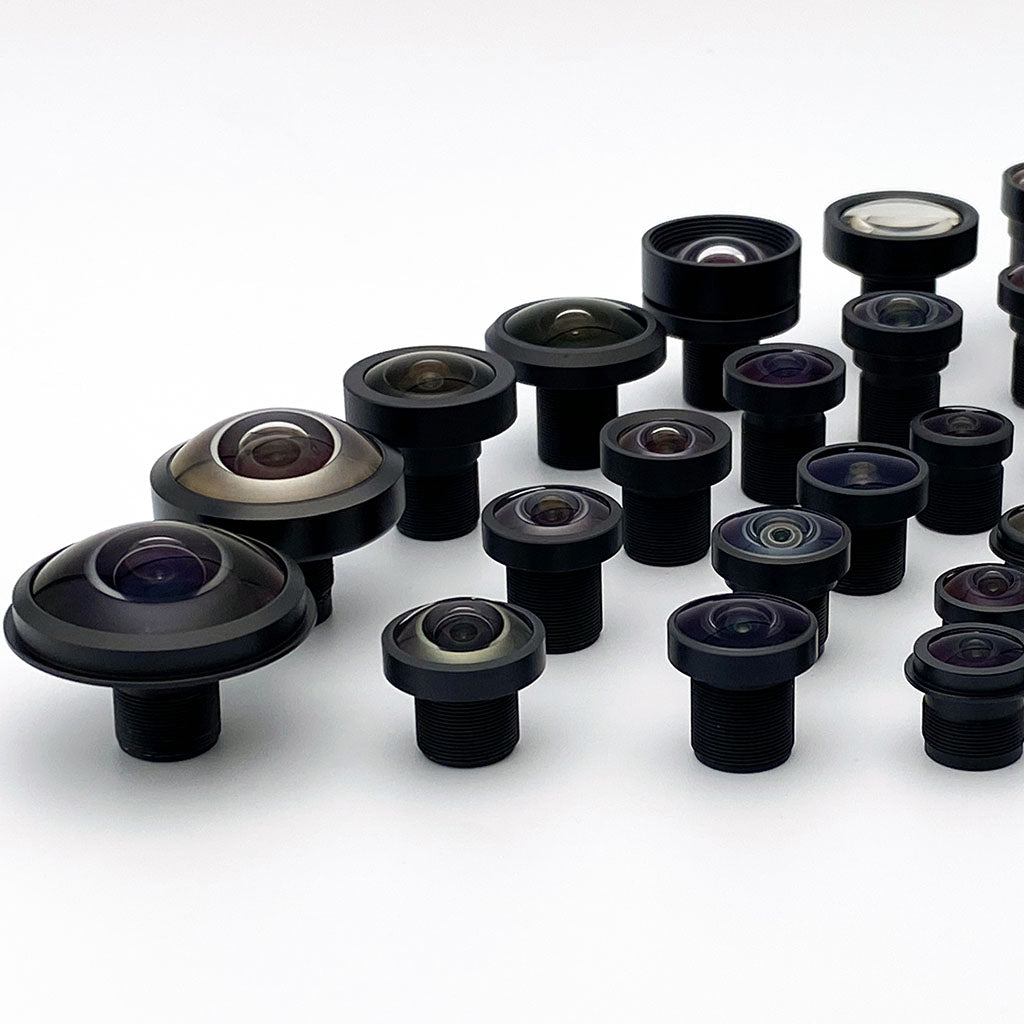

Lens Mount Guide: M12 vs C-mount vs CS-mount for Machine Vision Cameras
M8, M12, C-mount, and CS-mount differ in thread, flange focal distance, and back focal length. This guide shows how to pick the right mount before you order hardware.

M12 (S-mount) uses an M12x0.5 thread with no fixed flange distance. Focus is set by threading the lens in or out and locking it. C-mount and CS-mount both use 1"-32 UN threads, but C-mount has a 17.526mm flange focal distance while CS-mount has 12.526mm. A lens can thread onto the wrong mount and still fail to focus.
The 5mm difference is the rule: a C-mount lens works on a CS camera with a 5mm spacer. The reverse usually does not work. Choose M12 for compact embedded systems, CS for compact cameras with standardized focus, and C-mount for larger sensors, adjustable iris, and maximum lens interchangeability.
What is the difference between M12, C-mount, and CS-mount?
Two parameters define a lens mount: the thread interface, which is purely mechanical, and the registration distance, which sets where the image lands relative to the sensor. C-mount and CS-mount register at the flange, so any compliant pair starts at the same nominal lens-to-sensor distance. Nominal registration is not a focus guarantee: tolerance, rear clearance, focus travel, sensor stack, image circle, and optical performance stay product-specific.
M8 and M12 register wherever the thread is locked, so the installer sets focus by hand. Commonlands manufactures lenses for all four. S-mount commonly means M12×0.5. Board lens describes an application or construction, and board cameras also use M8 and other interfaces. The table compares them side by side.
| Parameter | M8 | M12 / S-mount | CS-mount | C-mount |
|---|---|---|---|---|
| Thread | M8x0.35 or M8x0.5 | M12x0.5 | 1"-32 UN | 1"-32 UN |
| Flange focal distance | Not standardized | Not standardized | 12.526mm | 17.526mm |
| Focus method | Thread in/out, lock | Thread in/out, lock | Focus ring on lens. Flange registration standardized | Focus ring on lens. Flange registration standardized |
| Typical sensor coverage | Up to 1/3" or 1/2.7" | Up to 1/1.8" (select designs to 2/3") | Up to 1" in compact bodies | Up to 1" and beyond |
| Typical image circle | 4-7mm | Up to 9mm and beyond | Up to 16mm | 16mm and beyond |
| Iris control | Fixed | Fixed (most models) | Fixed or manual | Adjustable ring common |
| System size / mass | Smallest, under 1g possible | Small, 2-15g typical | Mid-size | Largest, heaviest |
| Typical cost | Low | Lowest range per capability | Mid-range | Highest |
| Best for | Endoscopes, pinhole cameras, micro UAVs | Embedded vision, robotics, drones | Compact industrial, ITS, security | Machine vision, inspection |

What is M12 (S-mount)?
M12, also called S-mount or board lens mount, uses an M12x0.5 metric thread that screws directly into a holder on a camera module or PCB. M12 lenses are small (typically 10-25mm long), lightweight (2-15 grams), and available from ultra-wide fisheye to telephoto focal lengths.
M12 has no standardized flange focal distance. Each design assumes a different back focal length, so focus is set during installation by threading the lens in or out against a live image, then locking it. That makes M12 flexible for embedded systems but not interchangeable the way C-mount and CS-mount lenses are. Many fixed-focal M12 lenses have a rigid optical assembly. M12 varifocals and other adjustable designs can move internal groups.
No single number covers the M12 family. The near limit depends on the lens prescription, holder height and thread engagement, sensor-stack clearance, and the full-field sharpness you need, so confirm it with Commonlands engineering.
What is C-mount?
C-mount uses the same 1"-32 UN thread as CS-mount but registers at a 17.526mm flange focal distance. An adjustable iris is a design choice, not a flange consequence: adjustable irises are common in this C-mount segment and rare in M12. Sensor coverage does not follow from flange distance: image circle comes from the prescription, and a longer flange pushes wide-angle designs into retrofocus layouts. C-mount lenses commonly cover 1" and beyond because they are designed to.
Unlike M12, an adjustable C-mount lens focuses by turning a ring. What the ring moves is a design choice: the whole cell, a front group, or internal groups on a cam. Near-limit behavior varies by design too, so confirm it on the datasheet or with Commonlands engineering. Some C-mount lenses ship fixed-focus. Working distance is typically 100mm to infinity.
On cam-focused designs the end of cam travel sets a minimum object distance (MOD), measured from the front of the lens to the object. Closer than that, an extension tube is the usual fix. MOD and the focus mechanism belong to the lens, not the mount, and the softening inside MOD is not uniform across the field.
Many C-mount lenses add an adjustable iris for depth-of-field control, practical in machine vision because illumination is programmatically controlled. Use the depth of field calculator to quantify the effect. Select models are ruggedized for harsh environments, which applies to specific lenses, not the mount.
What is flange focal distance?
Flange focal distance (FFD) is the standardized distance from a mount's flange reference surface to the image sensor plane, measured along the optical axis. It is a property of the mount system, not of any individual lens. C-mount FFD is 17.526mm, CS-mount FFD is 12.526mm, and M12 has no universal FFD.
The standard works because both sides conform to the same number: a C-mount lens is designed so its focal plane sits 17.526mm from the flange at infinity, and a C-mount body is machined so the sensor sits at that same distance. Any compliant pair then starts in register, within the tolerance each part holds. FFD is strictly mount geometry, not focal length or working distance.
Datasheets also call it flange back distance, register distance, or flange-to-film distance. For focal-length and field-of-view math, use the EFL calculator.

What is back focal length in machine vision?
Back focal length (BFL) is the distance from the rear vertex of the lens, the last glass surface, to the image plane at infinity focus. It determines whether a lens can physically reach focus on a given camera: for a given sensor, effective focal length sets field of view while BFL sets mounting clearance. The distinction from FFD is exact. FFD is fixed by the mount standard and measured from the flange. BFL is a property of one lens, measured from the last glass vertex.
For M12 lenses, datasheets specify mechanical back focal length (MBFL): the distance from the drawing's specified rear mechanical reference to the image plane at the stated focus condition. Because M12 has no FFD, MBFL is how compatibility is specified, and it typically ranges from 2mm on wide-angle designs to 15mm or more on telephoto designs. The holder height must match it.
Two lenses of the same effective focal length can have different MBFL, so verify it per lens. For how EFL drives framing, see how to choose focal length for machine vision.
Before threading a lens in, check the drawing for rear-element clearance and safe travel relative to the sensor and filters. Approach focus within that range while watching a live image. If focus is unreachable, check holder height, travel, filter stack, and object distance. Soft corners can also arise from aberrations, tilt, or a chief ray angle mismatch.
Datasheets label this dimension inconsistently (MBFL, back focal distance, or BFL) and not every maker publishes it, so check the mechanical drawing before ordering holders. See the Commonlands M12 lens holder selection guide.
Lens mount compatibility and adapters
Thread fit does not guarantee optical compatibility. A lens can screw onto the wrong camera and still fail to focus, because the sensor sits at the wrong distance from the lens's designed focal plane. C-mount and CS-mount share the same thread, so a single 5mm precision spacer converts one direction. The other direction has no passive fix.
C-mount lens on a CS-mount camera
Yes. Add a 5mm C-to-CS adapter ring to restore the 17.526mm registration the lens was designed for. Many CS-mount cameras ship with one. The C CS mount adapter does exactly this, and no thread adapter is needed, only the spacing ring.
CS-mount lens on a C-mount camera
Usually no. A CS lens expects the sensor 5mm closer than a C-mount camera provides, and the flange stops it at the correct thread engagement, so it cannot go further in. Without modifying the camera body, infinity focus is typically not achievable.
M12 lens on a C-mount or CS-mount camera
It is possible with an adapter, and MBFL decides it first, though not alone. The Commonlands CLA127 M12-to-C/CS adapter gives an M12 lens a threaded seat on a C or CS body. Optically, the adapter's own seat depth fixes how far the lens sits from the sensor, and only M12 designs whose MBFL reaches that distance focus at infinity. Below it the image plane forms short of the sensor, and no thread position moves it back far enough.
Compatibility depends on mechanical back focal length, adapter seat depth, rear protrusion, and available focus travel. Focal length alone does not establish fit. Some wide-angle designs provide long back clearance through a retrofocus layout. Take the exact seat depth from the CLA127 M12 to C-mount adapter mechanical drawing and compare it against the lens MBFL.
Some camera bodies carry an IR-cut filter near the sensor, so budget its thickness, then check rear-element clearance in the throat, thread engagement, image circle, chief ray angle, and which surface the drawing measures MBFL from.
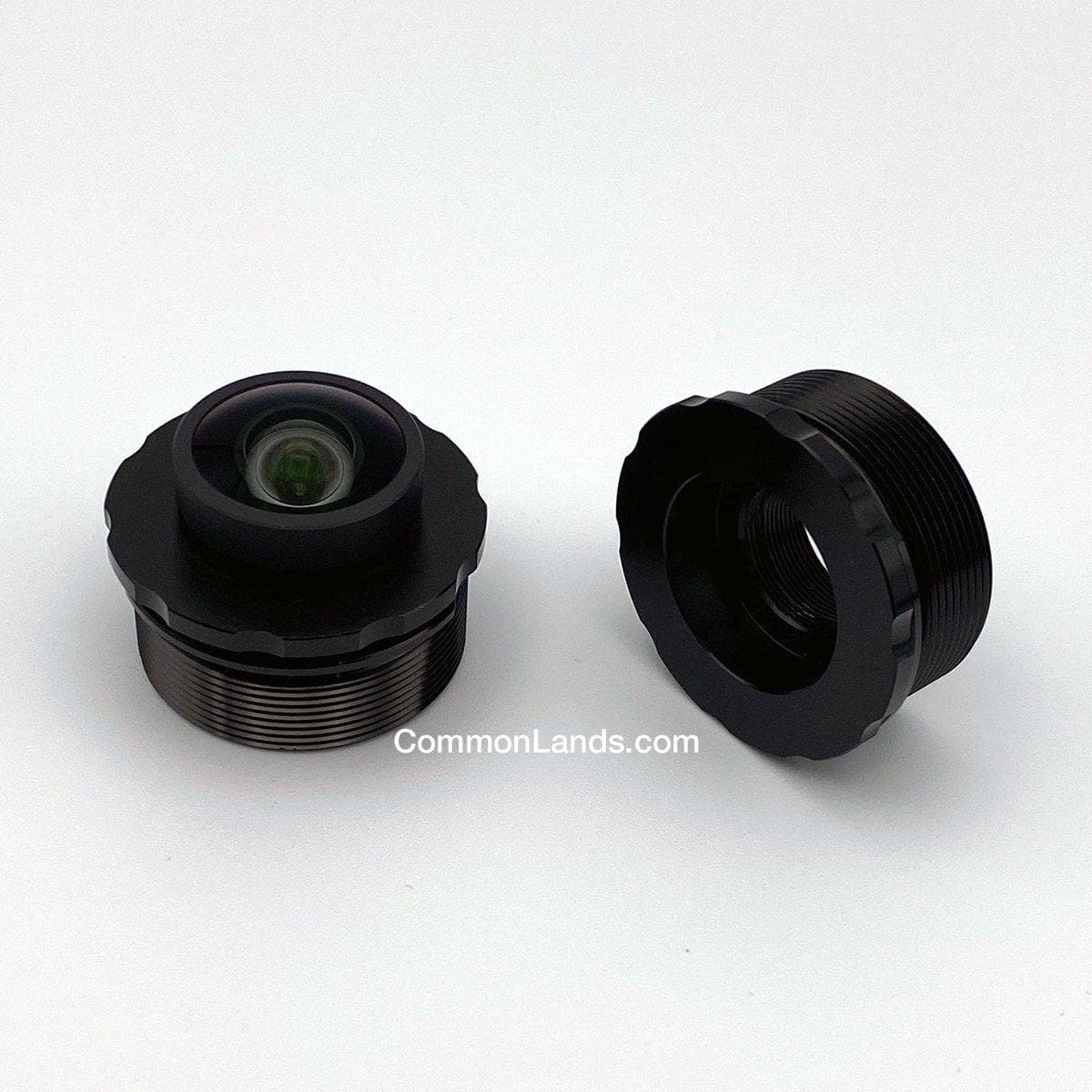
M8 vs M12 lenses: which should you choose?
M8 lenses use an 8mm thread (M8x0.35 or M8x0.5) and target extreme miniaturization. M12 lenses use a 12mm M12x0.5 thread and are the standard for embedded machine vision. The numbers are thread diameter, not focal length, and the larger M12 thread leaves more room for optical elements, which translates into image circle and correction headroom. If the system can physically accept M12, M12 is usually the safer default.
M8 lenses typically produce 4-7mm image circles and target 1/3" sensors, with 1/2.7" (about 6.7mm diagonal) as the practical upper limit. Many M12 lenses cover up to 1/1.8" (about 8.9mm diagonal), select designs reach 2/3", and the highest published M12 sensor class is 16MP (CIL340, CIL293). Neither format has a standardized flange distance, so the holder-matching rules above apply to both. For matching image circle to sensor diagonal, see sensor size and lens compatibility.
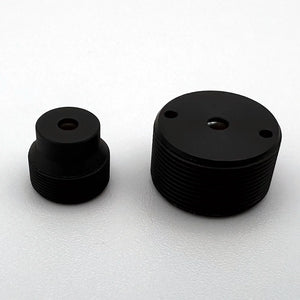
Where M8 wins is package volume: the CIL857 6mm lens weighs 0.8 grams in its M8 variant and 2 grams in M12. In endoscope housings, pinhole enclosures, wearables, and micro UAV payloads with gram-level budgets, M12 hardware does not fit. Outside those cases, M12 offers a wider focal length range (0.8mm to 100mm across the Commonlands catalog), more sub-1% distortion options, and far deeper US sourcing.
The CLA812-AL (M8x0.35 to M12x0.5) and CLA811-AL (M8x0.5 to M12x0.5) adapters mount M8 lenses securely into M12 holders. The lens still has an M8 image circle and M8 optical limits. Use adapters for evaluation on M12 development boards. For production systems where M12 fits, use an M12 lens directly.
Best lenses by mount type
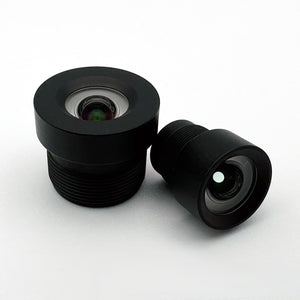
The table ranks one primary lens per mount with a runner-up, stocked in San Diego, same-day dispatch before 12 PM PST. M12 reach does not stop at 35mm: the catalog also lists 50mm, 75mm, and 100mm telephotos. The 2026 M12 lens ranking compares vendors.
| Mount | Lens | EFL | F# | Sensor coverage | Why this pick |
|---|---|---|---|---|---|
| M12 / S-mount | CIL250 25mm telephoto · $99 | 25mm | F/2.0 | Up to 1/1.7", 8MP to 10MP | Compact 20° telephoto for board cameras. IR corrected for day and night use |
| M12 / S-mount | CIL350 35mm telephoto · $59 | 35mm | F/2.4 | Up to 2/3", 8-10MP | Second M12 pick. An 11mm image circle covers 2/3" sensors at a lower price |
| M8 / M12 | CIL857 6mm · $39 | 6mm | F/3.0 fixed | 1/2.7", 7.0mm image circle | Smallest and lightest option, 0.8g in the M8 build, for pinhole, endoscope, and USB cameras |
| C-mount | CIL531 8mm · $149 | 8mm | F/2.8-F/16 | Up to 2/3", 12MP | Wide field with an adjustable iris. About 58° HFOV on a 2/3" sensor |
| C-mount | CIL579 75mm telephoto · $149 | 75mm | F/3-F/20 | 8MP | Runner-up C-mount for long standoff. The wide iris range suits outdoor ITS and ANPR |
| CS-mount | 8mm CS-mount · $59 | 8mm | F/1.8 | Up to 1/1.7", 12MP | Fast normal-to-wide view, about 50° HFOV on a 1/1.7" sensor, and it saves 5mm of body depth. Raspberry Pi HQ compatible |
Every entry is a lens Commonlands stocks and characterizes in-house, picked for mount fit and application coverage, not for the longest focal length.
Weighing suppliers as well as mounts? Our guide to Edmund Optics alternatives for imaging lenses maps seven vendors to the applications where each one fits, including where board-level M12 and C-mount lenses make more sense than catalog optics.

Frequently asked questions
What is the difference between M8 and M12 lenses?
M8 lenses use an 8mm thread (M8x0.35 or M8x0.5) and M12 lenses use a 12mm M12x0.5 thread. The larger M12 barrel allows larger optical elements, broader sensor coverage, and more design freedom. M8 targets extreme miniaturization and typically covers sensors up to 1/3" or 1/2.7".
Can I use a C-mount lens on a CS-mount camera?
Yes. Add a 5mm C-to-CS adapter ring between the lens and camera. This compensates for the flange distance difference and restores proper focus at infinity.
Can I use a CS-mount lens on a C-mount camera?
Usually not in practical systems. A CS lens expects the sensor to sit 5mm closer than a C-mount camera provides. Without mechanical modification, infinity focus is typically not achievable.
When should I choose M12 over C-mount?
Choose M12 when size, weight, and board-level integration matter. M12 lenses are smaller, lighter, and less expensive. Choose C-mount when you need larger sensor coverage, an adjustable iris, or a standardized interchangeable mount system.
Can I adapt an M12 lens to a CS-mount camera?
Mechanically yes, with an adapter. Optically it depends on the lens MBFL against the adapter's seat depth, which sets how far the lens sits from the sensor. Only M12 designs with enough MBFL reach focus, so telephoto focal lengths such as 12mm, 18mm, 25mm, and 35mm are the better candidates and wide angles usually are not. Check the CLA127 mechanical drawing for exact dimensions.
Need help choosing a mount?
Commonlands manufactures M8, M12, C-mount, and CS-mount lenses for machine vision and embedded vision, with MTF characterization on our lens designs. Our San Diego engineering team can work through FFD, MBFL, and adapter geometry with you before hardware is ordered.