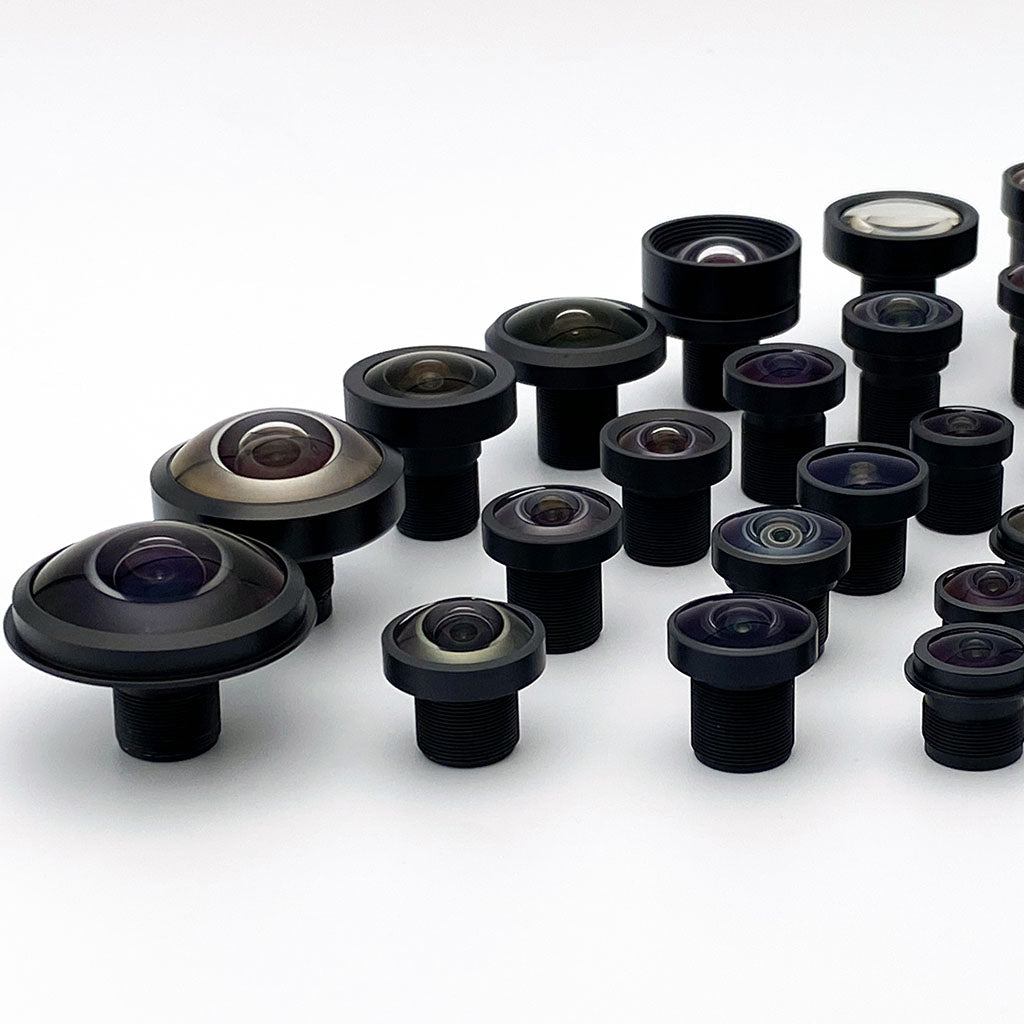

What is Focal Length of a Lens? Technical Definition
Focal length is the distance from the lens's rear principal plane to the rear focal point when the lens is focused at infinity, measured in air (refractive index n=1). Together with the sensor dimension, this fundamental optical parameter sets the angular field of view. Together with object distance, it sets magnification.
Technical Precision
For thick lens systems, focal length is specifically measured from the rear principal plane H' to the rear focal point F'. For thin lenses where thickness t << f, the principal planes coincide at the lens center, simplifying to the elementary definition.
The focal length of lens systems controls two inverse relationships:
- Longer focal length → Narrower field of view + Higher magnification
- Shorter focal length → Wider field of view + Lower magnification
The Focal Length Equation: Gaussian Optics
The fundamental focal length equation relates object distance, image distance, and focal length through the Gaussian lens formula:
Where: f = focal length, u = object distance, v = image distance
All distances measured from principal planes
For optical engineers, the focal length equation more commonly appears in its magnification form:
Gives the magnification magnitude. The real image is inverted
Valid for paraxial rays only
What is Focal Length's Role in Field of View?
Focal length and sensor size determine the ideal field of view at a distant focus. For rectilinear lenses, the angular field of view follows:
θ = full angle FOV, d = sensor dimension, f = effective focal length
Ideal rectilinear projection at a distant focus. Distortion and finite focus distance change the result
Focal Length Calculator – Find Required EFL
EFL vs BFL vs FFL: Which Focal Length Is Which?
Three lengths share the name and cause most datasheet confusion:
Effective focal length (EFL) is the distance from the rear principal plane H′ to the rear focal point with the lens focused at infinity. It is the optical quantity that sets field of view and magnification, and the principal plane it starts from can sit in front of, inside, or behind the physical barrel. Commonlands specs every lens by its EFL.
Back focal length (BFL) is the distance from the vertex of the last glass surface to the rear focal point. It is an optical distance that helps assess clearance. Usable mechanical space also depends on the rear barrel, focus distance, and filter or sensor stack. Telephoto designs have BFL < EFL. Retrofocus designs have BFL > EFL.
Front focal length (FFL) is the distance from the vertex of the first glass surface to the front focal point. Together with EFL, BFL, and the defined vertex references, it can locate the principal planes in the same surrounding medium.
Related but distinct: flange focal distance is a mount standard (17.526mm for C-mount), not a property of the lens design.
Worked Example: CIL059 on an OX08B40 Sensor
The Commonlands CIL059 has a 5.9mm EFL, and the Omnivision OX08B40 on its compatibility list has an 8.064mm-wide active area. At a 2m working distance:
Angular check: θ = 2 × arctan(8.064 / (2 × 5.9)) ≈ 69° horizontal
Measured on this pairing: 71° horizontal, 79° diagonal – the lens's −4% barrel distortion maps slightly more scene onto the sensor than the zero-distortion estimate predicts
Focal-Length Ratio Calculator
This tool reports f2/f1, the ratio of angular image scales for distant objects. It approximates the magnification ratio at the same distant object distance. At finite distance, compare m = f/(u-f) for each refocused thin lens instead.
Sensor Format Corrections
| Format | Diagonal (mm) | Width × Height (mm) | Crop Factor |
|---|---|---|---|
| 1/3" | 6.0 | 4.8 × 3.6 | 7.2× |
| 1/2.3" | 7.7 | 6.2 × 4.6 | 5.6× |
| 1/2" | 8.0 | 6.4 × 4.8 | 5.4× |
| 1/1.8" | 8.9 | 7.2 × 5.3 | 4.9× |
| 2/3" | 11.0 | 8.8 × 6.6 | 3.9× |
| 1" | 16.0 | 12.8 × 9.6 | 2.7× |
For sensor dimensions, pixel size, and lens compatibility beyond this table, see the full Image Sensors list.
Advanced Optical Considerations
Telecentricity in Machine Vision
Object-space and bi-telecentric lenses approximately preserve magnification as object distance changes, with residual telecentricity error. Image-space telecentricity alone does not provide that property. Object-space telecentricity places the entrance pupil at infinity, while image-space telecentricity places the exit pupil at infinity, ensuring chief rays are parallel to the optical axis.
F-Number and Numerical Aperture Relationship
Here D is the entrance-pupil diameter. At infinity focus, working f-number approaches nominal f-number. At finite magnification, use the working f-number, including the lens's pupil magnification, when relating aperture to image-space NA.
Where D = entrance pupil diameter, NA = numerical apertureDetermines depth of field and diffraction limit
What is Focal Length's Impact on System Design?
When choosing focal length, also check:
- Depth of Field: DOF ≈ 2Nc(u²/f²) at low magnification and focus distances well below hyperfocal. Here N is f-number and c is the allowed geometric blur diameter. Use near and far limit equations near hyperfocal focus
- Hyperfocal Distance: H = f²/(Nc) + f
- Diffraction Limit: Airy disk diameter = 2.44λ(f/#)
- Entrance/Exit Pupil: Determines vignetting and telecentricity
Distortion Effects on FOV
The standard focal length equation assumes zero distortion. Real lenses exhibit:
- Barrel distortion: Actual FOV > calculated (typical in wide-angle)
- Pincushion distortion: Actual FOV < calculated (typical in telephoto)
- Fisheye projection: Requires alternative models (equidistant, stereographic)