
What Is an M12 Lens? S-Mount Definition, M12 x 0.5 Thread, and Selection Guide
This guide covers the M12 x 0.5 thread, S-mount naming, sensor coverage, and lens holders. It also compares all-glass and hybrid construction to help you choose the right build.

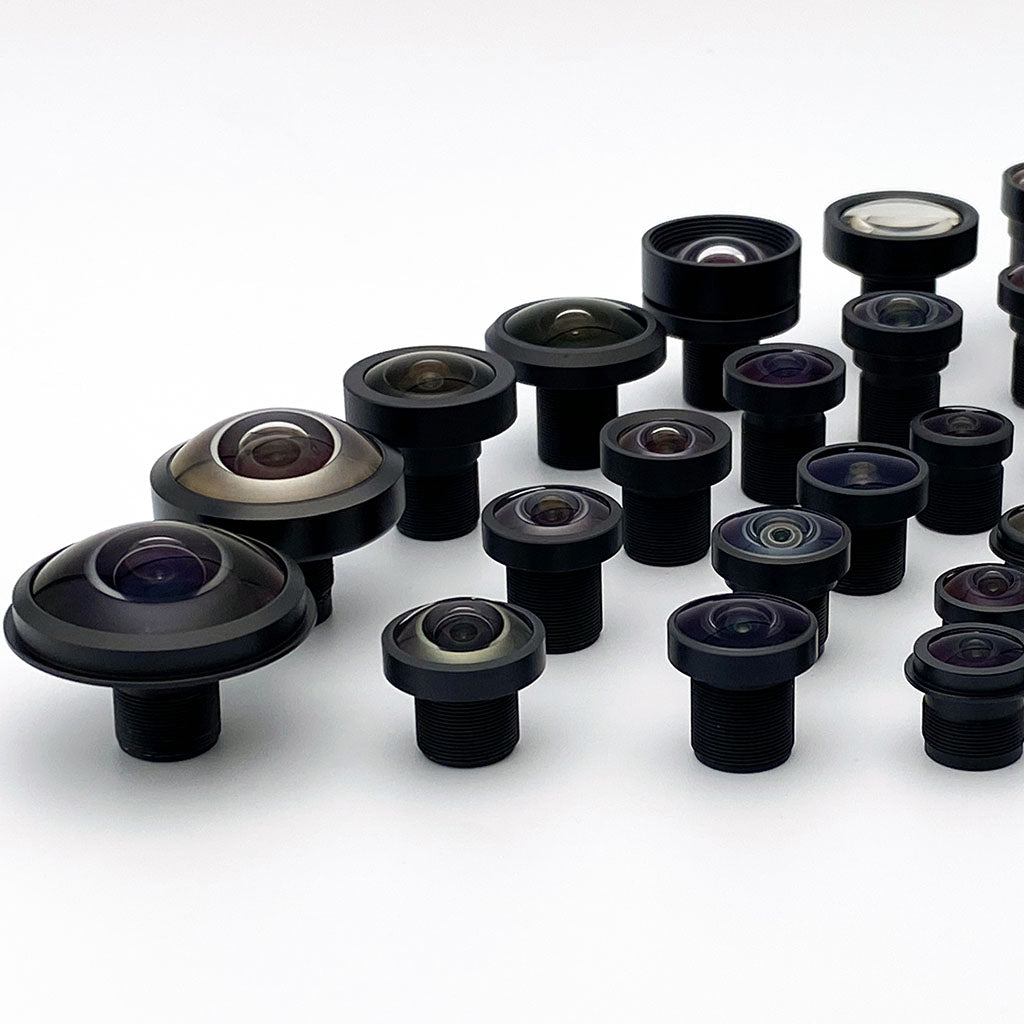
An M12 lens (also called an S-mount lens or board camera lens) is a compact camera lens with an M12 x 0.5 thread. The "M12" means 12mm nominal thread diameter. The "0.5" means 0.5mm thread pitch. M12 lenses screw directly into a camera holder and have no fixed flange distance. Focus is set by threading the lens in or out, then locking it.
M12 optics show up in cars, QR scanners, surveillance cameras, robots, and medical devices. Comparing M12 vs C-mount: M12 wins for compactness and board-level integration, C-mount for larger sensors and a standardized flange distance.
What Is an M12 Lens?
An M12 lens is a miniature camera lens with a 12mm diameter threaded mount and 0.5mm thread pitch. The mount screws directly into a lens holder on a camera module or PCB. M12 lenses are the standard optic for embedded vision systems because they weigh grams instead of tens of grams and cost less than larger industrial formats.

The Commonlands M12 lens collection runs from 0.8mm fisheye to 100mm telephoto, covering sensor formats from 1/6" through 1/1.8", select designs to 2/3".

What Does M12 x 0.5 Mean?
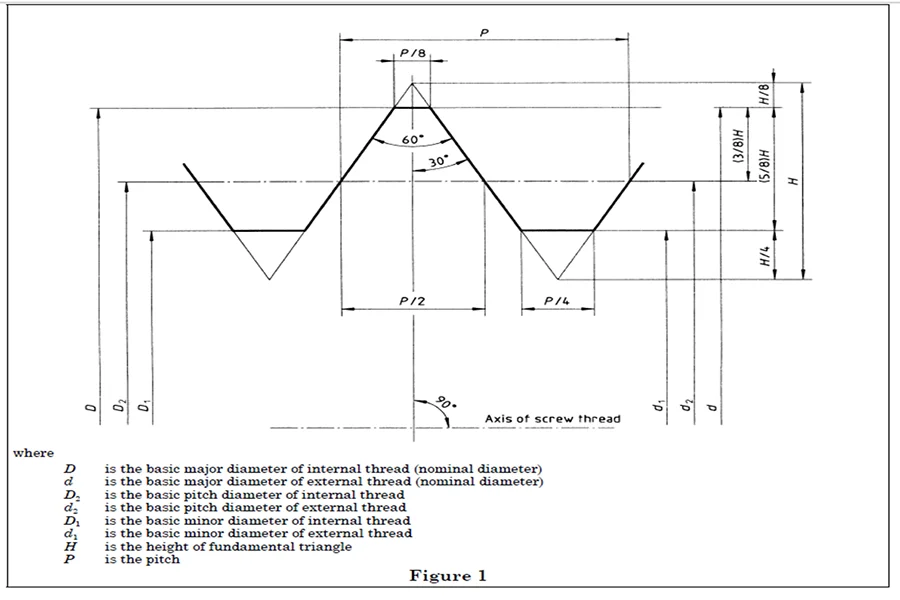
"M12 x 0.5" is the thread specification for the lens mount: M12 means the nominal major diameter of the thread is 12mm, and 0.5 means the thread pitch is 0.5mm, the distance between adjacent thread peaks. The spec follows the ISO metric screw thread standard and defines the mechanical interface only. It says nothing about optical performance, focal length, sensor coverage, or image quality. Those come from the lens design itself.

What Is an M12 Lens Used For?
M12 lenses go into any smart device that needs to see under board-level packaging constraints. Field of view, resolution, and ingress protection vary widely across the Commonlands catalog. The application defines the lens, not the mount.
- Autonomous mobile robots and warehouse AMRs (navigation, obstacle detection)
- Factory machine vision nodes (barcode reading, presence detection, inspection)
- Drones and UAVs (payload cameras where mass budget is tight)
- Smart traffic and parking cameras (compact outdoor enclosures)
- Medical and handheld devices (short optical stacks, cost sensitivity)
- Consumer electronics and webcams (compact camera modules)
What Sensor Sizes Work With M12 Lenses?
Most Commonlands M12 lenses support sensor formats from 1/6" through 1/1.8". Select designs extend coverage to 2/3". The lens image circle must be larger than the sensor diagonal. If the image circle is too small, you get vignetting (dark corners) and soft edges.
Beyond image circle, check chief ray angle (CRA) compatibility. Modern CMOS sensors with microlenses have CRA requirements. Mismatched CRA causes color shading and reduced corner response. See the chief ray angle and mismatch guide for details.
M12 Lens vs C-Mount: Which Should You Choose?
M12 is an M12 x 0.5 thread with no standard flange focal distance, while C-mount is 1"-32 UN fixed at 17.526mm and CS-mount is the same thread at 12.526mm. Most M12 lenses run a fixed aperture and weigh 3 to 15 grams. A C-mount lens usually carries an adjustable iris ring and weighs 50 to 200 grams. Pick M12 for embedded cameras, drones, and compact robotics, and C-mount for industrial inspection and larger sensors.
A C-mount focus ring may move the whole cell, the front cell, or internal groups on a cam, and some C-mount lenses ship fixed-focus. The mount dictates none of this. Near-limit behavior follows the design. The datasheet or Commonlands engineering can confirm it. A typical fixed-focal M12 assembly focuses by moving the whole lens on its thread. M12 varifocals can move internal groups. Check the selected design at the intended working distance.
See the lens mount guide: M12 vs C-mount vs CS-mount, or browse Commonlands C-mount lenses for larger formats.
How Do You Choose an M12 Lens Holder?
The holder provides the M12 x 0.5 threaded bore, screws to the board over the sensor, and sets the starting distance between board and lens. A holder that is too short can leave insufficient thread engagement when a long-back-focus lens is positioned for focus. A holder that is too tall can prevent enough inward travel. Compare the drawing's MBFL datum with the sensor-plane position, engagement length, available adjustment, and rear-element clearance before ordering.
Black PC is fine for prototyping. LCP (liquid crystal polymer) holds its dimensions better across temperature swings, which matters because holder drift becomes focus shift. Aluminum is the choice for sealed assemblies. The IP rating guide covers when IP67 or IP6K9K (industry shorthand IP69K) is required. Avoid 3D-printed holders in production.
Commonlands M12 Lens Holders
All holders below use the M12 x 0.5 thread and are $4.50 each, lens not included. See the product pages for mechanical drawings.
| Holder | Height | Hole spacing | Material | Best for |
|---|---|---|---|---|
| CLA020 | 10mm | 20mm | Black PC | General purpose, prototyping |
| CLA021 | 7mm | 20mm | LCP | Low-profile builds, thermal stability |
| CLA022 | 8mm | 22mm | Black PC | Low-profile, 22mm-spaced boards |
| CLA024 | 12mm | 22mm | LCP | Longer MBFL lenses |
Adapters and Motorized Mounts
To run an M12 lens on a C-mount or CS-mount camera, the M12-to-CS adapter ($12.00) threads into the body and adds an internal M12 thread with a focus lock ring. The adapter holds no optical element, so it changes mechanical registration without adding optical power. Added air spacing still contributes to optical path length. Check the lens MBFL against the combined depth. The CLA811 M8-to-M12 adapter mounts smaller M8 x 0.5 lenses in an M12 bore.
For remote or closed-loop focus, the CLA322 piezoelectric mount holds position with no power applied, while the CLA321 voice coil mount drives continuous autofocus but needs power to hold. Both take standard M12 x 0.5 lenses. The CLA321 uses 23.5mm hole spacing.
How Do You Focus an M12 Lens?
An M12 lens is focused by threading the entire lens in or out of its holder while watching a live image, then locking the barrel once the target distance is sharp. There is no focus ring: the M12 body is rigid, and the thread itself is the focus mechanism.
The focus position depends on working distance. Lenses focused at infinity will be soft at close range and vice versa. For a detailed procedure, see how to focus a camera.
A focused lens that is not locked will drift under vibration. Lock it with a lock ring against the holder face, which stays re-focusable, with a set screw, which can introduce tilt if overtightened, or with a thread adhesive. Anaerobic thread lockers such as Loctite 222 and 243 are common in production, but they cure only where air is excluded and the surface catalyzes them, so inactive metals and plastic holders need an activator.
Qualify any adhesive against your barrel and holder materials, thread gap, cure schedule, outgassing near the sensor, and whether the joint must come apart later. Some thermoplastics craze under anaerobic chemistry. Confirm focus before it cures.
All-Glass vs Hybrid M12 Lenses: Which Construction Do You Need?
An all-glass M12 lens uses only glass optical elements. A hybrid glass-plastic lens mixes glass with molded polymer elements. Optical glass has lower thermal expansion and a more stable refractive index than optical polymer, so all-glass designs tend to hold focus better across temperature, and hybrid construction costs and weighs less.
Tendency is not a rule. A deliberately athermalized hybrid can beat an all-glass lens in an uncompensated aluminum barrel, because focus drift belongs to the whole assembly. Treat construction as the first filter, then measure the build you plan to ship.
Construction shows up on spec sheets as element notation: "8G" means eight glass elements (all-glass). "2G4P" means two glass and four plastic (hybrid). If a datasheet omits it, ask the supplier, since hybrid is common at low price points. Molded plastic aspheres are not a shortcut. They hit surface shapes that are expensive to grind in glass. The deciding difference is usually thermal behavior, not image quality.
| Construction | Shortlisting signal for | Main compromise |
|---|---|---|
| All-glass, all-metal | Outdoor, vehicle, or thermally cycled deployments. High-resolution sensors with small pixels, where the depth-of-focus budget is tight. No re-focus access after installation | Higher cost, a few grams heavier |
| Hybrid glass-plastic | Temperature-controlled indoor environments. Lower-resolution or larger-pixel sensors with a looser depth-of-focus budget. Cost- and weight-constrained builds | More focus shift with temperature, unless the prescription is athermalized |
Validate either construction the same way: fix a resolution target at the working distance, cycle the assembly across the full operating temperature range, and confirm sharpness holds. Focus shift depends on the lens, sensor, and housing together, so do not rely on datasheets alone. Commonlands can run that test on request. For deployments with shock, vibration, or ingress, see the Commonlands ruggedized lens guide.
How Do You Choose the Right Focal Length?
Field of view depends on focal length, the sensor's active area, and the lens projection, and it shifts with focus distance at close conjugates. Hold sensor and projection fixed and a shorter focal length gives a wider view, a longer one a narrower and magnified view. The right focal length follows from sensor width, working distance, and required scene coverage, which is why it is calculated rather than guessed.
- Identify your sensor width from the sensor database.
- Define how wide a scene you need to capture at your working distance.
- Use the focal length calculator to estimate the required EFL.
- Verify the result with the field of view calculator.
- Consider distortion: wider lenses tend to have more barrel distortion unless they are specifically designed as low-distortion rectilinear types. If distortion matters, review the distortion guide.
Top 4 M12 Lenses for Machine Vision
The best M12 lens for machine vision depends on sensor format and working distance, so no single part number wins every build. For most 1/1.8" to 1/1.7" embedded cameras a 6mm low-distortion lens (CIL059) is the general-purpose starting point, with an 8mm all-glass lens (CIL085) for tighter distortion, an 8mm hybrid (CIL083) where weight and unit cost lead, and a 25mm IR-corrected lens (CIL250) for long standoff. All four are Commonlands M12 lenses in stock in San Diego and ship same day on orders placed before 12 PM PST.
| Rank | Lens | EFL | F# | Sensor format coverage | Best for |
|---|---|---|---|---|---|
| 1 | CIL059 | 5.9mm | F/1.7 (F/2.8, F/4.0, F/5.6 variants) | Up to 1/1.7" | General machine vision, barcode reading. IP67 sealed variant available |
| 2 | CIL085 | 8.2mm | F/3.0 (F/4.4 variant) | 1/1.8" (8.9mm image circle) | Low distortion (-0.9% TV at an 8.8mm image circle), 12MP resolution, embedded stereo, all-glass construction |
| 3 | CIL250 | 25mm | F/2.0 | 1/1.7" | Long working distance, day and night NIR imaging |
| 4 | CIL083 | 8.0mm | F/2.8 | 1/1.8" (9.0mm image circle) | Lightweight, cost-sensitive indoor builds |
Between the two 8mm options, construction is one screening input, not a verdict: qualify either with a measured focus and MTF run over your temperature range, a test Commonlands can run on request. The all-glass vs hybrid comparison above covers that tradeoff.
M12 Lens Suppliers Compared: Manufacturers vs Resellers
| Supplier | Based in | Role | What they do well |
|---|---|---|---|
| Commonlands | USA (San Diego) | Custom US design and assembly. Also resells catalog lenses | 0.8mm-100mm M12 catalog with published MTF and distortion data, datasheets and CAD per SKU, US stock with same-day shipping, and direct engineering support |
| Edmund Optics | USA | Manufacturer and distributor | Large multi-mount catalog with detailed technical documentation |
| Lensation | Germany | Reseller with design services. Does not manufacture | Board-level lens sourcing and tailored M12 optics for OEM programs |
| Arducam | China | Camera-module vendor. Resells M12 lenses | Camera modules and development kits that bundle M12 lenses with sensor boards for Raspberry Pi and embedded prototyping |
| Towin | China | Reseller. Does not manufacture | Standard M12 board lenses at low unit cost and high volume |

Frequently Asked Questions
Commonlands stocks M12 lenses from 0.8mm fisheye to 100mm telephoto, with same-day shipping on orders before 12 PM PST. These answers cover the standard itself.
M12 lens vs C-mount: which should I choose?
Choose M12 for compact embedded systems where size, weight, and cost are priorities. Choose C-mount for sensors larger than about 1/1.8", applications requiring an adjustable iris, or systems that need a fixed standardized flange distance of 17.526mm. See the lens mount comparison for a detailed breakdown.
How do you focus an M12 lens?
M12 lenses have no fixed flange distance. Focus by threading the lens in or out of the holder while viewing a live image. Once the image is sharp at your working distance, lock the lens with a set screw, lock ring, or thread locker. See how to focus a camera for a step-by-step guide.
How do I choose the right M12 lens holder for my camera?
Match three parameters: hole spacing (measure center-to-center between the board mounting holes, typically 18mm, 20mm, or 22mm), holder height (the lens mechanical back focal length must fall within the thread adjustment range), and screw type (M1.6, M1.7, or M1.8). Material (PC, LCP, or aluminum) is secondary once the geometry fits.
What is the difference between an all-glass M12 lens and a hybrid glass-plastic M12 lens?
An all-glass M12 lens uses only glass optical elements. A hybrid glass-plastic lens mixes glass with molded polymer elements. Construction is a first-pass filter: polymer changes index and shape with temperature faster than glass, and hybrids cost and weigh less. Thermal suitability comes from measured focus and MTF over temperature on the full lens, holder, and sensor assembly, a test Commonlands can run on request, so qualify the build you ship, not the label.
Can I use an M12 lens on a CS-mount camera?
Yes, with an M12-to-CS adapter that threads into the CS-mount body and provides an internal M12 thread with a focus lock ring. The adapter holds no optical element, so it adds mechanical axial separation rather than optical path length. Verify the lens mechanical back focal length against the combined depth of adapter and camera register before ordering.
Need Help Choosing an M12 Lens?
Commonlands manufactures M12, C-mount, and M8 lenses for machine vision and embedded vision. Send our San Diego engineering team your sensor model and application at engineering@commonlands.com or call +1 (858) 333-7325. Orders placed before 12 PM PST ship same day. Comparing options? See the best M12 lenses for machine vision, ranked.