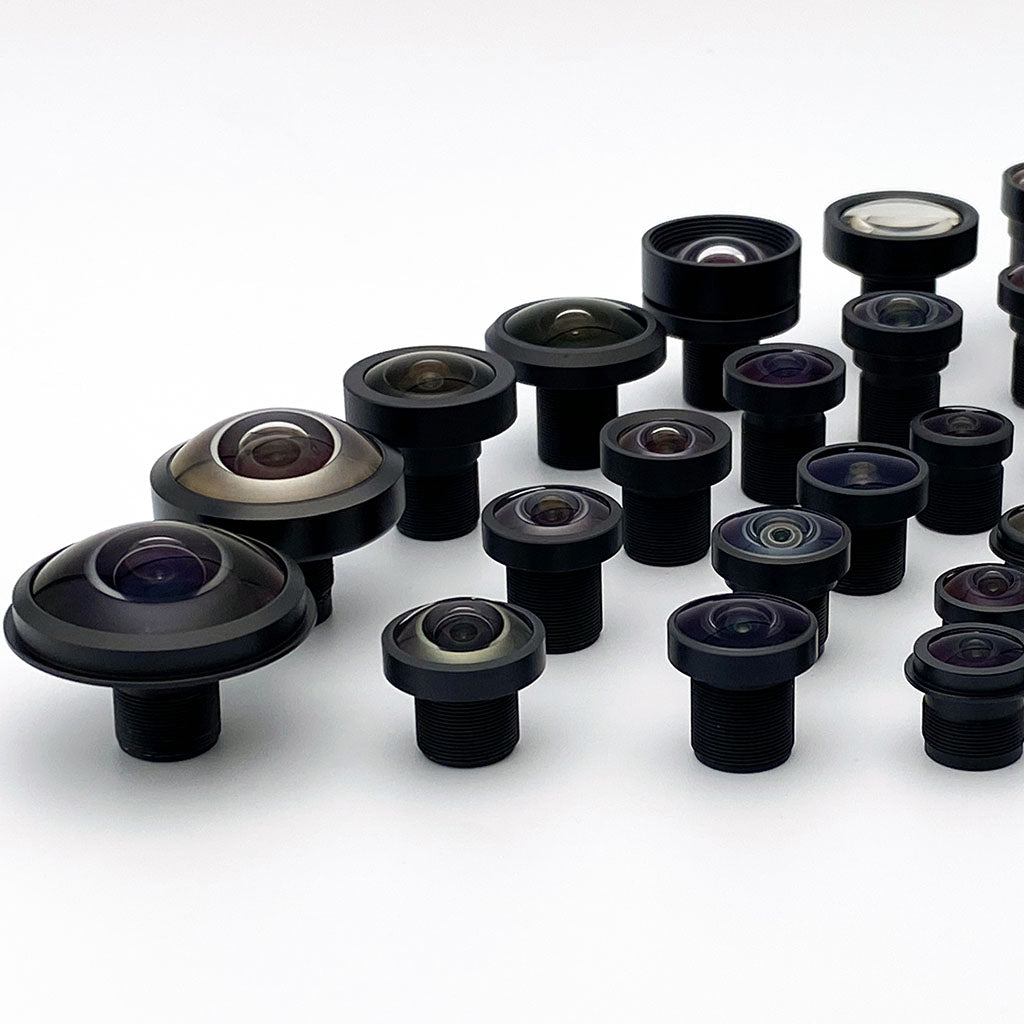

12+ Image Quality Metrics that Impact Computer Vision from the Embedded Vision Summit 2022
This guide collects our image quality series covering exposure, motion blur, HDR, resolution, noise, and the lens artifacts that travel with them.
The fourteen metrics below are exposure value, motion blur, dynamic range and HDR artifacts, noise, color and white balance, tone mapping, shading, resolution, image compression, distortion, texture blur, stray light, color fringing, and blemishes. Each one links out to the article, the slides, or the paper that covers it. This content was started for an Embedded Vision Summit talk on May 18, 2022 in Santa Clara, CA.
Quicklink to this page: commonlands.com/summit2022
The Image Quality and Computer Vision Topics
- Camera Exposure and Computer Vision
- Motion Blur
- High Dynamic Range
- Resolution and Sharpness
- Shading and Vignetting
- Noise
- Fisheye Distortion and Wide Angle Lenses
- Fringing and Chromatic Aberration
The Single Pixel Attack contextualizes why Image Quality matters
In the single pixel attack, researchers fooled a simple classification network by changing one pixel.
The attack turned a ship into a car, a horse into a frog, and a deer into an airplane.

Robustness testing at NREC reached the same conclusion from field data: nearly imperceptible image changes can flip a perception system's output with no attacker involved. The same logic extends to your camera hardware and image processing pipeline, which is why the metrics on this page matter to system accuracy, not just to how an image looks.
As Pezzementi et al. put it: "the natural world may be adversarial enough."
Pezzementi et al., NREC, "Putting Image Manipulations in Context: Robustness Testing for Safe Perception"
Exposure Value
Exposure sets how much signal reaches the sensor before gain touches it. The camera exposure guide covers exposure value, auto-exposure failure modes, and what clipping costs a detection network.


Motion Blur
Exposure time smears anything that moves during the frame. The motion blur guide covers blur extent, its cost to classification accuracy, and shutter and strobe countermeasures.

Dynamic Range and HDR Artifacts
Scenes with sun and shadow exceed what one exposure captures, and HDR capture brings artifacts of its own. The high dynamic range guide covers both failure modes.


Noise
Sensor noise can affect detection even when it is not visually objectionable. The effect depends on the model, task, and noise distribution. The image noise guide covers the noise chain. DOdge and Karam quantify the accuracy cost.

Color and White Balance
White balance changes the relative gains of color channels to compensate for illumination. Incorrect gains can shift object colors and reduce the reliability of a classifier trained under different lighting.
Mahmoud Afifi, Michael S Brown "What Else Can Fool Deep Learning? Addressing Color Constancy Errors on Deep Neural Network Performance "

Tone Mapping
Tone mapping compresses a scene's brightness range for display or further processing. It changes local or global contrast, so edges and intensity relationships can differ from the original linear image.
Yeganeh and Wang. Objective Quality Assessment of Tone-Mapped Images

Shading (Vignetting)
Shading is a gradual brightness or color change across the image caused by optics, illumination, or sensor response. Flat-field correction can reduce repeatable shading, but brightening a weak corner signal also amplifies its noise.

Resolution (Sharpness, Angular)
Resolution bounds what a network can localize, and megapixels alone do not describe it. The resolution guide separates pixel count, SFR, MTF, angular, and effective resolution.

Image Compression
Lossy compression removes image information to reduce file size or bandwidth. Blocking, ringing, and texture loss can alter the features a vision algorithm uses. Test accuracy at the intended compression settings.
Allen. "Image Quality Evaluation in Lossy Compressed Images."
Zheng et al. "Improving the Robustness of Deep Neural Networks via Stability Training"

Distortion (and Angular Resolution)
Distortion changes where each pixel's line of sight actually points, which matters more to geometry than to appearance. The distortion guide covers projection models and calibration.

Texture Blur/Resolution
Texture blur removes the fine detail texture-sensitive networks key on, even when edges stay sharp. Dodge and Karam measure the effect alongside noise and compression.

Stray Light
Unwanted light reaching the sensor can add a diffuse veil or distinct ghost images. These artifacts reduce scene contrast and may change with illumination angle. Control reflections and unwanted light paths in the lens and camera housing.
IEEE P2020 White Paper

Color Fringing
Chromatic aberration can put different wavelengths at different focus positions or image heights. The resulting color fringes and blur can affect edge detection. Demosaicing and saturation can also produce colored artifacts, so inspect the cause before selecting a correction.
Kang "Automatic Removal of Chromatic Aberration from a Single Image"
More on Chromatic Aberration from Imatest

Blemishes
Dust, scratches, and defective pixels can create localized marks in the image. Their effect depends on their position and the task. Inspect uniform bright and dark fields to distinguish persistent camera artifacts from scene detail.
Urcar "Let's Get Dirty: GAN Based Data Augmentation for Camera Lens Soiling Detection in Autonomous Driving"
More on Blemishes from Imatest

Get Started With Our Free Camera Calculators
Design Your Camera with Online Calculators
Wondering how to calculate the field of view or depth of field? Our calculators help you determine a lens and image sensor specification.


Working on a camera hardware project? What's your application?
Surveillance?
Our low F# high resolution lenses are candidates for 180° dome cameras, low light, and active IR illuminated scenes, matched against your sensor and CRA.
Aerial Robotics?
Our light-weight, miniature lenses suit collision avoidance and long-distance viewing once field of view and pixel coverage check out for your sensor.
Does it Require an IP65+ Lens?
We offer IP67 and IP69K (the industry shorthand for ISO 20653 IP6K9K) variants of select lenses. Each rating covers its tested lens variant as mounted, so qualify the installed assembly for your exposure.


Consumer / AR+VR?
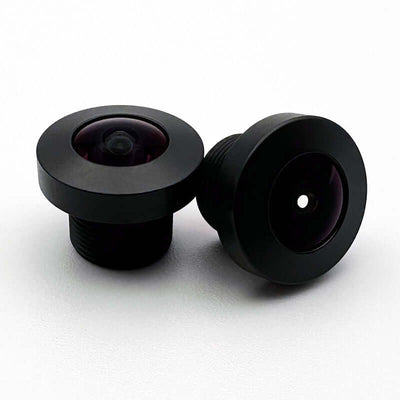
Our high resolution fisheye lenses support multi-camera 360° rigs (coverage depends on camera count, overlap, and stitching), and our stereographic-projection lenses give the natural edge rendering popular in action cameras.
Video Conferencing?
Low radial distortion reduces line bending, but wide rectilinear projections can still stretch faces near the frame edge. Evaluate people at the intended field positions and choose the projection and crop for the conferencing view.


Mobile Robotics?
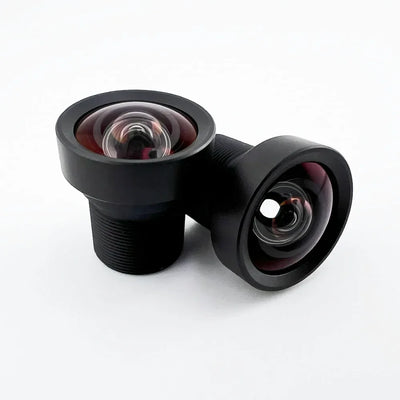
A low F# supports shorter exposures under fixed lighting, and low distortion cuts rectification work, when capture rather than compute is your bottleneck.
All specifications, online details, and drawings are subject to change without notice.
Looking for recommendations, trying to figure out where to start, or want to discuss customizations?
Contact our US-based optical engineers.