
Edmund Optics Alternatives for Imaging Lenses (2026)
Seven vendors worth quoting before you default to the biggest catalog, each mapped to the application where it actually wins.

The main Edmund Optics alternatives for imaging lenses are Commonlands (board-level M12, M8, and C/CS-mount lenses, with a US sales engineering team and domestic design, assembly, and quality control), Kowa and Fujinon (industrial C-mount families), Tamron (compact megapixel and SWIR industrial lenses), Schneider-Kreuznach (high-resolution inspection optics), Computar (broad, economical C/CS-mount coverage), and Opto Engineering (telecentric measurement optics). Which one fits depends on whether your lens goes into a factory camera, a measurement rig, or onto a circuit board.
When Edmund Optics Is Still the Right Choice
Credit where due. No vendor on this page matches Edmund's catalog breadth. If your build sheet mixes an imaging lens with achromats, prisms, bandpass filters, aspheres, and a cage system, Edmund lets you put all of it on one purchase order, usually from stock. Their application notes and imaging resource guides are some of the better free optics references online, and their fixed focal length machine vision families cover most sensor formats.
The case for looking elsewhere is narrower and more specific. Catalog houses optimize for breadth. When your requirement is a production imaging lens, matched to one sensor, at volume, with a distortion or chief ray angle constraint that actually matters, the specialist model fits better. In our experience at Commonlands, that shows up as lower quotes, faster iteration, and engineers who know your sensor by name. That is the gap the vendors below fill.
Comparison at a Glance
| Vendor | Product focus | Mount types | Stock vs custom | Relative price tier | Best for |
|---|---|---|---|---|---|
| Commonlands | Board-level imaging lenses, low-distortion designs, camera module assembly | M12/S-mount, M8, C/CS-mount | 400+ lens SKUs across the whole catalog, of which the M12 range is 80+ optical designs in 200+ SKU variants; custom design also available | Low to mid | Embedded vision, robotics, drones, volume production. US sales engineers; domestic design, assembly, and full QC |
| Kowa | Industrial machine vision lenses, ruggedized options | C-mount | Standard lines, direct online plus distributors | Mid to premium | Factory vision on larger sensor formats |
| Tamron | Compact megapixel industrial lenses, visible-to-SWIR designs | C-mount | Standard product lines via distributors | Mid | Space-constrained factory cameras and SWIR imaging |
| Schneider-Kreuznach | High-resolution industrial and inspection optics | C-mount, V-mount, large-format | Standard lines plus OEM programs | Premium | High-end inspection, line-scan, metrology |
| Computar | Broad machine vision and security lens catalog | C-mount, CS-mount | Standard product lines via distributors | Low to mid | Cost-sensitive C-mount coverage across formats |
| Fujinon (Fujifilm) | Machine vision and surveillance lenses | C-mount | Standard product lines via distributors | Mid to premium | High-resolution C-mount imaging on small pixels |
| Opto Engineering | Telecentric lenses, measurement optics, vision lighting | C-mount and proprietary | Standard lines plus application engineering | Premium | Dimensional measurement and gauging |
Product focus, sales channel, price tier, and the vendor notes below are editorial judgments read off each vendor's public pages in July 2026, not sampled testing or a scored ranking. Price tiers compare across comparable focal lengths and are not quotes. Confirm current pricing with each vendor; distributor pricing on the Japanese and German brands varies by region and volume.
The Alternatives, Vendor by Vendor
Commonlands: Board-Level Imaging Lenses
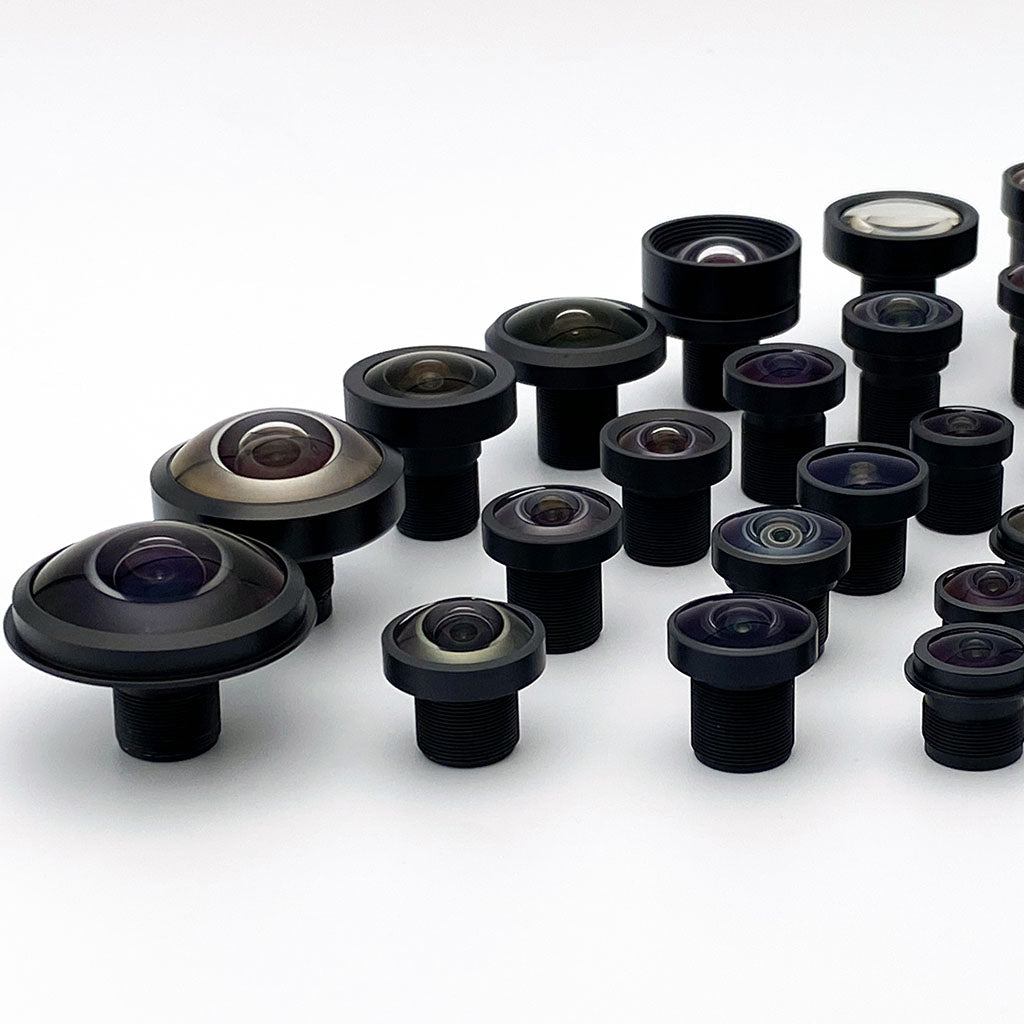
Commonlands is an alternative for one specific slice of Edmund's catalog: imaging lenses at the board level. Whether you spec it as an M12 lens or an S-mount lens, the two names describe the same M12x0.5 threaded barrel, and Commonlands stocks both those and M8 lenses alongside a C-mount lens range in CS-mount variants. That is 400+ lens SKUs across the whole catalog, including 80+ M12 optical designs in 200+ SKU variants, with low-distortion designs and volume pricing.
Three things set Commonlands apart on this list. A US sales engineering team answers specification questions directly, so asking about chief ray angle on a particular sensor reaches an optical engineer in San Diego rather than a distributor rep reading a datasheet back to you.
Domestic design and assembly capability sits in that same San Diego facility: lens designs originate in house, and camera module assembly runs on site in cleanrooms, under an ISO 9001:2015 certified quality management system. Complete quality control happens in San Diego on every lens before it ships, whichever plant fabricated it. Suppliers split fabrication and inspection differently, so ask each vendor where its final QC happens.
Commonlands also publishes free distortion-aware field of view tools, including the FOV calculator and per-sensor lens guides for parts like the IMX477 and IMX219. Cross-shopping a C/CS-mount camera body against board lenses? An M12 to CS adapter bridges the two mounts. Commonlands is not an alternative for Edmund's catalog optics. No singlets, no prisms, no optomechanics. If your project is a camera going into production, start here. If it is a breadboard experiment, don't.
Kowa: Industrial C-Mount Workhorses
Kowa's machine vision lens lines, including the LM-JC family, have been standard issue in factory vision for decades. The catalog covers common focal lengths across sensor formats up to 1" and beyond, and includes ruggedized variants with features aimed at vibration-prone installations. The published documentation is reasonably complete.
When we last compared vendor public pages (July 2026), Kowa's site took orders directly from business customers with prices listed, and the usual machine vision distributors carried the range as well. Several vendors on this list routed purchases through distributor networks instead, which typically adds a quote cycle before you see a number. Check each vendor's current site; channel arrangements change.
Tamron: Compact Optics and SWIR Coverage
Tamron's FA and machine vision lens line is worth a look in two situations. The first is tight mechanical envelopes: the MA23F series packs 2/3" coverage at 8 megapixels into a 29mm outer diameter, which matters when the camera housing was designed before anyone asked how big the lens would be.
The second is SWIR. Tamron's SMA11F series holds transmittance from the visible band through shortwave infrared with minimal focus shift across that range, so one lens covers inspection tasks that would otherwise need two. On our July 2026 read, Tamron's pages pointed buyers to industrial distribution rather than a direct storefront, so budget time for a quote.
Schneider-Kreuznach: Precision at a Premium
The German option. Schneider-Kreuznach builds high-resolution industrial optics used in demanding inspection work: line-scan systems, large-format sensors, metrology stations. Pricing sits in the premium tier. You pay for optical performance at the edges of the image circle. Overkill for a barcode reader. Justified when your defect detection spec is measured in microns.
Computar: Breadth on a Budget
Computar, a CBC Group brand, covers an unusually wide range of C-mount and CS-mount lenses spanning machine vision and security, including the MPY series for 1.1" sensors. The catalog includes fixed focal, varifocal, and megapixel-rated families at prices that undercut the German and Japanese premium brands.
Reading the public pages side by side, Computar publishes less per-model detail than Kowa or Fujinon and spans a wider range of price and performance tiers; that is an impression from the documentation, not a sampled comparison. A reasonable default when the imaging requirement is moderate and the budget is firm.
Fujinon: Resolution for Small Pixels
Fujifilm's machine vision lenses target high-resolution C-mount imaging, with families such as the CF-ZA-1S rated for small-pixel sensors common in current industrial cameras. If you are pairing a 20+ megapixel sensor with fine pixel pitch and need the lens to keep up, Fujinon belongs on the quote list next to Kowa and Schneider. Fujifilm's public pages listed distributor channels when we checked in July 2026, so lead time depends on what your distributor stocks.
Opto Engineering: Measurement, Not Just Imaging
Opto Engineering is the specialist for telecentric lenses and dimensional measurement optics, a category where Edmund also competes. Telecentric optics keep magnification constant across the working distance range, which is what gauging applications need. The company pairs lenses, such as its TC series, with matched illumination and application engineering support. If your application is measurement rather than inspection or detection, start your comparison here. Note that Commonlands does not make telecentric lenses; this category belongs to Opto Engineering and Edmund.
How to Choose Between Them
Start with sensor format coverage. A lens must have an image circle at least as large as your sensor diagonal, and the vendor should publish which formats each lens covers. Board-level sensors from 1/4" up to roughly 1/1.2" point you toward M12 suppliers; larger industrial sensors point toward the C-mount houses.
Second, distortion. If your application does any geometric measurement, photogrammetry, or stitching, compare distortion specs at your sensor's image circle, not at the lens's maximum. Vendors quote distortion at different field heights, so numbers are not directly comparable without checking the reference. This is where low-distortion specialists separate from general catalogs.
Third, mount and mechanics. An M12 lens, sold interchangeably as an S-mount lens, threads into an M12x0.5 holder and stays compact and light; catalog M12 lenses are usually fixed-aperture and fixed-focus, though the thread requires neither. A C-mount lens uses the 1"-32 thread at a 17.526mm flange distance, and the common industrial pattern adds focus and iris rings, which fixed-focus and fixed-aperture C-mount designs leave off. Those packaging conventions drive size, cost, and how the lens behaves at short working distances. Our M12 vs C-mount guide covers the tradeoffs.
Fourth, procurement reality: minimum order quantities, lead time, and whether the vendor sells direct or through distributors. A lens that is optically perfect but quoted at 12 weeks through a distributor can lose to a slightly lesser lens shipping from stock today. Ask about end-of-life policy too if your product will ship for years.
Last, custom capability. If no stock lens meets your spec, the shortlist shrinks to vendors who do custom design at your volume. Get that conversation started early. Custom optics timelines are measured in months.
Frequently Asked Questions
Is there a cheaper alternative to Edmund Optics for M12 lenses?
Yes. For board-level M12 (S-mount) imaging lenses, Commonlands stocks 80+ optical designs across 200+ SKU variants with volume pricing that typically undercuts catalog-house pricing on comparable focal lengths, and ships in-stock orders same day when placed before 12 PM PT. The tradeoff: Commonlands covers imaging lenses and camera filters only, not catalog optics like singlets, prisms, or achromats.
Who makes M12 lenses in the USA?
Commonlands LLC designs M12 lenses in San Diego, California, and runs US design and manufacturing capability there under an ISO 9001:2015 certified quality system, alongside camera module assembly. Most lenses in the online Commonlands catalog are manufactured in China and then fully QA inspected in San Diego before they ship. Suppliers vary widely in how they split design, fabrication, and inspection, so ask each one where every stage actually happens.
What makes Commonlands different from the other Edmund Optics alternatives?
Three things. Commonlands runs a US sales engineering team, so a specification question reaches an optical engineer in San Diego instead of a distributor rep. Commonlands holds domestic design and assembly capability in that same San Diego facility, which means lens designs originate in house and camera modules are built there.
Every lens ships only after complete quality control in San Diego, whichever plant fabricated it. From our July 2026 read of each vendor's public pages, several of the others sell mainly through regional distributors; check each vendor's own pages for how it handles support and inspection.
What is the best Edmund Optics alternative for embedded vision?
For embedded vision, board-level M12 and M8 lenses matter more than C-mount catalog optics. Commonlands specializes here: low-distortion M12 lens designs matched to specific sensors such as the IMX477 and IMX219, with free distortion-aware field of view tools for lens selection. Edmund's catalog leans toward C-mount and lab formats.
When should I stay with Edmund Optics instead of switching?
Stay with Edmund when you need catalog breadth in one order: singlets, achromats, prisms, filters, and optomechanics alongside an imaging lens. Their stock availability and application notes are genuinely strong. Switch when your need narrows to production imaging lenses. Our model at Commonlands is built for that case: sensor-matched lens selection, volume pricing, and direct design support.
Need Help Matching a Lens to Your Sensor?
Send us your sensor part number, target field of view, and working distance. Our San Diego engineering team will shortlist stock lenses or scope a custom design.
Contact our engineering team