
NIR Imaging for Machine Vision: 850nm vs 940nm, Bandpass Filters, and IR-Corrected Lenses
Near-infrared reveals contrast that visible light misses. This guide covers how to pick between 850nm and 940nm and what the complete filter-lens-illumination stack requires.

850nm LEDs produce a faint visible red glow. 940nm shows none under normal conditions. On many silicon sensors, quantum efficiency at 940nm runs near half of the 850nm value, sometimes lower, so check the specific sensor's QE curve before sizing illumination. The wavelength section below covers what that means for power and exposure.
Use a bandpass filter when the system needs to reject unwanted ambient light. If visible and NIR images must share one focus setting, check the lens's correction across both bands.
850nm vs 940nm: How to Choose the Right NIR Wavelength
Choose 850nm when a faint glow is acceptable and detection range or exposure time is the binding constraint. Choose 940nm when the illuminator must show no visible glow to people, or when the system runs in bright daylight where suppressing ambient NIR matters more than sensor quantum efficiency. Commonlands stocks matched bandpass filters for both wavelengths.
850nm: higher sensor QE with a faint visible glow
Silicon CMOS sensors have higher quantum efficiency at 850nm than at 940nm, so for the same drive power an 850nm source typically gives more usable signal, supporting shorter exposures or lower illumination power. The tradeoff is glow: the CIE photopic curve is tabulated to 780nm, so 850nm sits past the edge of human vision, but deep-red response fades gradually rather than stopping there, and an 850nm LED emits a short-wavelength tail into that fading region. At high drive currents this glow is detectable in dark environments.
940nm: no visible glow but lower silicon QE
940nm sits far enough outside the eye's response that it produces no perceptible glow under normal conditions. The cost is sensor response: silicon QE at 940nm is commonly around half or less of its 850nm value, varying by sensor. A 940nm system therefore needs more power, longer exposure, or both to reach the signal-to-noise ratio an 850nm system achieves at the same range. Before committing a high-throughput line, verify this margin against the actual sensor QE curve, LED radiant power at drive current and temperature, and filter transmission.
Atmospheric and outdoor considerations
Outdoors, ambient sunlight carries strong NIR that competes with active illumination. Atmospheric water vapor absorbs solar radiation in a band around roughly 930nm to 970nm, which suppresses ground-level solar irradiance at 940nm relative to 850nm. That is a large part of why 940nm suits outdoor systems such as driver monitoring and face recognition: the ambient background is lower, partly offsetting the QE penalty. Background near 850nm can be stronger than in the atmospheric absorption region around 940nm. Compare the actual filter bandwidth, solar conditions, sensor response, and target reflectance.
| Criterion | 850nm | 940nm |
|---|---|---|
| Sensor quantum efficiency | Higher, with a stronger signal per watt of illumination | Lower, commonly around half of the 850nm value or less. Verify per sensor |
| Visible glow | Faint red glow visible in dark environments | No perceptible glow under normal conditions |
| Illumination power needed | Lower for a given signal level | Higher, to close the sensor quantum efficiency gap |
| Typical use case | Industrial inspection, barcode reading, traffic monitoring where glow is acceptable | Covert or human-facing installations where illuminator visibility is unacceptable |
| Matching single-bandpass filter | CBP850 | CBP940 |
| Matching dual-bandpass filter | CDB850 | CDB941 |
These filters are not interchangeable: a 940nm bandpass filter blocks 850nm illumination and produces a dark image if paired incorrectly. See bandpass filter machine vision for how center wavelength and passband width factor into the selection.

What NIR Imaging Means in Machine Vision
In silicon machine vision, NIR means roughly 700nm to 1000nm, just beyond visible red: the band where silicon still responds. Optical convention runs NIR out to about 2500nm, which extends beyond silicon's response. Standard InGaAs commonly reaches about 1700nm. Operation near 2500nm needs an extended-range device or another detector specified for that band. In machine vision the term almost always means active illumination at 850nm or 940nm paired with a camera set to detect that band, not ambient infrared or thermal imaging.
Switching to NIR moves four elements of the optical stack together:
- The IR-cut filter must be out of the optical path. It typically blocks wavelengths above roughly 650nm, a design-dependent boundary, and stops NIR from reaching the sensor.
- The lens must transmit the NIR wavelength, and its focus plane shifts between visible and NIR unless the lens is IR-corrected.
- A bandpass filter matched to the wavelength rejects ambient visible light and improves signal-to-noise ratio.
- The sensor needs meaningful quantum efficiency at the target wavelength. Silicon QE drops significantly above 850nm.
Removing the IR-cut filter and switching on an LED, with nothing else changed, is not enough. The image comes out dim, soft, or noise-limited. Most machine vision NIR is active: a dedicated illuminator with a matched bandpass filter controls wavelength and intensity independent of ambient light. Passive NIR relies on ambient NIR already in the scene, and becomes impractical when that signal is too weak for the required exposure and SNR. Night scenes may still contain moonlight or artificial NIR.
See the Commonlands image sensor selection guide for how NIR response weighs against resolution, pixel size, and shutter type.
Why NIR Reveals Contrast That Visible Light Misses
NIR imaging is useful because reflectance, transmission, and absorption vary with wavelength, so many materials look different in NIR than under white light. That difference is the entire basis for NIR machine vision, not a general-purpose upgrade to image quality.
Inks and printed graphics
Carbon-based inks absorb visible light and stay dark. That absorption carries into the NIR band, so carbon-ink printing keeps its contrast against the substrate under 850nm or 940nm. Many dye-based inks that look opaque black to the eye are largely transparent in NIR, so a barcode printed in dye-based ink can effectively disappear in a 940nm image, revealing the substrate beneath.
That cuts both ways: disappearing ink helps when inspecting a feature under a label, but it defeats an OCR or print-verification system reading dye-based characters. Carbon-based ink does not have this problem. Verify ink composition on the actual production substrate before committing to a wavelength.
Surface glare and coatings
Specular reflections from glossy or metallic surfaces saturate visible pixels when ambient light is not controlled. Narrow-band NIR with a matching bandpass filter rejects the broadband visible glare, so the sensor mainly captures the NIR scattered from the surface. It does not remove specular reflection from the NIR source itself, but it removes the visible glare that dominates typical factory lighting.
Thin films and coatings that look uniform under white light can show different NIR reflectance by composition or thickness. Biological and food-grade materials often show NIR contrast tied to water content, which is why NIR appears in fill-level inspection, food sorting, and pharmaceutical packaging.
What NIR does not do
NIR is not universally better than visible. Color discrimination and legibility of visible ink are usually better served by visible light. NIR does not penetrate opaque materials the way X-ray does, and useful penetration depth varies by material and must be validated on real samples. A datasheet contrast difference does not guarantee the same result on production parts.

Where NIR Imaging Shows Up in Production Systems
NIR imaging shows up wherever visible-light contrast fails on a specific material pairing, which clusters around a few recurring problems.
Traffic and license-plate systems are among the most common deployments. Retroreflective plate coatings return a strong signal under 850nm synchronized with a short exposure, which can improve plate contrast. In-band ambient light, glare, and saturation can still limit the result. Because these run day and night, they are the most common use for the Commonlands CLA216-ICR-850BP switcher: color video by day, 850nm NIR at night, one camera. See lenses for traffic monitoring for lens selection.
Barcode reading uses NIR when the code is carbon-based ink on an NIR-reflective substrate, or when ambient lighting is uncontrolled. Robotics platforms near people sometimes pick 940nm so the illumination shows no visible glow to bystanders. Quality-inspection lines for packaging and seals use NIR to reveal defects invisible in the visible band, running single-bandpass under controlled illumination.
Filters, Lenses, and Switching Architectures for NIR Systems
Beyond sensor and illumination choice, an NIR system needs three hardware decisions: filter type, lens IR correction, and whether it must switch between visible and NIR modes at all.
Filter selection
The IR-cut filter is the most misunderstood element: it blocks NIR and must be out of the optical path, but removing it is necessary, not sufficient, because without a bandpass filter the sensor still sees ambient visible light. A single bandpass filter passes only the illumination band.
A dual-bandpass filter passes a visible and an NIR window at once for RGBIR (red, green, blue, infrared) sensors. The filter does no separating on its own, but the system still can: an RGBIR sensor separates the bands by pixel, and differencing illuminator-on and illuminator-off frames can isolate the changing active-light contribution. Scene motion, flicker, and ambient changes limit that method. It does not separate all visible light from all NIR. An electronic switcher separates them optically, moving an IR-cut and a bandpass filter in and out.
When lens IR correction matters
If a system runs only in NIR, focus at the NIR wavelength and IR correction is unnecessary. If it must stay sharp at both visible and NIR from one focus position (day/night cameras, RGBIR sensors, dual-mode inspection), an IR-corrected lens is required. A standard lens has chromatic focus shift between visible and NIR from dispersion in the glass. Removing the IR-cut filter does not close that gap, since the shift is in the lens design, not the filter.
Sensor selection
Not every sensor is a good NIR candidate. Many consumer and some machine vision sensors have an NIR-blocking layer in the pixel stack itself, independent of any external IR-cut filter, capping sensitivity at 850nm and 940nm. Pull the sensor's spectral QE curve and read the value at each wavelength rather than assuming a generic silicon response. RGBIR sensors often use a dual-bandpass filter to define the NIR passband, or leakage degrades daylight color.
Commonlands NIR Imaging Components
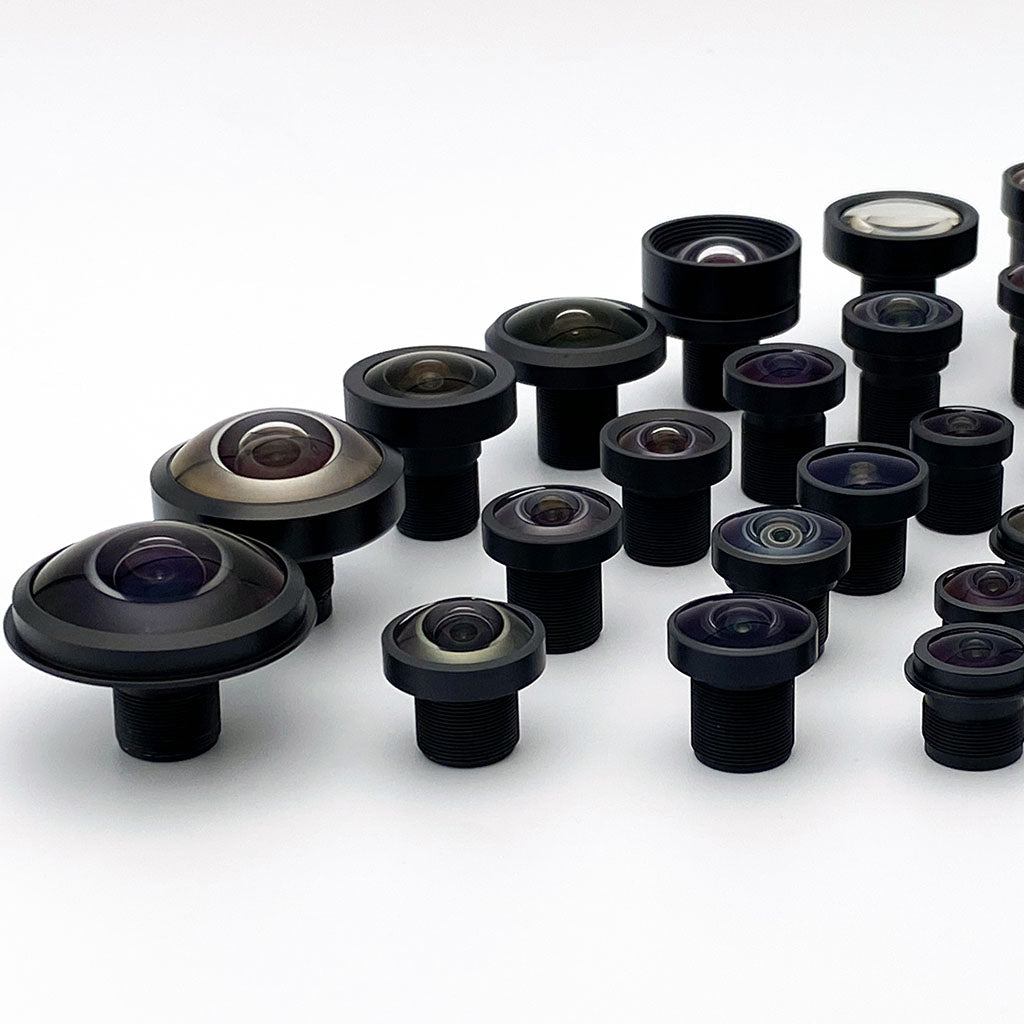
Commonlands stocks IR-corrected M12 lenses, 850nm and 940nm single-bandpass filters, and an electronic filter switcher for NIR systems. The six Commonlands parts below cover 850nm and 940nm builds, ordered for dual-mode systems that must stay sharp in visible and NIR from one focus position. An NIR-only build focuses once at the illumination wavelength, skips the IR-corrected lens, and starts at the bandpass filter.
| Rank | Component | Type | Key spec | Best for |
|---|---|---|---|---|
| 1 | CIL122 | IR-corrected M12 lens | 12mm EFL, F/2.0, 1/1.7in 8-12MP | Day/night and dual-mode systems that must stay sharp in visible and NIR from one focus position |
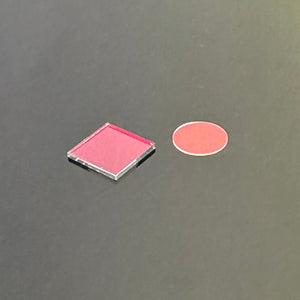
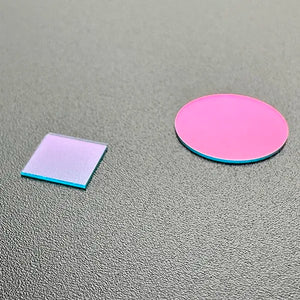
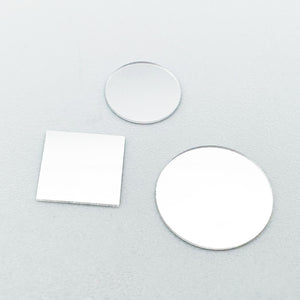
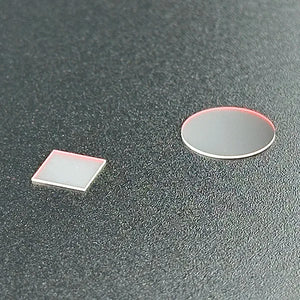
| 2 | CBP850 | 850nm single-bandpass filter | Passes 850nm, blocks visible. 7.0mm circular, 0.3mm thick | 850nm active illumination where a faint LED glow is acceptable and higher sensor QE matters |
| 3 | CBP940 | 940nm single-bandpass filter | T>90% at 940nm, blocks the visible band | Covert or human-facing 940nm systems where no visible glow is allowed |
| 4 | CLA216-ICR-850BP | Electronic IR-cut / 850nm bandpass switcher | IR-cut and 850nm bandpass in one moving holder, 7.6mm height | Single-camera day/night with specified out-of-band attenuation. Verify focus in each filter state |
| 5 | CDB850 | Dual-bandpass filter (visible + 850nm) | Passes a visible window and an 850nm window in one fixed element | Switcherless day/night on RGBIR sensors at 850nm, no moving parts |
| 6 | CDB941 | Dual-bandpass filter (visible + 940nm) | Passes a visible window and a 940nm window in one fixed element | Switcherless day/night on RGBIR sensors at 940nm, no visible glow |
The order follows build sequence, not price: in a dual-mode system chromatic focus shift originates in the lens glass and cannot be filtered out afterward, and a bandpass mismatch can reduce useful signal. Compare the full illumination spectrum, filter transmission, sensor quantum efficiency, exposure, and aperture to identify the dominant loss. MidOpt (midopt.com) and Edmund Optics also sell bandpass and dual-bandpass lines outside the Commonlands filter range.
Use the field of view calculator for the lens field angle, then check that angle against the illuminator's measured beam distribution over the working plane. The calculator describes the lens. It says nothing about the illuminator's angular irradiance profile.

Technical references
Frequently Asked Questions
What is the difference between 850nm and 940nm in machine vision?
Silicon sensors often have higher QE at 850nm, while 940nm emitters generally reduce visible red glow. Visibility still depends on emitter spectrum, intensity, and viewing conditions. Compare sensor QE, filter transmission, source output, target reflectance, and ambient light at both wavelengths. Those factors determine the signal and exposure needed.
What is NIR imaging in machine vision?
NIR imaging uses near-infrared wavelengths, typically 850nm or 940nm, to illuminate and image a scene outside the visible band. An active NIR system uses an NIR-sensitive sensor, optics that transmit the intended band, an NIR illuminator, and any required bandpass filter. Passive NIR imaging uses ambient radiation and needs no dedicated illuminator. For visible/NIR operation without refocusing, verify chromatic focus shift against the system sharpness requirement.
When should engineers use NIR imaging instead of visible light?
Use NIR when visible light does not give enough contrast on the target: printed graphics where ink and substrate share similar visible reflectance, specular glare from glossy surfaces, coatings that look uniform under white light but vary in NIR, or unpredictable ambient lighting. NIR is not always better. Validate that the real materials produce the expected NIR contrast first.
What filters are used for NIR imaging?
Three filter types appear in NIR systems. A bandpass filter centered near 850nm or 940nm passes a finite wavelength band and attenuates light outside it. Specify its bandwidth, transmission, and out-of-band blocking. A dual-bandpass filter passes a visible window and an NIR window at once in one fixed element, used for switcherless day/night on RGBIR sensors. An electronic switcher moves an IR-cut filter and a bandpass filter in and out for true day/night separation.
Do I need an IR-corrected lens for NIR imaging?
If the system operates only in NIR, focus at the NIR wavelength and correction is not required. If it must also image sharply in visible light from the same mechanical focus position, an IR-corrected lens is required. A standard lens has chromatic focus shift between visible and NIR. Removing the IR-cut filter does not fix it, because the shift is in the glass, not the filter.
Need Help Designing an NIR Imaging System?
Describe the sensor, working distance, illumination wavelength, and inspection goal. Commonlands engineering can help you choose between 850nm and 940nm, match a bandpass or dual-bandpass filter, and pair it with an IR-corrected M12 lens.