
Lenses for Intelligent Transportation Systems: Focal Length, Iris Control, and Plate-Pixel Requirements
ITS lens selection comes down to focal length, iris control, and pixel density. Those three variables set the outcome for traffic monitoring, LPR/ANPR, speed cameras, smart-city intersections, and tolling.

Intelligent transportation systems (ITS) span traffic monitoring, license plate recognition, speed enforcement, smart-city intersections, and tolling. These are outdoor imaging problems at a finite working distance, typically 10 to 50 meters from camera to target. Most deployments use a C-mount lens in the 12mm to 75mm range for its telephoto reach, adjustable iris control, and high-resolution sensor coverage.
Derive focal length from mounting distance, required scene width, and sensor format rather than guessing. For license plate reads, the lens also has to put enough pixels on each character and pair with a fast shutter and NIR illumination. Telephoto alone cannot fix motion blur or contrast.
What Does an ITS Camera Need From a Lens?
An ITS lens has to resolve detail at a fixed, known distance, hold focus across a wide temperature swing, and manage light that runs from headlight glare to pre-dawn darkness. Commonlands specs traffic monitoring, LPR/ANPR, speed enforcement, and tolling optics against this shared finite-working-distance geometry, which separates ITS optics from the general outdoor surveillance covered on the lenses for surveillance page.
The camera targets a scene at a defined range, usually 10 to 20 meters at close pole mounts and further for highway ANPR or tolling gantries. The lens is set to that focus distance, and its depth of field must span the vehicle positions in the lane, unlike a security camera focused near infinity.
Even a 15 to 20 meter distance needs more focal length than typical embedded vision: longer lenses isolate the target lane and put more pixels on each vehicle, which lifts classifier and OCR performance. Roadside mounts also vibrate and cycle through temperature, which shifts focus over a deployment, so mechanical stability decides reliability alongside the optical formula.

Why Is C-Mount the Standard Format for ITS Cameras?
C-mount covers the focal-length range the job requires (4mm to 75mm and beyond), adds an adjustable iris ring for exposure and depth-of-field control, and uses the 1"-32 UN thread at a 17.526mm flange distance that fits most industrial cameras. Commonlands C-mount lenses reach sensor formats up to 1.2" and resolutions up to 25MP, which covers current multi-lane ANPR imagers. M12 stays the better fit for compact embedded nodes where size outweighs iris control.
Adjustable Iris: The Key C-Mount Advantage for ITS
An adjustable iris is useful when the installation needs to change aperture. A fixed-aperture system can also work if it meets the exposure and depth-of-field requirements across the expected lighting range. Traffic cameras face direct headlights at night, reflective road surfaces by day, and foreground vehicles several stops brighter than the background.
An iris does not widen the sensor's dynamic range, since it attenuates bright and dark regions together. That spread belongs to HDR readout, exposure strategy, illumination, and flare control. What the iris buys is an optical operating point: a base aperture balancing depth of field against light throughput instead of leaning on camera gain.
How Do Engineers Choose Focal Length for Traffic Monitoring?
Focal length comes from three inputs: sensor dimension, working distance, and required scene width. The formula is a far-conjugate approximation, exact only in the pinhole rectilinear ray model, and it should agree with the Commonlands EFL calculator.
A 2/3" sensor (about 8.8mm horizontal) 15 meters from a lane that needs a 5-meter scene width gives EFL = (8.8 × 15,000) / 5,000 = 26.4mm, so a 25mm lens is the match. For an 8.8mm-wide sensor at 20m, changing EFL from 25mm to 35mm reduces the estimated scene width from 7.04m to 5.03m. Confirm the focal length and scene geometry before ordering.
As a rough map, 12mm gives a wide intersection or approach overview at close range. 25mm covers one or two lanes at 10 to 20 meters and is the default for most pole mounts. 50mm reaches speed-enforcement plate reads and moderate-range ANPR at 20 to 30 meters, and 75mm handles long-range, bridge-mounted, and tolling work past 30 meters. Reach comes at the cost of a narrower field, higher aiming sensitivity, and more thermal-drift risk.
Longer Focal Lengths Increase Aiming Sensitivity
Aiming sensitivity climbs with focal length. At 15 meters a 1-degree error shifts the boresight about 260mm regardless of focal length, but a 75mm lens framing a narrow scene loses a real fraction of its field to that shift, while a 25mm lens barely notices it. A rigid mount and a thermally stable enclosure matter more as focal length grows. See working distance in machine vision lenses.
What Lens Should You Use for License Plate Recognition?
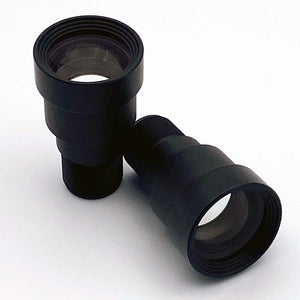
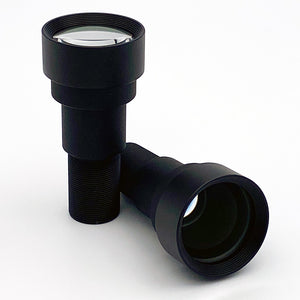
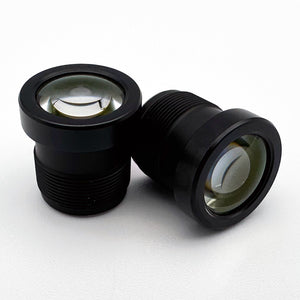
Choose a fixed focal length long enough to keep plate characters large on the sensor at the working distance. For a 20 to 50 meter standoff, a 50mm telephoto M12 lens such as the CIL051 is a proven start. For longer range or when iris control matters, the 75mm C-mount CIL579 adds an adjustable F/3-F/20 aperture for depth-of-field control.
ANPR software reads characters from pixel data and cannot infer what the sensor never resolved. The chain has to deliver four things: enough pixels on the plate (a widely used minimum is 20 to 30 pixels across the height of a character, below which B/8, O/0, and I/1 turn unreliable), sharp focus across the plate distances in the lane, motion blur held to a small fraction of a character stroke, and contrast from matched NIR illumination and a bandpass filter.
Sizing Focal Length and Pixels on Target
Verify pixels per character on the vertical axis: pixels per character = sensor_pixels_V × character_height / FOV_height. Character height, not plate width, is what the OCR minimum is stated against, so do not divide plate-width pixels by character count. As a worked case, a 1/2.3" 12MP sensor (4000px wide) at 25m behind a 50mm lens frames a 3.0m corridor at about 1.30 px/mm, so a 70mm character gets roughly 91 pixels and clears the 20-30px minimum.
Round down to the next stock focal length for general monitoring to keep the scene in frame. Round up for plate reading to add pixels, after confirming the narrower field still covers the corridor where plates pass.
Why Telephoto Alone Can Still Fail
Telephoto magnifies the scene, so it magnifies motion blur along with it. At 100km/h, a vehicle moves 27.8mm in 1ms. If that motion is transverse to the viewing axis and a 1920-pixel image covers 5m, the smear is about 10.7 pixels. Use projected image motion for the actual camera angle. A short NIR strobe can limit blur when it dominates ambient light and the required pixels integrate the full pulse.
Longer lenses also shorten depth of field. A C-mount lens can stop down to recover it, but only until diffraction takes over. Confirm the diffraction limit against your pixel pitch at the operating wavelength rather than a fixed F-stop. See how to choose focal length for the depth-of-field math.
A co-located NIR illuminator falls off with the inverse square of distance, so doubling working distance needs about four times the power, paired with an IR bandpass filter to suppress headlight glare.
How Do Glare, Headlights, and Low Light Affect ITS Lens Choice?
Fast Aperture and Headlight Glare
A fast lens (F/1.4 or F/2.8) lowers the minimum illumination for a clean image. The F/1.4 CIL522 and CIL525 suit low-light ITS work, though wide open the depth of field is shallow and aberrations and vignetting are largest. Headlights bloom when they saturate the sensor, and a wide aperture gets there sooner. Stopping down dims the whole frame, headlight peaks included, pulling highlights back under saturation at the price of scene light.
The adjustable iris on the CIL579 (F/3 to F/20) sets that exposure floor without touching camera gain, but stopping down must be evaluated against the required MTF and depth of field. At 550nm, an F/3 Airy disk is about 4µm across. At 850nm it is about 6.2µm. Those diameters are diffraction references, not a hard optimum: reducing aberrations can still improve contrast at some spatial frequencies.
Stopping down still buys depth of field, in proportion to the working F-number, paid for in light and resolution, so set exposure and strobed NIR illumination first. If one camera must hold focus across both visible and NIR, confirm the lens is IR-corrected. A channel imaging only in its NIR band can instead be focused for that band.
Shutter, Thermal Drift, and Sealing
Prefer a global shutter for fast vehicles under ambient exposure, since rolling readout skews and smears plates as the frame is scanned. A rolling-shutter camera can work when its readout skew stays within the task tolerance, when motion compensation is adequate, or when a strobe illuminates a shared integration interval under low ambient light. See global shutter vs rolling shutter.
Outdoor mounts also drift focus over a 30 to 40 degree Celsius day-night cycle, so check thermal drift against the depth-of-focus budget and validate enclosure sealing for dust, rain, and humidity.
Top Lenses for ITS and License Plate Recognition
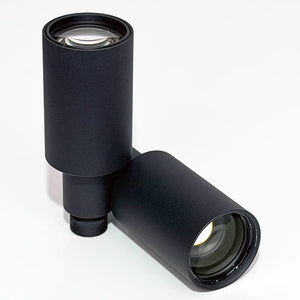
For most ITS and license plate recognition cameras, a Commonlands C-mount prime in the 12mm to 75mm range covers the job: the 25mm CIL525 for general lane monitoring, the 50mm CIL536 for speed-enforcement plate reads, and the 75mm CIL579 (adjustable iris) for long-standoff tolling. On embedded camera boards, the 50mm CIL051 telephoto M12 lens handles compact LPR at 20 to 50 meters. Size focal length against your mounting distance and sensor with the field-of-view calculator before ordering.
| ITS task | Lens | Mount | EFL | Iris | Why this pick |
|---|---|---|---|---|---|
| License plate recognition (embedded, 20-50m standoff) | CIL051 | M12 | 50mm | Fixed | 0.1% TV distortion keeps character geometry clean, and the M12 body fits directly on embedded LPR cameras. The 35mm CIL350 covers shorter parking and entry-lane reads. |
| Traffic monitoring and lane occupancy (10-20m) | CIL525 | C-mount | 25mm | F/1.4 | Balanced field of view and magnification for one or two lanes, with an F/1.4 floor for low light. The 12mm CIL522 widens to a full intersection overview. |
| Speed enforcement (plate read at trigger frame) | CIL536 | C-mount | 50mm | F/2.8 | Rated to resolve 12MP on a sensor with 1.85µm pixels. Paired with that camera at 20 to 30 meters, the geometry still leaves enough pixels per plate character to survive a strobe-frozen citation frame. |
| Tolling gantry (long standoff, angled mount) | CIL579 | C-mount | 75mm | F/3-F/20 adjustable | The adjustable F/3-F/20 iris controls exposure and depth of field across varying vehicle height. Select the aperture from measured MTF through the required depth range. The two-pixel Airy-disk diameter is not a hard sharpness optimum. Its 9.4mm designed image circle covers 1/1.7" to 1/1.8" sensors, so a 2/3" camera needs a different part. |
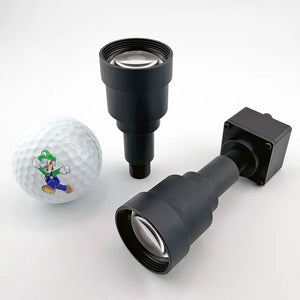
When one camera must cover several standoff distances or the geometry is not fixed, a motorized varifocal CCTV lens from a vendor like Computar or Fujinon fits better than a fixed prime, since a fixed focal length wins only once distance and framing are locked. A varifocal is not parfocal, though: each zoom position needs refocusing, and pixel-based calibrations such as plate corridors and speed baselines must be redone per setting. Browse the telephoto M12 lens collection for longer-reach embedded options.

Frequently Asked Questions
What lens is best for ITS traffic monitoring cameras?
A C-mount lens in the 12mm to 75mm range covers most ITS deployments. Intersection and approach-overview cameras sit at the short end, 4mm to 12mm. Plate reading, speed enforcement, and tolling sit at the long end, 25mm to 75mm. Commonlands recommends C-mount over M12 for outdoor ITS because it offers adjustable iris control and longer focal-length reach.
What lens should I use for license plate recognition?
Choose a fixed focal length long enough to keep plate characters large on the sensor at the required working distance. For standoff distances of 20 to 50 meters, a Commonlands 50mm telephoto M12 lens such as the CIL051 is a proven starting point. For longer distances or when iris control matters, a 75mm C-mount lens such as the CIL579 gives adjustable F/3-F/20 aperture for depth-of-field control. Calculate the required focal length from plate size, sensor size, working distance, and minimum pixels per character before selecting.
Why are C-mount lenses common in ITS traffic monitoring?
Traffic cameras operate outdoors over working distances of roughly 10 to 50 meters and must handle bright midday sun, direct headlights at night, and low ambient light in the same deployment. An adjustable iris ring lets engineers stop down to control depth of field and reduce headlight glare without changing the camera body. Compare actual lens candidates for the needed telephoto coverage. Commonlands also lists M12 focal lengths up to 100mm, so long focal length alone does not determine the mount choice.
How many pixels should be on a license plate for reliable OCR?
A widely used minimum is 20 to 30 pixels across the height of a plate character. Below that, ambiguous characters such as B/8, O/0, and I/1 tend to become unreliable, though the exact threshold depends on contrast, blur, compression, and the OCR algorithm. Compute pixels per character directly from the vertical axis: sensor_pixels_V × character_height / FOV_height. A horizontal pixel allotment across plate width divided by character count is not the same measurement and should not be compared against a height-based OCR minimum.
How do glare, headlights, and low light affect ITS lens choice?
A faster lens (lower F#, such as F/1.4) collects more light at night but risks headlight overexposure wide open. Stopping down dims the whole frame, headlight peaks included, and can cut aberration blur, but diffraction grows as the aperture shrinks, so stop toward the diffraction limit for your pixel pitch at the operating wavelength. The 850nm Airy diameter is about 55% larger than at 550nm. An IR-corrected lens matters when one focus must hold across visible and NIR. An NIR-only channel can be focused for its band.
Related Resources
These Commonlands technical guides cover the mount, focal-length, working-distance, and sensor decisions behind an ITS lens spec.
- What is a C-mount lens?Thread standard, flange distance, and sensor format coverage.
- M12 vs C-mount vs CS-mountSide-by-side comparison of the machine vision mount standards.
- How to choose focal lengthSelection from sensor size, working distance, and field of view.
- Working distance in machine vision lensesHow working distance interacts with focal length and depth of field.
- Image sensor selection for machine visionSensor format, pixel pitch, shutter type, and resolution matching.
- Camera field-of-view calculatorField of view from sensor format, focal length, and working distance.
Need Help Sizing an ITS Lens?
Sensor format, aperture range, thermal stability, and shutter compatibility all affect whether an ITS camera performs reliably across a full deployment cycle. Commonlands engineers can review your working distance, sensor, and plate-pixel requirements and recommend the right focal length and mount type.