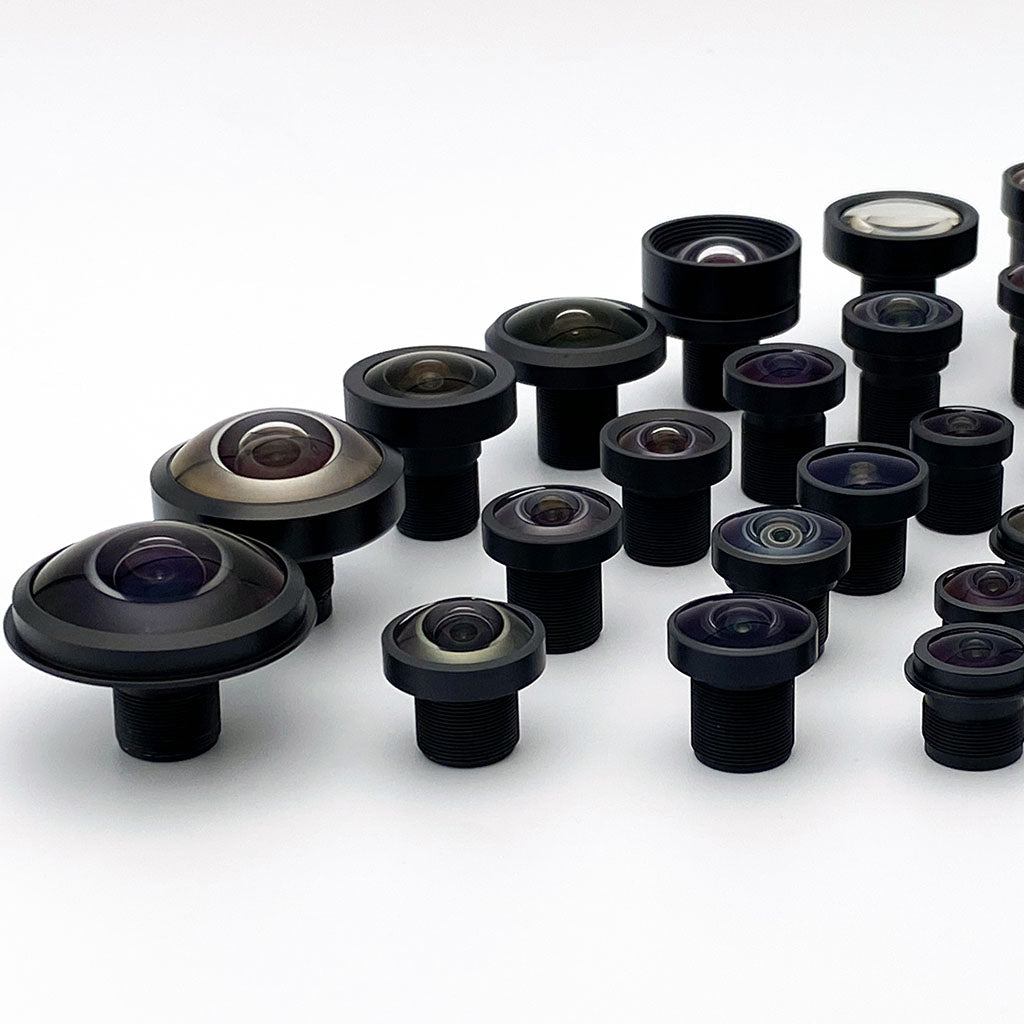

Lenses for Autonomous Vehicles: Choosing ADAS, Surround-View, and Driver Monitoring Optics by Camera Position
Camera position determines the optical job. Front, surround, rear, and in-cabin cameras each need a different lens spec.

There is no single lens for autonomous vehicle cameras. Front-view ADAS needs range, thermal stability, and low ghosting, commonly at 6-19mm. Surround and parking use 1.8-4mm wide-angle or fisheye coverage with controlled distortion for stitching. In-cabin driver monitoring needs fixed focus at 300-700mm, NIR compatibility at 850nm or 940nm, and enough face scale for landmark detection.
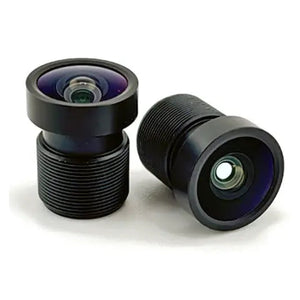
Compact Commonlands automotive M12 lenses with IP69K sealing (ISO 20653 writes it IP6K9K) and athermalized designs cover most of these positions, but each camera still needs its focal length, image circle, and chief ray angle verified against its own sensor.
Why Autonomous Vehicles Use Different Lenses by Camera Position
| Camera position | Primary optical job | Typical focal length | Key requirements |
|---|---|---|---|
| Front-view ADAS | Object detection at range | 6-19mm | Low ghost, thermal stability, low distortion |
| Surround-view / parking | 360-degree scene stitching | 1.8-4mm | Controlled distortion, IP69K, uniform response |
| Rear / reverse | Wide proximity coverage | 1.8-4mm | IP69K, wide FoV, distortion tolerance |
| Blind-spot / side | Lane-adjacent detection | 3-7mm | Moderate FoV, low ghosting, IP69K |
| Cabin / driver monitoring | Face, eye, and head-pose tracking | 4-8mm | NIR pass, fixed focus, distortion tolerance |
The focal-length column surveys common picks on typical 1/4" to 1/2" automotive formats, not a specification. Sensor dimensions, projection, required field of view, target distance, and packaging fix the real value. The selection workflow below derives it from those inputs.

Front-View ADAS Lens Requirements
Front cameras carry the highest detection burden: pedestrian recognition at a few tens of meters, vehicle following past 100m, and sign reading in between. The lens must put enough pixels on target at those distances, with contrast the model can use.
Pairing Detection Range With Coverage
Focal length drives pixel scale at distance: a 19mm lens puts more pixels on a pedestrian at 100m than a 6mm lens, at the cost of a narrower field that misses close objects. Many systems pair a narrow lens for range with a wider one for proximity on the same axis. Front cameras commonly land at 6-12mm on 1/3" to 1/2" sensors.
Thermal Stability
A front camera behind the windshield sees direct sun in summer and cold starts in winter, typically -40C to +85C. Elements, barrel, and cements expand at different rates, and glass index shifts with temperature (dn/dT), often contributing as much defocus as the mechanical mismatch. An athermalized design chooses element spacing and materials to keep focus within the depth of focus, one way to stabilize a fixed-focus system. Temperature control or a design with greater focus tolerance may also meet the requirement.
Low-Ghost Coatings and Stray-Light Control
Oncoming headlights, streetlamps, and direct sun are routine for a forward-facing camera. Ghosts are secondary reflections off element surfaces that appear as bright, displaced artifacts and can trigger false positives or mask real objects. Multi-layer anti-reflective coatings cut residual reflectance, and a low-ghost lens paired with the sensor's HDR mode preserves contrast around a dim pedestrian next to a headlight. Ask for ghost and flare data under point-source conditions.
The windshield belongs in that budget and is not a standard optical part: laminate build, wedge (often confined to a HUD or camera zone), and solar-control or IR-attenuating layers vary by vehicle and glazing supplier. A wedge, where present, keeps the two surface reflections from splitting a bright point source into a double image. A solar-control layer can cut NIR throughput sharply. Test the camera through the exact glass it ships behind, at the installed rake angle.
Low-Light Aperture Tradeoffs
A wider aperture (lower F#) gathers more light, at the cost of shallower depth of field. A fixed-focus lens locks focus at a distance that keeps depth of field deep enough for the full detection range. Very fast apertures (F/1.2 and below) narrow that margin and raise sensitivity to thermal focus shift.
Sensor fit still needs verification even on an automotive M12 lens. Confirm the image circle covers the sensor diagonal and the chief ray angle profile matches the sensor's microlens design. A mismatch causes color shading and corner signal loss the detection model cannot recover. See lens chief ray angle and mismatch.
Surround-View, Parking, and Rear Camera Requirements
Surround, parking, and rear cameras mount at the vehicle's corners or sides with wide-angle or fisheye optics. Their job is coverage, not range: maximum area around the vehicle, with enough quality for the stitching or proximity pipeline.
Wide Field of View and Fisheye Tradeoffs
Covering 130-190 degrees on the 1/4" to 1/2" formats common in automotive typically needs focal lengths under 4mm and fisheye designs. Below roughly 3mm on a 1/3" sensor most lenses show heavy barrel distortion, which the rendering pipeline corrects during bird's-eye view synthesis.
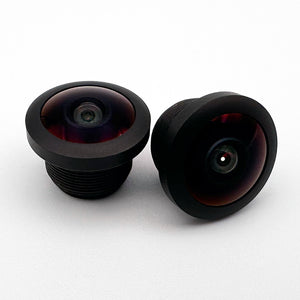
The practical limit is image circle at the required field angle, not the headline angle. Confirm the datasheet figure applies at the widest listed angle. Background is in the fisheye and wide-angle lens distortion guide. The Commonlands 186° IR corrected fisheye M12 lens (CIL239) covers full hemispherical fields on a 5.2mm image circle.
Distortion and Stitching Concerns
Stitching pipelines apply a per-lens calibration mapping pixels to ground-plane coordinates, which depends on the distortion profile staying stable over temperature and from unit to unit. Thermal swings can shift focus and effective focal length, so verify both over the operating range. A reverse or parking camera adds a near-field demand: objects centimeters from the bumper fill much of the frame, so validate the calibration at the distances a parking maneuver sees before drawing guideline overlays.
Environmental Exposure
Rear and corner cameras face road spray, pressure washing, ice, and temperature cycling. IP69K (written IP6K9K under ISO 20653 for road vehicles) covers high-pressure, high-temperature washdown, and is commonly specified for exterior mounting, though the requirement depends on the camera's location and the OEM's spec. Sealing on an M12 lens sits at the barrel and front element. The housing still needs a matching seal to hold at the system level. See IP rating for machine vision lenses.
Driver Monitoring and In-Cabin Lens Requirements
Driver monitoring (DMS) and occupant monitoring (OMS) cameras face the driver, not the road. They mount from an A-pillar, overhead console, mirror assembly, or steering-column pod. That geometry sets three requirements no exterior position shares: short working distance, controlled NIR illumination, and sunlight rejection.
Working Distance and Face Scale
Single-driver monitoring resolves the face, eyes, and head pose from 300-700mm. Multi-occupant OMS covering rear seats extends to 900-1200mm and needs a wider field of view. The 3.6mm CIL337, 133 degrees on its 7.2mm image circle, covers the full cabin but shrinks the driver's face compared with a 6mm or 8mm lens, dropping landmark-detection confidence when the face fills little of the frame height.
Around 6mm EFL is a common starting point for single-driver monitoring at 400-700mm, but a starting point is not a spec: sensor size, camera placement, cabin geometry, and the facial coverage the algorithm needs set the real focal length.
The 66 to 78 degree figures for that class are catalog numbers for specific parts on specific formats, the 6.0mm CIL061 at 66 degrees on a 7.0mm image circle and the 5.8mm CIL359 at 78 degrees on 7.2mm, so recompute the angle against your sensor with the Commonlands field of view calculator before committing a mount.
NIR Illumination and Sunlight Rejection
A standard lens with an IR-cut filter blocks both 850nm and 940nm and leaves the system blind at night, so 24-hour DMS needs a variant without an IR-cut filter, or one confirmed for NIR. Some modules place that filter in the sensor package, so confirm its location first.
Interior cameras still see direct sun through the glass, which can wash out NIR contrast exactly when the system needs it. A narrow bandpass filter tuned to the illumination wavelength rejects out-of-band sunlight while passing the LED signal, but sunlight carries power inside the passband too. LED power, pulse duty cycle, pulse-synchronized capture, and filter width and angle-of-incidence shift set the contrast that survives. See the bandpass filter guide for CWL and FWHM selection.
Distortion Tolerance Depends on the Algorithm
The downstream algorithm sets the distortion tolerance. Gaze estimation and head-pose analysis measure angles between facial landmarks and need low distortion or a calibrated undistortion step at the edges. Presence and eye-closure scoring need less geometric precision, so higher distortion is fine when coverage matters more. The 133° CIL337 and 44° CIL079 provide different coverage. Their catalog distortion figures use F-theta and TV conventions, so neither the raw percentages nor field angle alone ranks the correction required. Compare the full calibrated mappings for the intended crop and output.
Sensor Format and Thermal Integration for Cabin Modules
Most embedded DMS modules use 1/2.5" or 1/2.7" sensors, smaller than the 1/2" to 1/1.7" formats on front ADAS. Interior temperatures still swing from -40C cold starts to +70C or higher in a parked vehicle, so the same athermalized design applies, and a lens bonded into its holder can drift out of focus if the adhesive creeps under heat.
Choosing Focal Length, Sensor Format, and Mount Family
Focal Length Selection Workflow
- Define the angular coverage needed for the position: roughly 50° HFOV for front-view, 180-190° fisheye coverage for four-camera surround-view (wide enough for seam overlap and near-field ground coverage), and a 66-78° diagonal FoV class for single-driver cabin monitoring.
- Identify sensor width and diagonal from the image sensors database.
- Use the field of view calculator to find the focal length matching that coverage on the actual sensor.
- Confirm the image circle covers the sensor diagonal, and check chief ray angle compatibility against the sensor datasheet.
Catalog field of view figures on product pages are diagonal at full image circle. The calculator returns HFOV, VFOV, and DFOV for your sensor, so do not compare the two directly.
Common Automotive Sensor Formats
Automotive sensors typically run 1/4" to 1/2", with 1/1.7" to 1/1.8" formats in higher-resolution forward cameras. Sensor width sets the focal length needed for a given field of view.
| Sensor format | Approx. width | Typical application | Notes |
|---|---|---|---|
| 1/4" | 3.6mm | Interior / DMS | Compact, cost-effective |
| 1/3" | 4.8mm | Surround-view, rear | Common in automotive modules |
| 1/2.5" | 5.7mm | ADAS, surround-view | Wider FoV at the same focal length |
| 1/2" | 6.4mm | Front-view ADAS | Balanced size and sensitivity |
| 1/1.7" | 7.5mm | High-res front camera | Larger image circle required |
M12 vs. C-Mount for Automotive Packaging
Commonlands M12 lenses are the practical choice for most automotive integrations: compact, lightweight, and sized for board-level mounting in housings often under 30mm in any dimension. C-mount lenses use a 1"-32 UN interface with a 17.526mm flange distance and suit larger industrial cameras impractical for in-vehicle packaging.
M12 has no standardized flange distance, so focus is set during manufacturing and locked, with no customer-adjustable focus ring. Adjustable C-mount lenses focus by rotating a ring. Whether it moves the whole cell, a front group, or internal groups on a cam varies by design, as does near-limit behavior, so confirm the mechanism on the datasheet or with Commonlands engineering during automotive qualification. For the full comparison, see M12 vs. C-mount vs. CS-mount.
Top Automotive M12 Lenses by Camera Position
For a Commonlands-only automotive M12 build, the four lenses below cover the main camera positions, and all four ship same day from San Diego on orders placed before 12 PM PT. IP69K in the table abbreviates the ISO 20653 IP6K9K jet rating.
| Camera position | Lens | EFL | F# | Why it fits |
|---|---|---|---|---|
| Front ADAS, long range | CIL190 | 19mm | F/1.6 | Narrow field of view puts more pixels on distant objects. IP69K, all-glass all-metal barrel |
| Surround / parking | CIL239 fisheye | 1.8mm | F/2.0 | 186° hemispherical coverage on a 5.2mm image circle, IR corrected for mixed daylight and NIR lighting |
| Driver monitoring (NIR) | CIL061 | 6mm | F/1.9 | Without Filter option passes 850nm and 940nm NIR. 66° frames a single driver at 400-700mm |
| Rear / proximity | CIL337 | 3.6mm | F/1.6 | 133° near-field coverage with IP69K washdown sealing |
Commonlands automotive M12 lenses are select-ruggedized: IP sealing and athermalization are specified per SKU, not applied as a blanket automotive grade across the line. The AEC-Q family does not qualify a bare lens: AEC-Q100 covers integrated circuits, AEC-Q200 passive components, AEC-Q102 optoelectronic devices, and AEC-Q104 multichip modules, not cameras or optics as a category. A camera module carries AEC-Q104 only when its maker qualifies it. A lens cannot carry or confer it.
A standalone lens is validated through environmental testing instead: thermal cycling, damp heat, vibration, and ingress protection. If your program needs a named qualification or temperature grade, ask for the environmental test data on the SKU, or specify a custom automotive design.

Frequently Asked Questions
What lens is used in autonomous vehicle cameras?
There is no single lens for all autonomous vehicle cameras. Each position gets a lens matched to its optical job. Front-view cameras typically use 6-19mm with low ghosting and thermal stability, surround-view cameras 1.8-4mm wide-angle or fisheye, and driver-monitoring cameras 4-8mm with NIR compatibility and fixed focus for 300-700mm working distances.
Why do automotive lenses need thermal stability?
Automotive cameras operate from -40C cold starts to +85C or higher in parked vehicles. Without an athermalized design, focus shifts and MTF degrades at temperature extremes, so a detection model can miss objects it would resolve at room temperature. Athermalized lenses use element spacing and material choices that keep focus within the depth of focus across the operating range.
What lens should I use for driver monitoring?
For most single-driver monitoring, a 6mm M12 lens (F/1.6-F/1.9) is a practical starting point. The Commonlands CIL359 (78 degree FoV, IP6K9K) and CIL061 (66 degree FoV, Without Filter option for NIR) both fit that spec. To cover multiple occupants, the 3.6mm CIL337 (133 degrees) extends coverage but compresses subject scale. For tighter framing and gaze-tracking accuracy, the 7.85mm CIL079 (44 degrees, -3% TV distortion) is the better choice.
Does driver monitoring need NIR compatibility?
Yes, if the system illuminates the driver at night. Most DMS cameras use 850nm or 940nm NIR LEDs so illumination stays unobtrusive. A standard lens with an IR-cut filter blocks most signal at both wavelengths, so 24-hour operation needs a lens variant without an IR-cut filter or one confirmed for NIR transmission, such as the CIL061 Without Filter option.
What does IP69K mean for an automotive lens?
IP69K covers high-pressure, high-temperature washdown resistance: 80C water at 80-100 bar, sprayed at close range from multiple angles per the ISO 20653 (IP6K9K) or IEC 60529 (IPX9) procedure. The certificate belongs to the tested variant, as mounted, and speaks only to that water exposure. Detergents, repeated car-wash cycles, and the rest of the camera fall outside it. The ratings test different threats, not steps on one ladder: IPX9K jets and IPX7/IPX8 immersion are separate tests, so IP69K compliance does not imply immersion protection and must be verified independently.
Need Help Specifying an Automotive Camera Lens?
Commonlands manufactures M12 and C-mount lenses for machine vision, robotics, and automotive camera systems. Lenses are tested against published specs before shipping. Samples ship same day from San Diego on orders placed before 12 PM PT.