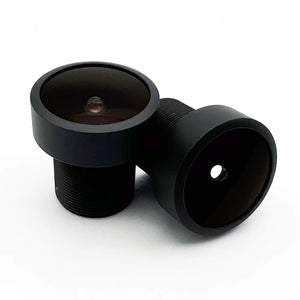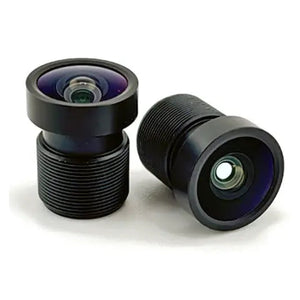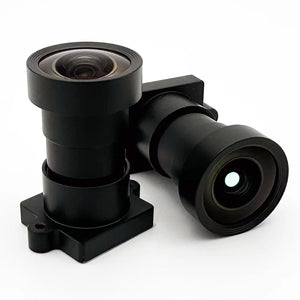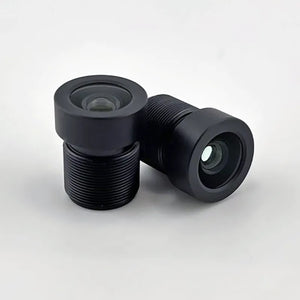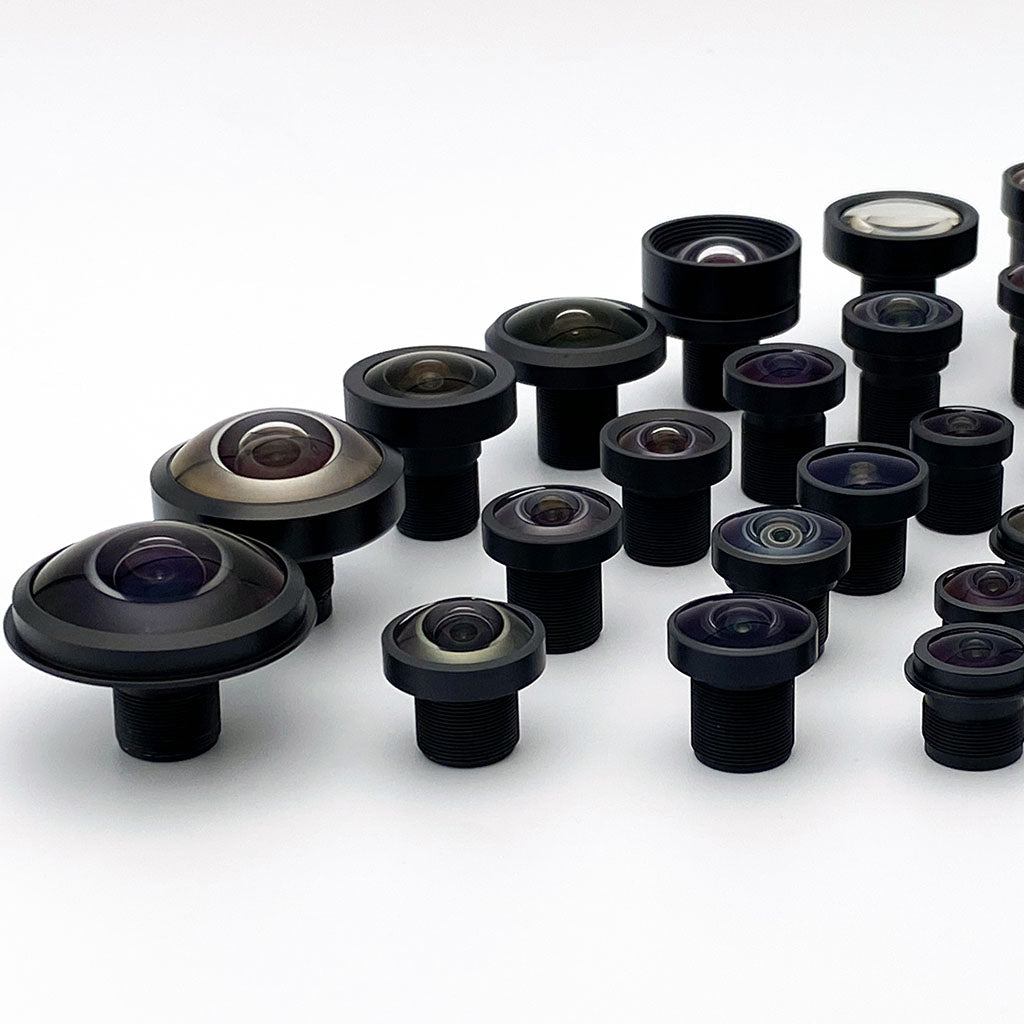

Automotive and Mobile Robotics Lenses

Lenses for ADAS, AMRs, and AGVs, including IP6K9K-rated options (industry shorthand IP69K) and all-glass designs. Focus stability over temperature comes from the whole design and is confirmed by test.

IP6K9K Sealing options
-30°C to +90°C Tested thermal range
Same Day US shipping
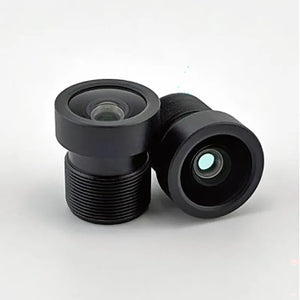
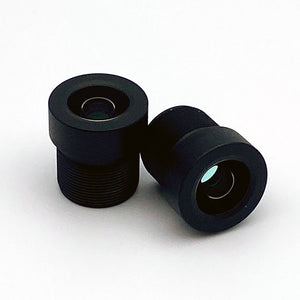
Automotive 5.9mm M12 lens for ADAS cameras

How Do ADAS and Robot Vision Share Requirements?

Both automotive ADAS and mobile robots require ruggedized optics that maintain performance under vibration and temperature cycling. All-glass assemblies remove one drift term, polymer index and shape change, but focus stability over temperature comes from the design as a whole: glass choices balancing CTE and dn/dT, element spacing, and barrel behavior, confirmed by measuring focus and MTF on the assembled lens over temperature.

Thread-locked M12 mounts keep the lens-to-holder joint from backing off under road vibration and warehouse floor impacts. Holding focus and alignment through those events also depends on internal element retention and the module's own mounting, so reliability testing runs on assembled lenses rather than being inferred from the thread lock.
What Makes 360° Perception Critical?

Surround view enables safe navigation in tight spaces. Our wide-angle and fisheye lenses hold consistent distortion profiles across production batches, so a per-model calibration transfers between units with less drift. SLAM suitability itself is a system property, proven by the calibration model, field of view, MTF, and exposure timing in the algorithm.

Compact designs fit vehicle profiles and robot chassis while maintaining large apertures for low-light warehouse environments. Metal barrels resist deformation between freezer and ambient zones, though thermal stability of focus depends on the full optomechanical design, not the barrel material alone.

Automotive and Mobile Robotics Lenses Collection

M12 lenses for automotive ADAS and mobile robotics, including IP6K9K-rated options.

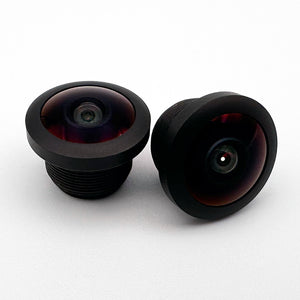
1mm M12 Lens Stereographic Fisheye Lens

220°@4.0mm Stereographic M12 Fisheye

$39.00

Download .STPView Product
IP69 AR0234 Lens CIl329

Wide-Angle 2.8mm M12 Lens

$39.00

Download .STPView Product
Wide Angle M12 Lens Sunex

Wide Angle 3.2mm M12 Lens

$39.00

Download .STPView Product
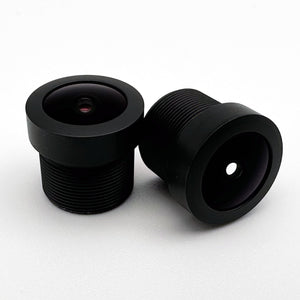
IP69K Automotive M12 lens

IP69K 3.3mm M12 Lens

$39.00

Download .STPView Product
Wide-Angle 4mm M12 Lens

Wide-Angle 4mm M12 Lens

$99.00

Download .STPView Product
Waterproof M12 lens Wide Angle

Automotive 5.3mm M12 Lens

$39.00

Download .STPView Product
Automotive 4.3mm M12 Lens

Automotive 4.3mm M12 Lens

$39.00

Download .STPView Product
5.5mm M12 Lens

5.5mm M12 Lens 1/2.5" 2MP

$39.00

Download .STPView Product
AR0822 M12 Lens CIL358

Wide-Angle 5.8mm M12 Lens

$49.00

Download .STPView Product
Advanced Driver Assistance System Camera Lens 6mm M12 Lens S-Mount lens

Automotive 5.9mm M12 Lens

$39.00

Download .STPView Product
6mm M12 Lens for Blackfly S-mount cameras

Fast 6mm M12 Lens

$39.00

Download .STPView Product

Browse Automotive M12 Lenses for ADAS and Robotics

Commonlands' In-House Automotive Reliability Testing

These rows summarize our in-house test program, not a published qualification: profiles, durations, sample sizes, and acceptance criteria vary by SKU and program. Ask for the environmental test report on the SKU you are qualifying to get the named profile, conditions, and measured results for the temperature range your program requires.

Test Type Conditions Results
Thermal Cycling -30°C to +90°C, 500+ cycles Testing available; request report
Random Vibration Automotive-style profiles Testing available; request report
Mechanical Shock Multi-axis testing Testing available; request report
Salt Spray Extended exposure Testing available; request report
High-Pressure Wash ISO 20653 IP6K9K Testing available; request report

See Our Reliability Testing in Progress

Thermal cycling, random vibration, and IP6K9K washdown testing for automotive and mobile robotics lenses run in our own San Diego facility, not a third-party lab. Customers are welcome to visit and observe testing in progress.

View our environmental reliability testing capabilities →
Thermal shock and environmental reliability testing chambers at the Commonlands San Diego facility

Why Multi-Environment Performance Matters?

Automotive and warehouse robots operate from bright sunlight to minimal emergency lighting. Multi-layer AR coatings increase transmission and reduce reflections across the visible band.

Large aperture designs favor light collection in dim warehouse environments; because a wider aperture reduces depth of field, lens selection balances f-number against the focus range each application needs. Proper sensor compatibility supports consistent performance with common automotive and industrial CMOS sensors.

How We Validate Reliability

Testing uses accelerated environmental exposure patterned on automotive and industrial robotics practice. Temperature cycling and vibration testing check long-term stability, with profiles and acceptance limits set per SKU and program.

Each lens design undergoes in-house environmental testing to establish operating limits. All-glass construction with metal housings removes the polymer drift term, but thermal focus stability and durability in service are judged from measured tests on the assembled lens, not from the materials list.

Engineering Standards

IP6K9K-Rated Options

High-pressure, high-temperature washdown on select lenses

-30°C to +90°C

In-house thermal cycling profile

Quality Testing

Optical inspection during production

Vibration Tested

Random vibration on automotive-style profiles

Batch-Consistent Distortion

Stable profiles for calibration reuse in SLAM pipelines

All-Glass Optics

Removes the polymer drift term; thermal focus shift still measured per assembled design

M12 Threads vs. Active Alignment: Production Volume Considerations

Mounting technology depends on precision requirements, yield targets, cycle time, and equipment economics as much as annual volume. As pure amortization arithmetic, a $100K active alignment cell spread over 30,000 modules is about $3.33 per module. That figure is tooling amortization alone, before labor, yield, maintenance, and equipment utilization, so it is not a break-even.

Where a program lands depends on the levers it must price: yield target, tolerance stack, takt time, and amortization period. There is no general crossover volume; run the comparison with your own figures for each lever.

M12 Thread Mount Lenses

Fit: tolerance stacks that close at threaded-assembly tolerances

  • No tooling investment required
  • Field-replaceable lens modules
  • Rapid prototyping capability
  • ±50μm typical alignment tolerance
  • Manual focus adjustment possible
  • Standard inventory availability
  • $0 NRE costs for new projects

Applications

  • Robotics development platforms
  • Aftermarket ADAS systems
  • Industrial AGV/AMR fleets
  • Research & pilot programs

Active Alignment Assembly

Fit: stacks tighter than threaded assembly holds, with volume to amortize tooling

  • ±5μm precision alignment achievable
  • Automated 6-axis positioning
  • Permanent adhesive bonding
  • Optimized for each sensor
  • Eliminates field adjustment
  • Lower unit cost at volume
  • $50-150K tooling investment

Applications

  • OEM automotive programs
  • Series production vehicles
  • Consumer electronics
  • High-volume fleet deployments

Contact Us

Connect with our US-based engineering team