
What Is a C-Mount Lens? Flange Focal Distance, Manual Iris Control, and CS-Mount Compatibility
This guide covers the 1"-32 UN thread, the 17.526mm flange focal distance, cam-driven focus, the adjustable iris, CS-mount compatibility, and when C-mount beats M12.
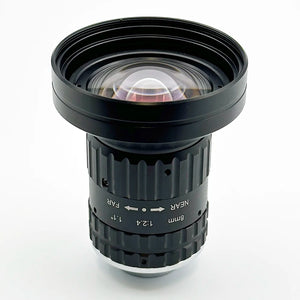
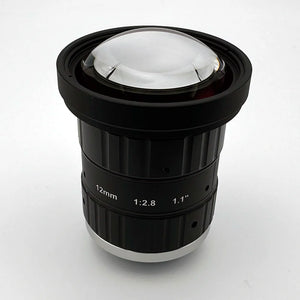
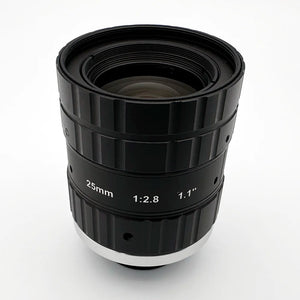
A C-mount lens is a screw-thread lens standard using a 1"-32 UN thread and a fixed 17.526mm flange focal distance (FFD), the distance from the mount flange to the sensor plane. Many C-mount lenses focus through an internal cam mechanism that moves optical groups relative to each other, rebalancing aberrations across the focus range, and include a manual iris ring for aperture control.
C-mount is the default industrial lens mount for machine vision: broad focal length selection, sensor coverage up to 1.2" and beyond on many lenses, and an adjustable iris that most M12 lenses do not have. CS-mount shares the thread with a shorter 12.526mm flange, and M12 is a different, smaller system entirely.
What is a C-mount lens?
A C-mount lens uses a 1"-32 UN thread (one inch outer diameter, 32 threads per inch) and a specified 17.526mm flange focal distance. The thread and flange are the entire mechanical specification. Every C-mount camera body is machined to this FFD, and every C-mount lens is designed with a matching back focal distance, which is what lets lenses and cameras from different manufacturers work together without optical shimming.
Focus on many C-mount lenses is not a simple slide. An internal cam mechanism converts rotation of the focus ring into linear motion of two or more lens groups, moving them relative to each other. This is a compensating system (Kingslake, Lens Design Fundamentals, 2nd ed., §18.3): as the groups shift to change focus, their relative motion also rebalances off-axis aberrations such as field curvature and astigmatism across the focus range. That is a fundamentally different mechanism from M12 lenses, which are rigid assemblies focused by threading the entire lens body in or out with no internal group movement.
Minimum object distance (MOD) on a C-mount lens is a hard mechanical limit: the end of cam travel. Inside MOD, the image goes uniformly soft across the whole field, and an extension tube is needed to focus closer. MOD is measured from the front of the lens to the object, not from the sensor. Working distance on a C-mount lens typically runs from around 100mm to infinity depending on the specific product; it is not a single fixed range across the catalog, and not every datasheet publishes MOD.
Beyond thread and flange, the standard does not specify optical performance, sensor coverage, or aperture range. A 2.8mm wide lens and a 75mm telephoto are both C-mount. A lens rated for a 2/3" sensor and one rated for 1.2" are both C-mount. The mount is a mechanical interface, not a performance tier. Browse the C-mount lens collection to see the current range, and see the lens mount guide for the full M12 vs C-mount vs CS-mount breakdown, including flange focal distance and back focal length definitions.
The 17.526mm figure traces to the C-mount standard's origins on 16mm cine cameras, and the number carries a tight machining tolerance because it directly sets focus accuracy. A camera body machined even a few hundredths of a millimeter off nominal shifts a lens's focus point at infinity, which is why FFD is held to a tight machining tolerance and why many C-mount camera datasheets specify an FFD tolerance band rather than treating the figure as merely nominal. Lens designers work back focal distance to the same tolerance band so that a lens focused at the factory using a test bench reaches focus on any properly machined C-mount body without field adjustment.
Why is C-mount still common in machine vision?
C-mount remains the default industrial lens mount because the fixed flange distance created decades of genuine interchangeability, not because of inertia. A lens from one vendor mounts on a camera body from another, and the optical axis lands correctly every time, which lets engineers swap cameras without changing lenses or swap lenses to adjust field of view without a new camera body.
Large installed base
Nearly every major industrial camera manufacturer offers C-mount bodies, and most major machine vision lens manufacturers offer C-mount optics. That depth of ecosystem is not matched by CS-mount or M12.
Adjustable iris on many lenses
Many C-mount machine vision lenses include a manual iris ring, giving engineers direct control over depth of field independent of exposure. Stopping down from F/2.8 to F/8 can meaningfully increase depth of field. See what is a manual iris lens below for the full mechanics.
Broad focal length range
C-mount focal lengths run from roughly 2.8mm wide-angle designs to 100mm-plus telephoto. Working distance for a given lens still varies by product, but the catalog breadth covers most machine vision geometries. M12 focal lengths cover 0.8mm to 100mm as well, but C-mount concentrates more options at the longer end for larger-sensor applications.
Support for larger sensors
C-mount lenses are available with image circles up to 1.2" and beyond on select products. Sensors above roughly 1/1.8" are effectively C-mount territory today, since M12 lenses are rarely designed to cover that diagonal. As sensor resolution rises and manufacturers move to larger formats to hold pixel pitch, C-mount scales with them.
What is a CS-mount lens?
A CS-mount lens shares the same 1"-32 UN thread as a C-mount lens but uses a shorter 12.526mm flange focal distance instead of 17.526mm. The 5mm shorter optical path lets designers work with shorter back focal lengths, which can reduce element count and simplify IR-corrected designs at some focal lengths. It is not a smaller version of C-mount optically. The flange geometry drives the entire lens design.
Because the thread is identical, a C-mount lens physically screws into a CS-mount camera body, and a CS-mount lens physically screws into a C-mount body. Whether either combination actually focuses is a separate question, covered below.
| Parameter | CS-mount | C-mount |
|---|---|---|
| Thread | 1"-32 UN | 1"-32 UN |
| Flange focal distance | 12.526mm | 17.526mm |
| Typical max sensor coverage | ~2/3" | 1.2" and larger on select lenses |
| Typical focal length range | ~2.5mm-16mm | 2.8mm-100mm+ |
| Common use | CCTV, ITS, security, Raspberry Pi HQ prototyping | Industrial machine vision, scientific imaging |
A C-mount lens on a CS-mount camera works with a 5mm C-to-CS spacer adapter. Without it, the lens sits 5mm too close to the sensor (the image forms behind the sensor plane) and cannot reach focus at any position. Many CS-mount industrial cameras ship with this spacer included, and the CLA217-CCS adapter ($6.00) provides the correction.
A CS-mount lens on a C-mount camera does not work and cannot be corrected. The sensor sits 17.526mm back, 5mm farther than the CS-mount lens is designed for, and spacers can only add optical path length, never remove it. If you have CS-mount lenses and a C-mount camera, you need different lenses.
C-to-CS correction works in one direction only. Verify the camera receiver against its datasheet before ordering lenses: a CS-mount receiver measures 5mm shallower to the sensor reference surface than a C-mount receiver.
CS-mount is common in ITS (intelligent transportation systems) and security cameras because the shorter flange distance can simplify IR-corrected optics at a comparable form factor to C-mount, useful for 850nm and 940nm illuminated license-plate and night-surveillance systems. It is also the native mount on the Raspberry Pi High Quality Camera, which accepts CS-mount lenses directly and C-mount lenses with the 5mm spacer. For most industrial machine vision, particularly sensors larger than 2/3" or focal lengths above 16mm, C-mount remains the practical default. See the full mount comparison guide and browse the CS-mount lens collection.
Verifying the camera receiver before ordering lenses is the single most useful CS-mount habit to build. Most manufacturers label the receiver clearly as C or CS in the camera datasheet. When the datasheet is unclear, the physical flange depth can be measured directly: a CS-mount receiver sits approximately 5mm shallower to the sensor reference surface than a C-mount receiver. Getting this wrong before ordering means either a lens that never reaches focus or an unnecessary spacer purchase. A five-minute datasheet check avoids both.
What is a manual iris lens?
A manual iris lens has a physical iris ring that the user rotates to set the aperture (f-number), then locks in place. There is no motor and no feedback circuit. This is different from a fixed-iris lens, common on M12 lenses, where the aperture is set at the factory and cannot change, and different from an auto-iris lens, which uses an electronic actuator to adjust aperture continuously in response to scene brightness.
Adjustable iris control is the single biggest practical advantage of C-mount over M12 for machine vision. Stopping down (raising f-number) increases geometric depth of field; opening the iris (lowering f-number) reduces it. Past the diffraction threshold covered below, added depth of field comes with growing diffraction blur. Because machine vision illumination is typically LED-based and programmable (ring lights, backlight arrays, coaxial illuminators), engineers can stop down to gain depth of field and then drive the lighting harder to compensate for the reduced light throughput. That tradeoff is impractical in ambient-light photography but routine on a production line, which is why stopping down is a normal commissioning step rather than a compromise.
Manual iris also holds its setting between frames, unlike auto iris. For dimensional measurement or any application where image geometry must be repeatable, a locked manual iris holds the same aperture across frames and power cycles under normal operating conditions. Auto iris varies frame to frame, shifting depth of field and, because aperture interacts with residual aberrations, the plane of best focus. That is acceptable for surveillance, not for repeatable measurement.
| Iris type | Who sets aperture | Typical use |
|---|---|---|
| Manual iris | User, with a ring, locked before deployment | C-mount machine vision with programmable lighting |
| Fixed iris | Factory-set, not adjustable | M12 embedded and low-cost applications |
| Auto iris | Electronic actuator responding to scene brightness | Outdoor CCTV, variable-lighting surveillance |
Stopping down has a resolution limit too, and that limit depends on pixel pitch, not just f-number. The Airy diffraction spot diameter scales as roughly 2.44 x wavelength x f-number: at 550nm, F/11 produces a spot around 14.8 microns across (nearly 7 pixels on a 2.2 micron-pitch high-resolution sensor), well past the roughly two-pixel spot size where sampling and diffraction losses become significant, and MTF loss from diffraction is continuous rather than a cliff at one pixel. For C-mount lenses on sensors around 3.45 micron pixel pitch, F/4 to F/8 is a practical working range, extending past the strict two-pixel point because the MTF loss is gradual; small-pixel, high-resolution sensors hit the diffraction limit at lower f-numbers, roughly F/4 to F/5.6 at 2.2 micron pixel pitch. See the f-number guide and depth of field guide for the full calculations.
Manual iris matters most in three recurring situations. First, parts with real height variation (circuit boards with components at different heights, machined parts with recesses, bottles with embossed labels), where the engineer can stop down until the full height range falls within acceptable focus, something a fixed-iris lens cannot do after the fact. Second, systems with programmable lighting, where aperture and illumination intensity become two variables tuned together rather than one fixed tradeoff. Third, applications where calibration stability is required: a locked manual iris holds its setting across frames and power cycles under normal operating conditions, unless someone deliberately unlocks and resets it.
Engineers still need to confirm image circle against sensor diagonal, lens resolution against pixel pitch, and corner performance at the chosen aperture. The f-number that maximizes depth of field is not always the f-number that minimizes corner aberrations.
What is an industrial lens?
An industrial lens is a lens selected for machine vision, robotics, automation, inspection, or scientific imaging, where image geometry and repeatability matter more than photographic aesthetics. The term is not tied to one mount or price point; it describes a set of engineering priorities that separate machine vision optics from consumer camera lenses and generic CCTV glass.
Repeatable geometry comes first: once a lens is focused and locked, field of view and distortion should stay constant across units and production runs, because a calibrated algorithm cannot tolerate geometry that shifts by serial number. Known image circle coverage matters next: an industrial lens is specified for a sensor format (1/3", 1/2", 2/3", 1", 1.1", and larger) with an image circle that covers the sensor diagonal without vignetting and stays reasonably flat into the corners. Distortion behavior must also be predictable enough for measurement algorithms to correct for it. Mechanical stability rounds out the list: a locking ring or set screw on focus, and on the iris where present, keeps the lens from drifting under vibration or thermal cycling.
Consumer camera lenses are optimized for autofocus speed, aesthetic rendering, and zoom flexibility across interchangeable-camera ecosystems; their distortion often varies across the zoom range and their sensor formats rarely overlap with machine vision sensors. CCTV lenses share C-mount and CS-mount threads with industrial lenses but are optimized for wide-area surveillance coverage at low cost, with corner sharpness and distortion accuracy treated as secondary. The practical test: are you capturing an image to view, or to measure? CCTV and consumer lenses are built for the former; industrial lenses for the latter.
| Property | Industrial lens | Consumer lens | CCTV lens |
|---|---|---|---|
| Distortion specification | Published and characterized | Often not specified for machine vision | Rarely specified, typically higher |
| Aperture control | Manual iris (C-mount) or fixed (M12) | Electronic, via camera body | Manual DC iris or fixed |
| Focus locking | Set screw or locking ring | Not applicable (autofocus) | Sometimes, often friction-only |
| Mount standard | C-mount, CS-mount, M12 | Proprietary (E, F, RF, L) | C-mount, CS-mount |
C-mount and M12 are the two dominant industrial mounts, and they are different systems, not two sizes of the same thing. C-mount focuses through a cam that rebalances aberrations as groups move; M12 is a rigid assembly focused by threading the whole lens in or out with no internal rebalancing. Neither is universally better: choose based on sensor size, required aperture control, and packaging constraints, as covered in the C-mount vs M12 comparison below and the M12 lens guide.
Mount compatibility with industrial cameras is what closes the loop between lens and system. Because C-mount, CS-mount, and M12 are all threaded interfaces with either a standardized flange focal distance (C-mount, CS-mount) or a well-documented mechanical back focal length (M12), lenses and cameras from different manufacturers can be paired without custom optical shimming. That interchangeability is a large part of why these three mounts, rather than proprietary photographic mounts, dominate industrial vision.
What is an FA lens?
FA stands for factory automation. An FA lens is typically a C-mount fixed-focal-length lens designed for finite working distances, manual focus lock, and direct iris ring access, used in inspection, measurement, and barcode-reading systems. The term originated in industrial optics vendor catalogs and is now used broadly across the industry to identify this class of lens. It is not a mount specification: it does not define a thread, flange distance, or image circle size, and it is a category label layered on top of the underlying C-mount (or occasionally CS-mount) hardware.
When a catalog lists an FA lens, the label typically signals a lens built for a fixed camera position and finite subject distance rather than infinity photography, a lockable focus ring, a manual iris for aperture adjustment, and compatibility with standard industrial mounts. Not every vendor applies the term consistently (some reserve it for high-resolution C-mount lines, others use it more broadly), so engineers should verify the actual specifications rather than relying on the label alone. Related shorthand includes "FA optic," "FA glass," and "FA machine-vision lens," all referring to the same category.
FA lens and machine-vision lens overlap heavily but are not identical. Machine-vision lens is the broader term and includes fixed-aperture M12 board-camera optics. FA lens is most naturally applied to traditional C-mount fixed-focal lenses with an adjustable iris. The practical difference is aperture control, since M12 lenses typically do not provide an adjustable iris. C-mount is the dominant FA-lens format because it covers sensor formats from roughly 1/4" to 1.2"+, focal lengths from about 4mm to 75mm and beyond, and gives most lenses an adjustable iris for depth-of-field tuning against LED-based programmable illumination.
Verify sensor format against image circle, lens resolution against pixel pitch, working distance against the exact installation distance (some FA lenses have a finite working-distance range, not infinity focus), distortion tolerance for measurement accuracy, and iris range against the depth-of-field requirement. Use the EFL calculator to size focal length first.
FA lens focal lengths commonly span roughly 4mm to 75mm and beyond. Shorter focal lengths, in the 8-16mm range, cover wide fields of view at short working distances. Mid-range focal lengths, 25-35mm, are typical for conveyor or bench inspection at 300-500mm working distance. Longer focal lengths, 50mm and up, are chosen when the working distance extends past roughly 500mm, or when the application needs a tighter field of view with more magnification. These are typical bands rather than fixed thresholds. The actual required focal length still comes from working distance, sensor width, and field of view through the EFL calculator, not from a rule of thumb.
Sensor size and image circle coverage
C-mount specifies the mechanical interface, not sensor coverage. Coverage is set by the lens image circle, the diameter of the usable projected image at the focal plane. If the image circle is smaller than the sensor diagonal, the corners of the image go dark, a defect called vignetting; corners may also go soft where the field exceeds the lens's corrected image circle, a separate resolution effect. Always check the lens image circle against your sensor diagonal, or choose a lens rated for a larger format than you need.
| Sensor format | Approx. diagonal | Typical lens tier |
|---|---|---|
| 1/3" | 6.0mm | Entry C-mount, CS-mount, CCTV |
| 1/2" | 8.0mm | Mid-range M12 and C-mount |
| 2/3" | ~11.0mm | Standard industrial C-mount |
| 1" | ~16.0mm | Higher-resolution C-mount |
| 1.1" | ~17.6mm | High-resolution 12-25MP industrial |
Oversizing image circle is optically safe: a lens rated for 1.1" on a 2/3" sensor wastes some image circle but does not degrade performance; the cost delta usually makes it unnecessary anyway. Resolution has to match separately: a 12MP-rated lens paired with a 25MP sensor becomes the resolution bottleneck, since sensor pixel count above the lens's resolving capability adds little additional resolved detail. See the sensor size and lens compatibility guide and image sensor selection guide for format-matching detail, and check the image sensor database for dimension reference before finalizing a lens/sensor pairing.
Sensor format naming is not literal. A "1/1.8 inch" sensor does not have a 1/1.8 inch diagonal in any dimension that traces back to actual film formats; the labeling is a legacy convention, and the only number that matters for lens selection is the sensor's actual diagonal in millimeters, verified against the lens image circle spec. When a datasheet omits image circle or only lists a maximum format claim, check the image sensor database or request the measured value from the vendor before committing to a design, since corner performance at the true sensor diagonal is what determines whether the pairing actually works.
Corner performance itself is not uniform even within a lens rated for a given sensor: MTF (modulation transfer function) at the corner of the field is almost always lower than MTF at the center, and the gap widens as the sensor diagonal approaches the lens's rated image circle. A lens rated for 1.1" tested on a 1.1" sensor is being asked to perform at the very edge of its design envelope, while the same lens on a 2/3" sensor uses only the well-corrected central portion of the image circle. This is a separate consideration from vignetting: a lens can clear the sensor diagonal with no dark corners and still show meaningfully softer resolution at the corners than at the center, which matters for full-field measurement tasks even when it does not matter for general inspection.
What are C-mount lenses used for?
C-mount appears across industrial and scientific imaging wherever optical performance and aperture control matter more than camera size. The mount is not niche; it is the default in several application classes.
- Quality inspection: surface defect detection, dimensional measurement, and label or barcode verification, where iris control and resolution matter. See lenses for quality inspection.
- Robotics: 2D and 3D machine vision on robot arms and AGVs, where the camera is mounted at a fixed working distance and needs to hold focus under vibration. See lenses for robotics.
- Barcode reading: fixed-mount scanners on conveyor lines, from close-range label reading to overhead tunnel scanners. See barcode reading guide.
- Scientific and laboratory imaging: microscopy, spectroscopy, and lab cameras that expose a C-mount receiver because the compatible-optics ecosystem is broad.
- Factory automation: pick-and-place guidance, part orientation, and bin picking under controlled illumination, the classic FA-lens use case described above.
- Longer working distance inspection: gantry-mounted and overhead cameras where longer C-mount focal lengths hold resolution at distances where M12 options run out. See the working distance guide.
- Traffic and infrastructure monitoring: fixed C-mount cameras on gantries and poles, often paired with IR illumination for nighttime capture. See lenses for traffic monitoring.
- Electronics and semiconductor inspection: higher-resolution C-mount lenses matched to smaller pixel pitches for component-level defect detection. See electronics inspection lens guide.
The common thread across these applications is a fixed camera position and a finite, known working distance. Once mount compatibility and sensor coverage are settled, the field of view still has to be sized from the actual system geometry, not assumed from the mount or copied from a previous project. Use the field of view calculator and focal length selection guide before committing to a lens, and confirm working distance separately, since working distance is a system-level design decision rather than a fixed physical law.
C-mount vs M12: which should you choose?
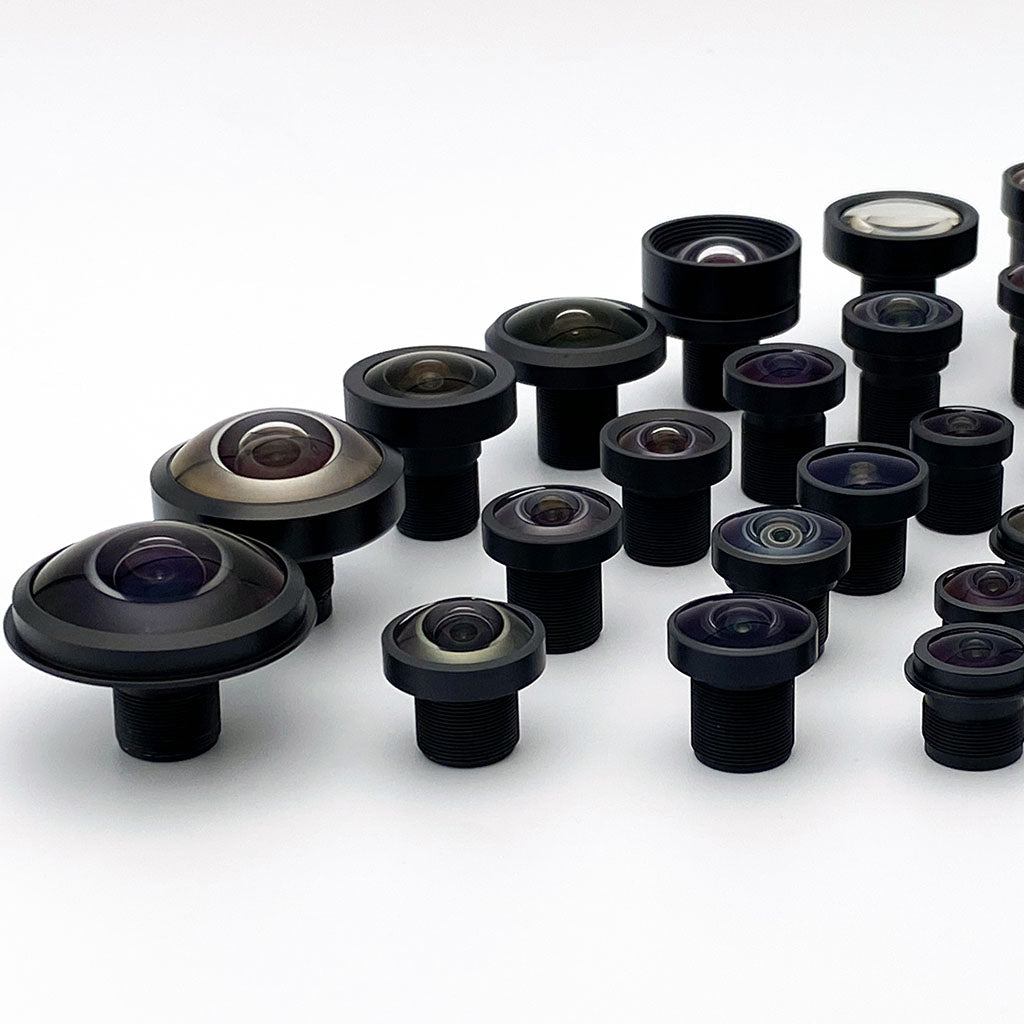
Choose C-mount when you need an adjustable iris for depth-of-field control, sensor coverage above roughly 1/1.8", or a wide range of focal lengths including options past 50mm. Choose M12 when size, weight, and cost are the dominant constraints. Embedded cameras, drones, and small robotics platforms are the natural home for M12. Neither mount is a smaller or larger version of the other; they are different focus systems entirely.
| Parameter | C-mount | M12 / S-mount |
|---|---|---|
| Thread specification | 1"-32 UN | M12 x 0.5 |
| Flange focal distance | Fixed at 17.526mm | No standard, varies by lens |
| Focus mechanism | Internal cam moves groups, rebalancing aberrations across focus range | Rigid body threaded in/out, no internal rebalancing |
| Iris control | Adjustable iris ring on many lenses | Typically fixed aperture, no iris ring |
| Working distance | Varies by product, typically 100mm-infinity | 50mm-infinity (uncorrected) |
| Typical sensor coverage | Up to 1.2" and larger on select lenses | Most models up to 1/1.8" (select designs 1/1.7"-1/1.6") |
| Focal length range | 2.8mm-100mm+ | 0.8mm-100mm |
| Typical lens mass | Heavier | Lighter |
| Best for | Industrial inspection, larger sensors, DOF control | Embedded, drones, robotics, compact sensors |
A C-mount lens focuses through an internal cam that moves lens groups relative to each other, rebalancing off-axis aberrations across the focus range (Kingslake, Lens Design Fundamentals, 2nd ed.). An M12 lens is a rigid assembly: threading it in or out moves the entire lens with no internal aberration rebalancing. The two mounts behave differently at short working distances for this reason, and neither will consistently outperform the other across every application.
Cost and lead time also separate the two mounts in practice. C-mount lenses generally use more elements and tighter cam-mechanism tolerances, which puts typical unit pricing above comparable M12 optics, though a well-specified M12 lens for a demanding sensor is not automatically cheaper than an entry C-mount lens. The larger consideration is integration effort: C-mount's standardized flange distance means a system integrator can source lens and camera from separate vendors and expect them to reach focus together, while M12 back focal length varies enough by lens design that camera-lens pairing should be verified against the specific holder height in the datasheet rather than assumed from the mount name alone.
For a full mount comparison including M8 vs M12, see the lens mount guide: M12 vs C-mount vs CS-mount. Browse the M12 lens collection for compact options.
Top 5 C-mount lenses for machine vision
The five Commonlands lenses below cover the common C-mount machine vision roles, from an 8mm wide-area lens (CIL531, 2/3", F/2.8 to F/16) to a 25mm high-resolution option for 1.1" 20MP sensors (CIL544, F/1.8). Four are C-mount. The CIL725 2.5mm fisheye is CS-mount, included for Raspberry Pi HQ and panoramic builds that use a CS-mount receiver. Every lens carries an adjustable iris, the control that separates C-mount from most M12 optics.
| Rank | Lens | Mount | EFL | F# / iris | Format coverage | Best for |
|---|---|---|---|---|---|---|
| 1 | CIL531 8mm | C-mount | 8mm | F/2.8-F/16, adjustable | Up to 2/3", 12MP | Wide-area overhead robotics and large-area inspection |
| 2 | CIL522 12mm | C-mount | 12mm | F/1.4-F/16, adjustable | Up to 2/3", 3MP at 4.2 micron | Bright general-purpose inspection baseline |
| 3 | CIL535 35mm | C-mount | 35mm | F/2.0-F/16, adjustable | Up to 2/3", 12MP at 2.2 micron | Longer standoff conveyor and gantry inspection |
| 4 | CIL544 25mm | C-mount | 25mm | F/1.8, adjustable | 1.1", 20MP+ at 2.74 micron | High-resolution measurement on large sensors |
| 5 | CIL725 2.5mm | CS-mount | 2.5mm | F/1.6, adjustable | 2/3", 6.2mm image circle | Panoramic and Raspberry Pi HQ builds |
How we picked: every lens here is stocked at Commonlands with a published image circle and an adjustable iris, and each was assigned to a distinct role so the five span wide-area through high-resolution work instead of repeating one focal length. The specs match the product datasheets. Size focal length from your working distance and sensor width in the EFL calculator and confirm image circle against your sensor diagonal in the sensor size and lens compatibility guide before ordering.
Fujinon, Kowa, and Computar are the established C-mount FA lens makers, and Edmund Optics stocks a broad C-mount catalog under its TECHSPEC line. Their ranges run deeper at long focal lengths and formats above 1.1", so they remain the reference point for those cases. Commonlands competes on direct pricing, same-day San Diego stock, and direct access to the engineers who specify the optics.
Frequently asked questions
What is a C-mount lens?
A C-mount lens is a screw-thread lens using 1"-32 UN thread and a 17.526mm flange focal distance. The standard defines the mechanical interface between lens and camera body, so lenses and cameras from different manufacturers work together. Many C-mount lenses focus through an internal cam that rebalances aberrations across the focus range and include an adjustable iris ring.
What is the flange focal distance of a C-mount lens?
17.526mm, measured from the lens mount flange to the sensor plane. C-mount camera bodies are machined to this distance, and C-mount lenses are designed with back focal distance to match. CS-mount uses the same thread with a 12.526mm flange instead, a 5mm difference that governs adapter use.
What is a CS-mount lens?
A CS-mount lens shares the C-mount 1"-32 UN thread but uses a shorter 12.526mm flange focal distance instead of 17.526mm. The 5mm shorter path can simplify optical designs and IR correction. CS-mount is common in CCTV, ITS, security cameras, and Raspberry Pi HQ Camera prototyping.
Can a C-mount lens be used on a CS-mount camera?
Yes, with a 5mm C-to-CS spacer adapter that restores the 17.526mm flange distance. Without it, the lens sits 5mm too close to the sensor (the image forms behind the sensor plane) and cannot reach focus at any position. Many CS-mount industrial cameras ship with this spacer included; the CLA217-CCS adapter provides the correction for $6.00.
Can a CS-mount lens be used on a C-mount camera?
No. A CS-mount lens is designed for a 12.526mm flange distance, and a C-mount camera places the sensor 17.526mm back. Spacers only add optical path length; none can shorten it. This compatibility rule is one-directional, and there is no adapter fix.
What is a manual iris lens?
A manual iris lens has a physical iris ring the user rotates to set the aperture (f-number), then locks in place. Unlike a fixed-iris lens, aperture is adjustable. Unlike an auto-iris lens, there is no electronic actuator. Manual iris is standard on most C-mount machine vision lenses and is the primary mechanism for depth-of-field control.
Why is the adjustable iris a C-mount advantage in machine vision?
Because machine vision illumination is typically LED-based and programmable, engineers can stop down the iris to gain depth of field and then raise light intensity to compensate for reduced throughput. That tradeoff is difficult with fixed-illumination photography but routine on a production line, which makes an adjustable iris genuinely useful rather than a leftover camera feature.
What is an industrial lens?
An industrial lens is a lens selected for machine vision, robotics, automation, or inspection, where repeatable geometry, known image circle coverage, and mechanical stability matter more than photographic aesthetics. C-mount, CS-mount, and M12 are the three dominant industrial mounts, each optimized for a different balance of size, sensor coverage, and aperture control.
What is an FA lens?
FA stands for factory automation. An FA lens is typically a C-mount fixed-focal-length lens designed for finite working distances, manual focus lock, and direct iris control, used in inspection, measurement, and barcode-reading systems. FA lens is a category label, not a separate mount standard.
When should I choose C-mount over M12?
Choose C-mount when you need an adjustable iris for depth-of-field control, sensor coverage above roughly 1/1.8", or a wide range of focal lengths including options past 50mm. Choose M12 when size, weight, and cost are the dominant constraints, such as embedded cameras, drones, and small robotics platforms. See the lens mount guide for a detailed breakdown.
Can a C-mount lens cover any sensor size?
No. C-mount is a mount specification, not a sensor coverage guarantee. A C-mount lens is designed for a particular image circle, typically 1/3" through 1.2", with 2/3" to 1.1" most common in machine vision. Putting a 2/3" lens on a 1.1" sensor produces vignetting because the image circle does not cover the sensor diagonal. See the sensor size and lens compatibility guide for format matching.
Are CS-mount lenses good for Raspberry Pi HQ cameras?
Yes. The Raspberry Pi High Quality Camera uses a CS-mount receiver and accepts CS-mount lenses natively or C-mount lenses with the included 5mm spacer. CS-mount lenses in the roughly 2.5mm-16mm range cover most prototyping use cases, including fisheye options like the CIL725 2.5mm CS-mount fisheye.
Does stopping down the iris always improve image quality?
No. Stopping down increases depth of field but reduces light throughput and, past a certain f-number, runs into the diffraction limit, where the diffraction-limited spot size approaches roughly two pixels of the sensor's pixel pitch (the sampling-matched threshold) and additional depth of field comes at a continuous cost of resolution. The practical upper bound depends on pixel pitch, and because the MTF loss is gradual these working ranges extend past the strict two-pixel point: F/4-F/8 for sensors around 3.45 micron pixels, but small-pixel high-resolution sensors hit the diffraction limit at lower f-numbers, roughly F/4-F/5.6 at 2.2 micron pixel pitch.
Need help choosing a C-mount lens?
Commonlands manufactures C-mount, CS-mount, and M12 lenses for machine vision and embedded vision. Lens designs are MTF characterized against design specifications. Send our San Diego engineering team your sensor model and application at engineering@commonlands.com or call +1 (858) 333-7325. Orders placed before 12 PM PST ship same day.