
What Is a Telecentric Lens? Object-Space Telecentricity, Perspective Error, and Machine Vision Alternatives
A guide to object-space telecentricity, image-space telecentricity, and perspective error, plus when standard M12 or C-mount optics are the right choice instead.
A telecentric lens is a lens in which the chief rays on at least one side of the system run parallel to the optical axis instead of converging toward a finite point. In the object-space form used for machine vision metrology, the entrance pupil sits at optical infinity, so apparent object size stays constant as the object shifts slightly in depth. Telecentric lenses are not a Commonlands product; this page explains the concept so engineers can decide whether they need one or whether a standard M12 or C-mount lens already solves the problem.
What is object-space telecentricity?
Object-space telecentricity is a lens property in which the entrance pupil sits at optical infinity on the object side. Chief rays from every field point travel parallel to the optical axis before entering the lens, so magnification stays much more constant when the object moves slightly closer to or farther from the lens than it would with a standard lens of the same focal length.
In any lens, the entrance pupil is the image of the aperture stop as seen from the object side. In a standard lens, that pupil sits at a finite distance, so a chief ray's angle of arrival changes when the object moves axially, and the object's apparent size changes with it. An object-space telecentric design is typically built by placing the aperture stop at the rear focal plane of the front lens group; this maps the entrance pupil to infinity, so chief rays on the object side arrive as a parallel bundle regardless of field position or small axial shifts.
The residual magnification change that remains in a real lens depends on design quality and how far the object sits from nominal focus. No lens is perfectly telecentric across the full field at every object distance. Telecentric error is specified as a maximum chief-ray angle, typically in degrees, milliradians, or arc-minutes, and it should be checked against the measurement tolerance for tight metrology work.
Pupil location and aperture size are independent. The entrance pupil position sets telecentricity; f-number sets depth of field and light throughput. An object-space telecentric lens can be built with a wide or narrow aperture. The stop location, not its diameter, is what makes the design telecentric.
One direct cost of this geometry is physical size: the front element must be at least as large as the full object field width, because parallel chief ray bundles arrive across the entire field rather than converging toward a small pupil. A lens covering a 50mm object field needs a front element of at least 50mm, typically larger. Throughput is typically lower in practice, too: at a given front-element size, the parallel full-field ray bundle limits the affordable object-side NA, and telecentric systems are often run at smaller apertures for depth of field, so they are commonly paired with bright LED illumination to offset the reduced light throughput.
Object-space telecentricity does not increase depth of field. At a given magnification, depth of field is set by f-number and pixel pitch, the same as any lens; use the Commonlands depth-of-field calculator to estimate it for a given aperture and sensor. What telecentricity changes is how reliably an object measures the same size at different points within that depth of field.
Object-space telecentricity matters specifically for dimensional measurement, and it is worth being precise about where it applies. Common cases include inspecting parts on a conveyor with piece-to-piece height variation, measuring the diameter of cylindrical parts that are not all exactly the same length, gauging flat parts with surface height variation across the field, and any application where the measurement tolerance is tighter than the perspective-scaling error a standard lens would introduce across the expected axial range. It matters much less for detection or classification tasks, where accurate sizing is not the goal.
A practical checklist before specifying a telecentric lens
Before specifying an object-space telecentric lens, confirm the application actually requires dimensional measurement rather than detection. Quantify the axial position variation the object can have across a production run, and calculate the magnification error a standard lens of the target focal length would introduce across that range. Compare that error to the measurement tolerance. If it exceeds tolerance, telecentricity is justified. Also confirm the working distance and field of view are compatible with available telecentric options, since these lenses have a fixed nominal working distance and a narrower range of focal lengths than standard C-mount lenses, and verify the illumination setup separately, since coaxial or dome lighting that works well with standard lenses can behave differently with a telecentric front element.
What is image-space telecentricity?
Image-space telecentricity is a lens property in which the exit pupil sits at optical infinity on the image side. Chief rays arrive near-perpendicular to the sensor across the full field instead of at progressively steeper angles toward the corners. It is a sensor-coupling property, not a measurement-accuracy property, and it does not stabilize magnification versus object distance.
Every lens has two pupils: the entrance pupil on the object side and the exit pupil on the image side, both images of the same physical aperture stop. In most lenses both sit at finite distances, so the chief ray angle (CRA) at the sensor increases with field position, reaching 20°–30° at the corners of some large-format designs. One common way to build an image-space telecentric lens places the aperture stop at the front focal plane of the rear group, so any ray through the stop center emerges parallel to the axis and the exit pupil lands at infinity.
The practical benefit is at the sensor. CMOS sensors use microlenses over each photodiode, laterally shifted progressively from center to corner to match the expected chief ray angle, calibrated to an expected CRA distribution. If the chief ray angles at the sensor exceed what the microlens design expects, corner pixels lose effective fill factor, producing shading and, on color sensors, corner color shift. Image-space telecentricity removes the CRA gradient by keeping incidence near-zero across the field, which matters most for large-format sensors (1" and above) with strict CRA specs, and matters much less for small formats with relaxed CRA tolerance.
Image-space telecentricity does not guarantee constant magnification versus object distance, and object-space telecentricity does not guarantee near-normal chief ray incidence at the sensor. They are independent properties solving independent problems. A bi-telecentric lens is required if an application needs both.
Image-space telecentricity also does not fix distortion, correct MTF, or solve illumination falloff. An image-space telecentric lens can still have significant barrel distortion or poor MTF at full aperture. Evaluate those specs separately from the datasheet. Engineers deciding whether image-space telecentricity is needed should start from the sensor's maximum CRA spec at the image corner and compare it to the lens's expected CRA at that field point before treating telecentricity as a requirement.
Image-space telecentricity is worth specifying when the sensor datasheet lists a maximum corner CRA under roughly 10°–15° (common on many large-format, 1" and above, industrial CMOS sensors), when a large-format sensor makes even a moderate CRA slope produce large corner angles, when field-uniform intensity is itself a measurement parameter rather than an aesthetic preference, or when one lens design must serve multiple sensor models with different CRA profiles. It is not the deciding factor when the sensor has relaxed CRA tolerance (many consumer CMOS sensors accept 25°–30° at the corner), when the image circle is small enough that a standard lens already stays within spec, or when the real requirement is magnification stability versus object distance (that calls for object-space telecentricity, not image-space).
What is perspective error?
Perspective error is the measurement error that occurs when a conventional entocentric lens views a scene through an angular field of view. Because all chief rays converge toward a single entrance pupil at a finite distance, a feature at one working distance subtends a different angle, and measures a different size, than the same feature slightly closer or farther from the lens. It is a consequence of projection geometry, not a lens aberration.
Perspective error and lens distortion are frequently confused but solve different problems. Distortion is a fixed optical aberration that misplaces image points relative to an ideal rectilinear grid; it is repeatable and can be characterized and removed through calibration. Perspective error is not a lens defect: it depends on the 3D position of each scene point, which changes from part to part, so there is no fixed calibration that removes it. A lens can measure less than 0.1% distortion and still produce substantial perspective error if part height or working distance varies.
| Error type | Root cause | What changes | Typical fix |
|---|---|---|---|
| Lens distortion | Optical aberration in lens elements | Image point position vs. ideal rectilinear grid | Low-distortion lens; software calibration |
| Perspective error | Angular field of view, central projection | Magnification when object distance changes | Object-space telecentric lens; fixed flat scene at constant working distance |
| Parallax error (related) | Camera viewpoint offset from measurement plane | Feature appears laterally shifted based on height | Telecentric lens; camera perpendicular to measurement plane |
For a rough estimate, the percentage magnification change across a height variation h at working distance d is approximately h/d. A 5mm tall part at a 200mm working distance introduces roughly 2.5% magnification variation between its near and far faces. Whether that is acceptable depends entirely on the measurement tolerance. For sub-pixel metrology it usually is not.
Low distortion is not the same as no perspective error. A well-corrected lens can still show significant magnification change with depth. Quantify expected depth variation, estimate the resulting perspective error against working distance, and compare that to your measurement tolerance before assuming a low-distortion lens is sufficient.
Perspective error shows up most in tall or tilted parts (connectors, standoffs, board-mounted components), in setups with variable working distance (conveyors, compliant fixtures), and in sub-pixel accuracy requirements where a fraction of a percent of magnification change matters. It is largely irrelevant for flat parts imaged at a fixed, well-controlled working distance, or for presence/absence checks that do not require dimensional accuracy. Use the field-of-view calculator to check magnification at your working distance before deciding whether the error is significant.
A related but distinct effect is parallax error, which occurs when the camera's viewpoint is offset from the measurement plane rather than from angular field of view itself: a feature appears laterally shifted based on its height rather than simply changing size. Both effects share the same root cause, a lens viewing 3D geometry from a fixed vantage point, and both are addressed the same way: fixing working distance mechanically wherever possible, and moving to object-space telecentric optics when mechanical fixturing cannot hold depth variation inside the tolerance budget. Software distortion correction is not a substitute for either fix. It improves point-placement accuracy but cannot recover information lost to distance-dependent magnification change, because that error depends on the 3D geometry of the specific part being measured, not on a fixed, repeatable lens property.
What is an entocentric lens?
An entocentric lens is a conventional lens in which all chief rays converge toward a single entrance pupil at a finite distance inside the optical system. Objects farther from the lens appear smaller in the image; this central projection is the standard behavior of ordinary lenses, and the term entocentric simply describes it. It does not imply lower quality. Most M12 and C-mount lenses used in machine vision are entocentric unless a product page explicitly states telecentric.
The thin-lens relationship shows why magnification tracks distance: image height equals focal length times object height, divided by (object distance minus focal length). For a fixed focal length focused at one working distance, magnification is fixed at that distance, but if the object shifts closer or farther, even by a few millimeters, image height changes proportionally. For a 50mm lens at a 500mm working distance, a 5mm shift changes magnification by roughly 1.1%, which can matter for a system targeting sub-1% measurement accuracy.
Entocentric lenses remain the right default for the large majority of machine vision tasks: general inspection, robotics guidance, barcode reading, and any setup where parts are flat or nearly flat and imaged at a consistent working distance. They are also the only practical choice when a wide field of view is required, since telecentric front elements must match or exceed the object field width and become large and expensive quickly at wide fields. Entocentric lenses can still support dimensional measurement when scene geometry is favorable: flat parts at a controlled distance, with careful calibration. The limiting factor is whether depth variation in the scene stays inside the measurement tolerance.
Characterize the scene first: measure the expected height variation and compare h/d against your tolerance. If the resulting perspective error is small relative to tolerance, a well-corrected entocentric lens (smaller, less expensive, and more flexible) is the right choice. If it is a significant fraction of tolerance, evaluate an object-space telecentric lens instead.
Entocentric lenses are the right default when objects are flat or nearly flat and imaged at a consistent working distance, when the task is general inspection, assembly verification, robotic guidance, or barcode reading rather than precision metrology, when a large field of view is required (telecentric front elements scale with object field width and get large fast), when cost or physical size rules out a telecentric front element, or when the setup needs variable working distance or adjustable magnification that a fixed-conjugate telecentric lens cannot provide. Robotics, conveyor inspection of flat labels and PCBs, barcode and QR reading, and general presence/absence detection are all well served by standard entocentric optics, and treating entocentric as a lesser category misreads what the term actually describes: projection geometry, not image quality.
Telecentric vs. entocentric lenses: the key differences
Neither type is universally better. The choice depends on whether the application requires magnification constancy across object depth variation or whether a broader, cheaper, more flexible standard lens already meets the tolerance. A telecentric lens sized to a part smaller than itself, costing several times more than an entocentric alternative, and constraining field of view is the wrong choice for a general conveyor inspection line where flat parts sit at a fixed distance. For that application, a well-corrected entocentric lens is the right tool, not a downgrade.
| Property | Object-space telecentric | Standard (entocentric) |
|---|---|---|
| Chief rays, object side | Parallel to optical axis | Converging toward finite entrance pupil |
| Magnification vs. object depth | Constant within usable range | Changes with object distance |
| Perspective error | Suppressed | Present |
| Physical size | Large (front element ≥ object field width) | Compact |
| Relative cost | High | Low to moderate |
| Light throughput | Lower: front-element size limits the affordable object-side NA, and systems typically run stopped-down for depth of field | Higher for the same form factor |
| Working distance flexibility | Fixed; small usable depth range | Variable; adjustable focus |
| Best use case | Precision gauging, metrology, dimensional inspection | Detection, general inspection, flexible setups |
The three telecentric configurations are also easy to conflate. The table below separates them by which pupil sits at infinity and which engineering problem each one solves.
| Configuration | Pupil at infinity | What stays controlled | Where it matters |
|---|---|---|---|
| Object-space telecentric | Entrance pupil | Magnification vs. object distance | Dimensional measurement, gauging, height-variable parts |
| Image-space telecentric | Exit pupil | Chief ray angle at the sensor | Large-format sensors with strict CRA tolerance |
| Bi-telecentric | Both | Both of the above simultaneously | High-precision metrology requiring uniform sensor coupling too |
| Entocentric (standard) | Neither | Nothing explicitly constrained | General detection, inspection, robotics, barcode reading |
When a machine-vision catalog says "telecentric" without qualification, it means the object-space form unless stated otherwise. If a vendor lists "bi-telecentric" explicitly, verify it against the exit pupil specification rather than taking the label at face value.
No lens is perfectly telecentric across its full field at every object distance, and telecentric error is specified as a maximum chief-ray angle, typically in degrees, milliradians, or arc-minutes, rather than as a percentage. Confirm that spec against your measurement budget at the expected axial variation range before finalizing a lens choice, the same way you would check MTF or distortion. Telecentricity, MTF, and distortion are independent specifications: an object-space telecentric lens can have excellent or mediocre resolution depending on design quality and glass selection, and none of the three properties substitutes for the others.
When telecentric optics are worth the size and cost
Telecentric lenses solve a specific problem: magnification stability when object depth cannot be perfectly controlled. If your application has that problem, they are the correct tool. The clearest cases are:
- Precision dimensional gauging where measured dimensions must hold to fractions of a millimeter and parts cannot be guaranteed to sit at an exact fixed distance from the lens.
- Height-variation inspection where part thickness differences, board warp, or stacking variation would otherwise shift apparent dimensions enough to cause false accepts or rejects.
- Metrology systems where camera calibration must hold over long production runs without recalibrating for small mechanical drift along the Z axis.
- High-accuracy position measurement where a feature at one depth must read the same size as the same feature at a slightly different depth.
The common factor is depth variation that cannot be eliminated mechanically. If parts can be fixtured to tight enough depth tolerances that perspective error falls well inside the tolerance budget, that changes the calculation. Telecentric optics become necessary when perspective error is a significant fraction of tolerance, not simply because telecentricity reads as a premium feature.
Consider a connector inspection line measuring pin height to a 0.05mm tolerance at a 150mm working distance. A standard entocentric lens with even excellent distortion correction will show a magnification shift proportional to the pin-to-pin height variation on the part. If that height variation is 2mm at 150mm working distance, the magnification varies by roughly 1.3% across the part; applied to a feature several millimeters wide, that alone can consume a meaningful fraction of a 0.05mm tolerance budget before any other error source is considered. Work the number for your actual feature size and tolerance. In that scenario, at that working distance, an object-space telecentric lens is effectively the only optical fix; the alternative is moving to a much longer working distance with a longer focal length, if the machine layout allows it. Compare that against a barcode-reading or presence/absence station on the same line, where the same 2mm height variation has no bearing on whether the code decodes or the part is present. There, the added size, cost, and fixed working distance of a telecentric lens buy nothing.
A telecentric lens does not have inherently better depth of field than a standard lens of similar specification. At a given magnification, depth of field is set by f-number and the acceptable blur (pixel pitch); telecentricity itself does not change it. What is specific to the telecentric design is that within the depth of field, measurements stay dimensionally accurate regardless of exactly where the object sits in that range. Many production telecentric systems run at smaller apertures with bright programmable LED illumination to extend the usable measurement range, since illumination can be scaled up to offset the light lost to a smaller aperture.
It also helps to separate the two error sources that drive this decision, since they are easy to conflate. A low-distortion lens corrects where image points land relative to an ideal rectilinear grid, a fixed, repeatable, and calibratable property. Telecentricity addresses a different problem entirely: whether magnification itself shifts when the object moves in depth. A lens can carry excellent distortion specs and still be the wrong choice if the real driver of measurement error is depth variation rather than in-plane geometry. Evaluate both error sources independently before selecting a lens class, and size the decision to the actual tolerance budget rather than defaulting to the more expensive option as a precaution.
Telecentric lens manufacturers: where to buy
Commonlands does not sell telecentric lenses. The manufacturers below are established sources for object-space and bi-telecentric optics in industrial machine vision, listed with where each is based and what each is known for. All six are lens makers with a catalog telecentric line.
| Manufacturer | Headquarters | Product focus | Known for |
|---|---|---|---|
| Opto Engineering | Italy | Dedicated telecentric and machine-vision optics | Broad telecentric catalog spanning object-space and bi-telecentric lines |
| Edmund Optics | USA | Catalog optics and machine-vision lenses | TECHSPEC telecentric range, large stock, fast shipping |
| VS Technology | Japan | Machine-vision lenses | Telecentric and high-resolution industrial lenses |
| Moritex | Japan | Machine-vision optics and lighting | Telecentric lenses paired with matched illumination |
| Sill Optics | Germany | Telecentric, scan, and f-theta optics | Telecentric measurement lenses and custom designs |
| Computar | Japan | Machine-vision and CCTV lenses | Entry-level telecentric line alongside standard lenses |
This list covers manufacturers that ship a catalog telecentric line into industrial machine vision, ordered roughly by breadth of telecentric offering. It is not exhaustive, and inclusion here is not an endorsement. Confirm current focal lengths, working distance, telecentric error, and stock directly with each manufacturer.
If your parts sit at a controlled working distance and true telecentricity is not required, the standard low-distortion M12 and C-mount options in the standard-lens alternatives from Commonlands section below cover most inspection and gauging work at a fraction of the size and cost. Check magnification at your working distance with the field-of-view calculator before deciding whether a telecentric lens is actually warranted.
When a standard low-distortion lens is enough
Most machine-vision applications do not require telecentricity. The cases where a standard lens is the right answer are broader than many engineers assume:
- Detection, presence-absence inspection, and classification where dimensional measurement to tight tolerances is not required.
- Parts fixtured accurately enough that depth variation is small relative to working distance, keeping perspective error inside tolerance.
- Setups where working-distance flexibility matters: standard lenses focus over a range; telecentric lenses have a fixed conjugate.
- Applications where size or weight constraints rule out a large telecentric front element.
- Cost-sensitive deployments where a well-corrected standard lens plus controlled fixturing already meets the tolerance.
Low-distortion standard lenses fit particularly well when the primary concern is geometric accuracy within the object plane rather than magnification stability across depth. If the object always sits on a flat surface at a known distance, low distortion plus careful calibration can satisfy many gauging requirements without the size, cost, and working-distance constraints of telecentric optics.
Use the field-of-view calculator to find magnification at your working distance, and the EFL calculator to check focal length and sensor coverage. Both apply the same rectilinear-projection math (EFL ≈ (WD × sensor width) / FOV width) used throughout Commonlands' machine vision content. The projection itself involves no small-angle approximation, and the formula is accurate whenever the working distance is large compared with the focal length; at short working distances, substitute (WD − EFL) for WD to account for the finite conjugate.
A practical checklist before choosing a standard lens
Measure the height variation across the parts you need to inspect within a single frame, and identify the tallest and shortest features that matter. Estimate the resulting magnification change with h/d and compare it to your measurement tolerance. If the change is small relative to tolerance, select the lowest-distortion standard lens available for your sensor format and working distance, and calibrate carefully. The distortion residual after calibration will often be a significant term in the remaining error budget. If the change is a significant fraction of tolerance, do not try to correct it with a lower-distortion lens; distortion and perspective error are independent problems, and only moving the entrance pupil to infinity removes the latter. Fix working distance mechanically wherever the mechanical design allows it, since even telecentric lenses have a finite depth range beyond which magnification shifts, and reducing working-distance variation helps any lens class.
Standard-lens alternatives from Commonlands
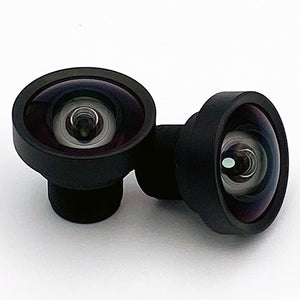
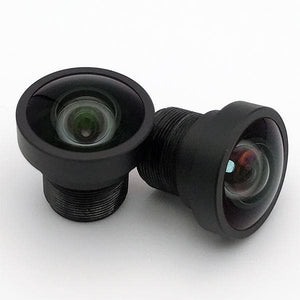
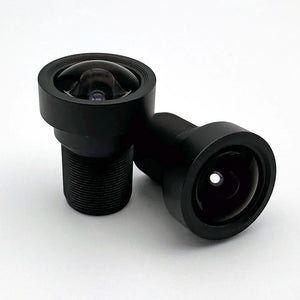
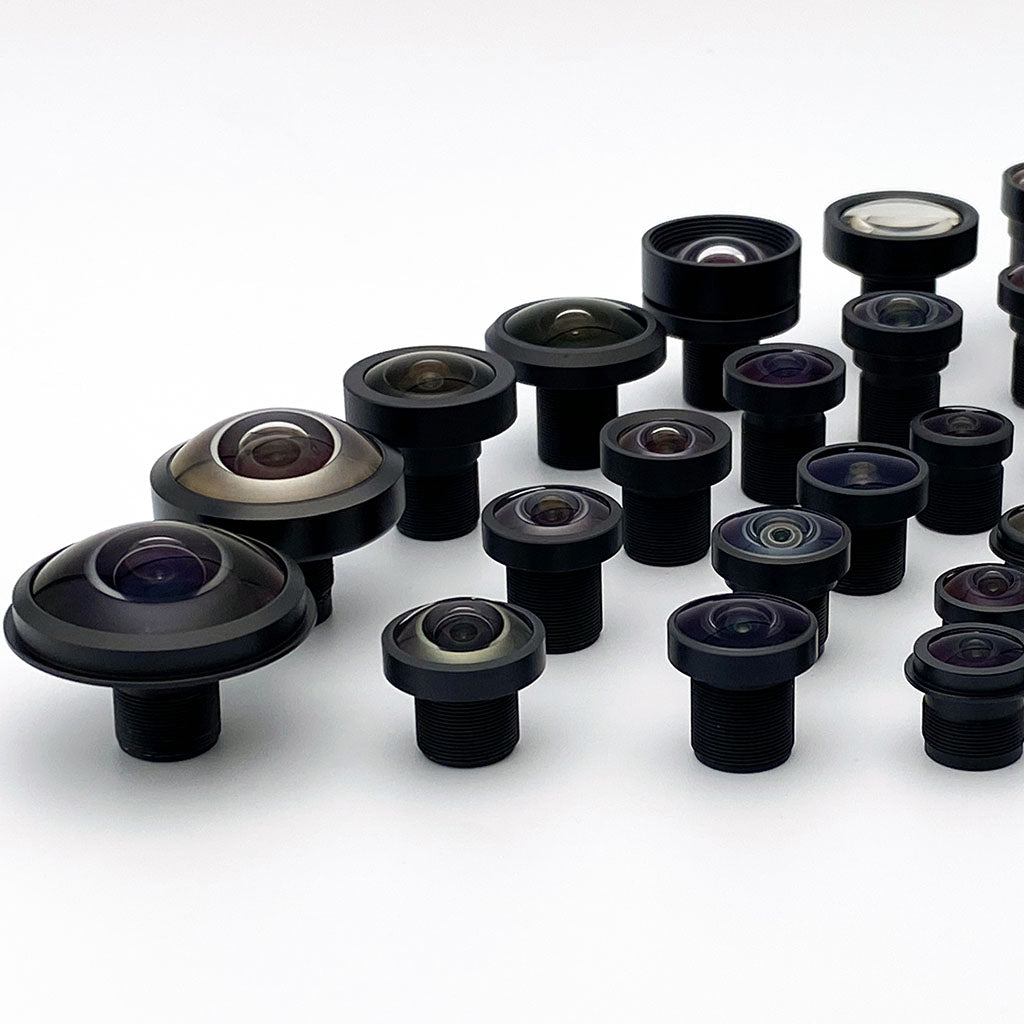
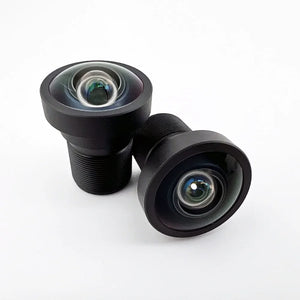
These are entocentric lenses, not telecentric ones. They are appropriate when controlled fixturing, working distances long relative to part height, or a tolerance budget that absorbs residual perspective error mean telecentricity is not required. Each offers low geometric distortion, which addresses in-plane accuracy, a separate property from magnification stability across depth. The M12 vs. C-mount guide covers the mechanical and focus-mechanism differences between these two mount families in more detail; both are entocentric designs, and the choice between them turns on sensor format, working distance, and whether adjustable-iris depth-of-field control is needed, not on telecentricity.
Frequently asked questions
What is a telecentric lens?
A telecentric lens is a lens in which the chief rays on at least one side of the system run parallel to the optical axis instead of converging toward a finite point. The object-space form used most in machine vision places the entrance pupil at optical infinity, so apparent object size stays constant within the usable depth range, suppressing perspective error.
What is object-space telecentricity?
Object-space telecentricity means the entrance pupil sits at optical infinity on the object side. Chief rays from every field point travel parallel to the optical axis before entering the lens, so magnification stays much more constant as the object shifts slightly in depth. This is the form of telecentricity most relevant to dimensional measurement in machine vision.
What is image-space telecentricity?
Image-space telecentricity means the exit pupil sits at optical infinity on the image side, so chief rays arrive near-perpendicular to the sensor across the full field. It improves chief-ray-angle coupling with sensor microlenses and can reduce corner shading, but it does not stabilize magnification versus object distance. That requires object-space telecentricity instead.
What is perspective error in machine vision?
Perspective error is the measurement error that occurs when a conventional entocentric lens views a scene through an angular field of view. Because chief rays converge toward a finite entrance pupil, a feature measures a different size depending on its exact working distance. It is a geometry effect, not a lens aberration, so distortion correction does not remove it.
What is an entocentric lens?
An entocentric lens is a conventional lens whose entrance pupil sits at a finite distance, so chief rays converge toward that point rather than running parallel to the axis, and magnification changes with object distance. Most M12 and C-mount machine vision lenses are entocentric. The term describes projection geometry, not lens quality.
Is a telecentric lens the same as a low-distortion lens?
No. Low distortion describes how faithfully a lens maps straight lines within a plane. Telecentricity describes chief-ray direction and whether magnification is stable versus depth. A lens can have very low distortion and still show perspective error if its entrance pupil sits at a finite distance. The two properties correct different problems and are not substitutes for each other.
What is a bi-telecentric lens?
A bi-telecentric lens is telecentric on both sides at once: the entrance pupil sits at infinity on the object side and the exit pupil sits at infinity on the image side. It combines magnification stability with near-normal sensor incidence, and is the largest and most expensive of the three telecentric configurations.
Do telecentric lenses have better depth of field than standard lenses?
Not inherently. At a given magnification, depth of field is set by f-number and the acceptable blur (pixel pitch); telecentricity itself does not change it. What object-space telecentric designs add is that within the depth of field, dimensional measurements stay accurate regardless of exactly where the object sits, because magnification does not track axial position the way it does with a standard lens.
Why do standard entocentric lenses change magnification with distance?
Chief rays in an entocentric lens converge toward the entrance pupil at a finite distance. As object distance changes, the angle each feature subtends at that pupil changes, and so does its image size. This is fundamental to central projection and cannot be eliminated in a standard lens; only moving the entrance pupil to infinity, as object-space telecentric designs do, removes it.
When do I need a telecentric lens instead of a standard lens?
You need a telecentric lens when you are measuring dimensions to tight tolerances and cannot guarantee the object sits at exactly the same distance from the lens every time. Estimate the expected depth variation, calculate the resulting perspective error, and compare it to your tolerance budget. If parts are tightly fixtured, or the task is detection rather than measurement, a well-corrected standard lens is usually the better choice.
Can software correct perspective error the way it corrects distortion?
No. Distortion is a fixed, repeatable lens property that can be characterized once and corrected in software. Perspective error depends on the 3D position of each scene point, which changes from part to part, so there is no fixed calibration that removes it. Telecentric optics address the problem at the source rather than in post-processing.
Why are telecentric lenses so much larger than standard lenses?
An object-space telecentric lens must collect parallel chief ray bundles across the entire object field, which means the front element diameter has to be at least as large as the field width itself. A lens covering a 50mm object field needs a front element of roughly that size or larger, regardless of focal length. A standard entocentric lens has no such constraint, because its chief rays converge toward a small finite pupil instead of arriving as a full-width parallel bundle; its front element is sized by the aperture, roughly EFL divided by f-number, rather than by the object field width, so it stays far smaller than a telecentric front element covering the same field.
Does Commonlands sell telecentric lenses?
No. Telecentric lenses are not a current Commonlands product. This page is educational, explaining object-space telecentricity, image-space telecentricity, and perspective error so engineers can determine whether their application truly needs telecentric optics or whether a standard M12 lens or C-mount lens already meets the measurement tolerance.
Selecting a lens for your inspection setup?
Telecentric optics are not a Commonlands product, but standard M12 and C-mount lenses cover the large majority of machine vision applications. Use the free calculators to check field of view and depth of field for your working distance, or contact engineering to talk through a specific measurement tolerance.