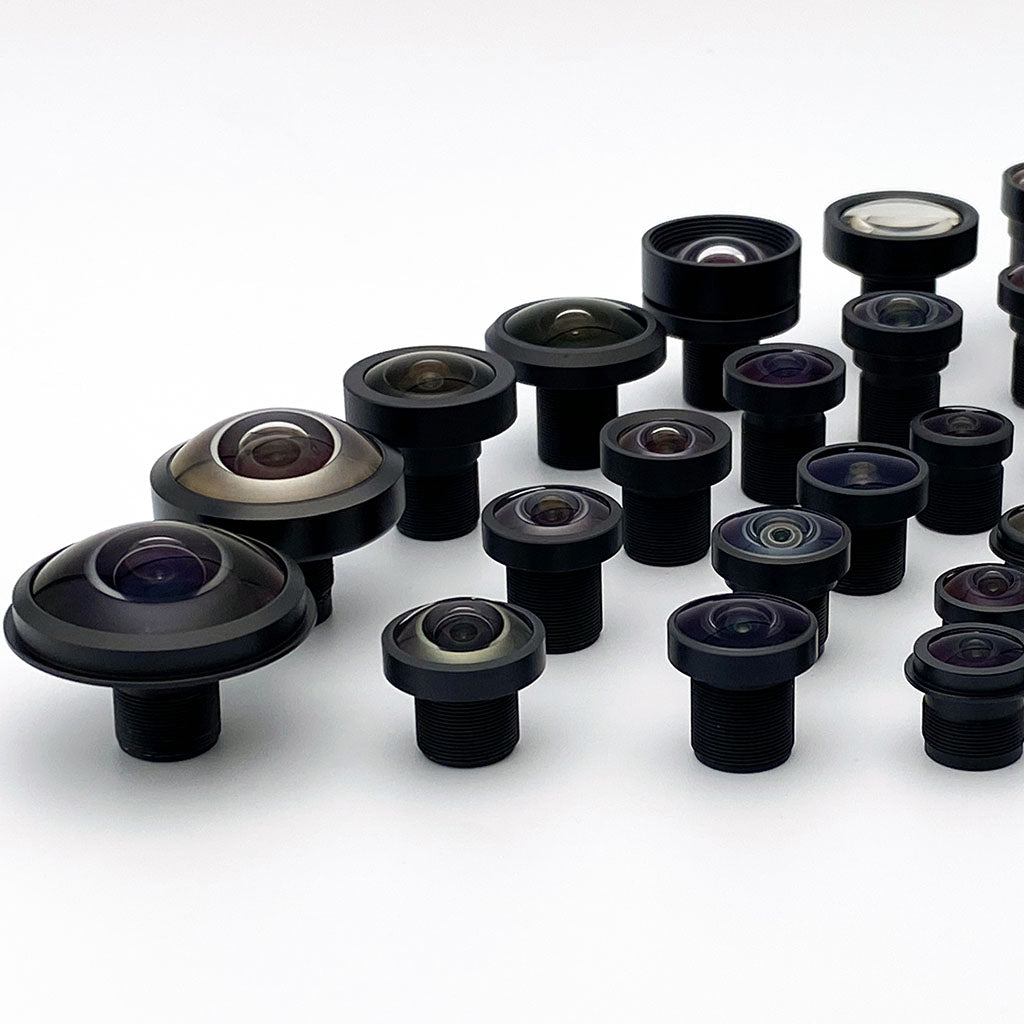

Machine Vision Lenses for Security

Lenses for Surveillance: A Machine Vision Guide to Day/Night Security Cameras

Machine vision lens selection for security and surveillance cameras: IR-cut filter switching, 850nm versus 940nm illumination, low-light aperture, fixed versus varifocal, and environmental sealing.

By the Commonlands engineering team · Updated July 2026 · 19 min read

An outdoor security camera with a fixed M12 lens mounted on a building at dusk

Surveillance lens selection comes down to four decisions: whether the camera needs day/night IR-cut filter switching, which NIR wavelength the illuminator uses, how fast an aperture the low-light budget requires, and whether the mounting distance is fixed at install time. Get those four right and the fixed-versus-varifocal and mount-format choices follow directly.

Most compact IP camera modules use M12 lenses; installations that need an adjustable iris for glare control, longer reach, or larger sensor coverage move to C-mount. Both mount types appear throughout this guide with real specifications, not marketing claims about detection range.

What lens should I use for a day/night surveillance camera?

Use an IR-corrected lens whenever the camera has a mechanical IR-cut filter switcher. During the day the switcher inserts an IR-cut filter so the sensor sees only visible light and colors render correctly; at night it swings the filter out so the sensor can use near-infrared (NIR) illumination for a monochrome low-light image. The lens has to hold focus registration through that transition, or the image goes soft every time the switcher toggles.

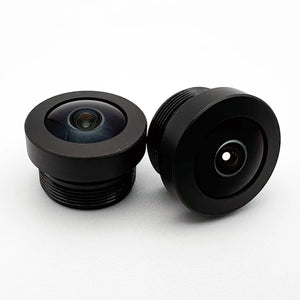
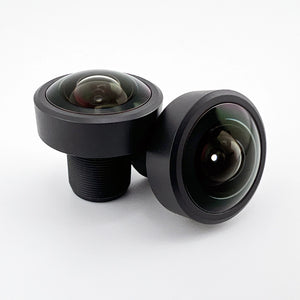
Commonlands stocks IR-corrected M12 lenses built for exactly this: the CIL046 4.4mm M12 lens is RGBIR-corrected at F/2.0 for 1/1.7" sensors up to 8MP, and the CIL290 1.9mm M12 fisheye is IR corrected with an optional 660nm IR-cut filter variant for 1/2.7" sensors up to 5MP. Both ship in versions with and without the cut filter installed, so the same optical design supports either a fixed-filter build or a switcher-equipped one, depending on which part number is ordered.

Why focus shift happens without IR correction

Ordinary glass has different refractive index at visible wavelengths than at NIR wavelengths, so a lens optimized only for visible light forms its sharpest image at a slightly different plane once NIR light dominates the scene. An IR-corrected lens design compensates the glass prescription so the focus plane stays consistent across both bands. See the IR-corrected lens guide and the day/night filter-switcher detail in the bandpass filter guide for the full mechanism.

If the deployment has no switcher (a fixed daytime-only color camera, or a fixed NIR-only night camera), a standard non-IR-corrected lens is adequate, since the design is optimized for a single band and never has to cross over. Operating across both bands is what creates the requirement, most commonly via a switcher: a filterless budget camera module that images visible and ambient NIR simultaneously, with no switcher present at all, hits the same chromatic focus blur if the lens is not IR corrected.

The switcher itself is a small, electromagnetically (solenoid) driven assembly that physically moves an IR-cut filter into and out of the optical path between the lens and the sensor, typically triggered by an ambient-light sensor or a scene-analysis algorithm running on the camera. When ambient light drops below a threshold, the filter retracts, the sensor gain increases, and NIR illumination (if present) becomes the dominant light source. This is a mechanical wear item with a finite switching life, and it is a separate component from the lens itself. The lens has to be optically compatible with both filter states, but it does not contain the switcher.

It follows that a non-IR-corrected lens installed on a day/night camera can look correctly focused in whichever band it was set up under and defocus in the other band. Bench-testing a day/night build should therefore exercise both the daytime (IR-cut) and nighttime (NIR) states rather than relying on a single static focus check under one lighting condition.

A day/night surveillance lens with its IR-cut filter visible at the rear
A 6mm M12 CCTV lens covers a typical wide monitoring scene.

Should I use 850nm or 940nm NIR illumination?

850nm and 940nm are the two common NIR illumination wavelengths for surveillance, and the choice trades range against covertness. 850nm illuminators produce a faint visible red glow that a person standing near the light source can usually notice, but most CMOS sensors retain meaningfully more quantum efficiency at 850nm than at 940nm, which translates to more usable signal and often longer effective range at the same illuminator power. 940nm is close enough to invisible that most people will not notice the illuminator operating, which matters for covert or aesthetically sensitive installations, but the sensor typically responds less strongly at that wavelength, and image quality or range drops unless the sensor and lens are specifically selected for 940nm sensitivity.

The lens's role here is narrower than illumination selection itself: an IR-corrected lens needs to hold focus across whichever NIR band the illuminator uses, and the lens coating and glass transmission should be checked against that specific wavelength rather than assumed. A lens validated for 850nm performance is not automatically equally corrected at 940nm. See the 850nm versus 940nm guide for the sensor-side quantum efficiency comparison and illuminator selection detail.

Practical default

Choose 850nm when maximum detection range and image quality are the priority and a faint illuminator glow is acceptable. Choose 940nm when the installation requires the illuminator to be effectively unnoticeable, and confirm the sensor datasheet's quantum efficiency at 940nm before committing, since it varies significantly between sensor models.

Illuminator range is a system-level calculation, not a lens-level one: it depends on illuminator optical power, the illuminator's own beam angle relative to the lens field of view, sensor quantum efficiency at the chosen wavelength, and atmospheric conditions such as fog, rain, or dust that scatter NIR light (dense fog and rain scatter NIR and visible light comparably, while NIR penetrates fine haze and dust somewhat better than visible light). A lens with a wider field of view than the illuminator's beam angle wastes the edges of the illuminated scene in darkness, so the illuminator beam angle and lens field of view should be matched, not selected independently. Published illuminator range figures generally assume a moderately reflective subject, so a dark, low-reflectivity subject will typically fall short of the rated range. Check whether a given manufacturer states the reflectivity basis for its range figure, since not all do.

Mixed-wavelength deployments are also common: some sites run 850nm illumination on wide-coverage cameras where range matters most, and 940nm on cameras positioned where a visible glow would be noticed by the public or would interfere with a customer-facing area. There is no requirement that every camera on a site use the same wavelength, but the lens on each camera should be verified against the illumination it will actually pair with, not assumed compatible by default.

What aperture is best for a low-light surveillance lens?

A faster lens, meaning a lower F-number, collects more light per unit time at a given exposure and gain setting, which is the main lever available for nighttime image quality once illumination power is fixed. The CIL522 12mm C-mount lens ships with an adjustable iris from F/1.4 to F/16, so the same lens runs wide open at F/1.4 for maximum light throughput at night and can stop down in daylight to control glare and extend depth of field. That adjustability is the practical advantage C-mount holds over fixed-aperture M12 in a surveillance deployment that has to work across a full day/night cycle, since illumination in an outdoor scene is only partially controllable, unlike a factory inspection cell with programmable strobes.

M12 low-light options are fixed at a single aperture set at manufacture. The CIL046 ships at a fixed F/2.0, which is fast for a compact board lens and works well for many indoor and moderate-range outdoor installations, but there is no iris ring to trade light throughput for depth of field or glare control after the fact. For the general relationship between F-number, light throughput, and image quality, see the low-light lens selection guide.

Image-plane illuminance ∝ 1 / F#² Going from F/2.8 to F/1.4 is a two-stop change and roughly quadruples the light reaching the sensor at the same exposure time, holding all else constant.

Opening the aperture also narrows depth of field and can increase off-axis aberrations and vignetting near the edge of the frame, so the fastest available F-number is not automatically the right daytime setting even on a lens with an iris ring. But stopping down has its own cost that grows with F-number: diffraction. At 550nm visible light, the Airy disk diameter at F/8 is roughly 10.7µm, and at F/11 roughly 14.8µm; under 850nm NIR illumination both diameters grow by roughly 1.5 times. That is already 2.5 to 3.5 times the CIL522's 4.2µm pixel pitch, well past the point where the aperture itself, not the sensor, is limiting resolution. Since this guide elsewhere insists the lens has to out-resolve the sensor's pixel pitch, stopping all the way down to F/8 or F/11 in daylight works against that goal on a small-pixel sensor. In practice, small-pixel C-mount surveillance lenses hit the diffraction ceiling around F/5.6 to F/8, and glare or depth-of-field control in daylight should stop down only as far as that ceiling allows, not to the smallest available aperture.

Aperture is one lever in a larger low-light exposure equation that also includes exposure time and sensor gain. Longer exposure collects more light but risks motion blur on a moving subject, which is a real constraint in security footage where the subject of interest is, by definition, often moving. Higher sensor gain compensates for insufficient light without changing exposure time, but gain amplifies sensor noise along with signal, so pushing gain too far in place of a faster lens or better illumination produces a noisy, grainy image that may still fail to resolve the detail an investigator needs. A faster lens is the only one of the three levers that does not cost either motion blur or noise, which is why lens aperture gets disproportionate attention in surveillance system design relative to its line-item cost.

The practical ceiling on how fast a lens should go is set by the sensor and the scene, not just the lens datasheet. Very fast apertures on small-format lenses can show more field curvature and astigmatism at the edge of the frame, degrading corner sharpness even as center sharpness improves. A lens rated F/1.4 is not necessarily sharper across the whole frame at F/1.4 than at F/2.8, only brighter. For a scene with a wide dynamic range, such as a building entrance lit by a bright overhead fixture against a dark parking lot, a slightly stopped-down setting with adequate illumination often outperforms a wide-open setting that clips highlights and shows more edge softness.

Should a surveillance camera use a fixed or varifocal lens?

Fixed focal length lenses are the simpler, more compact, and often less expensive option, and they are the practical choice once mounting distance and required coverage are known before installation. A camera mounted at a fixed height over a fixed doorway or hallway rarely needs the field of view to change after commissioning, so a fixed lens removes a mechanical adjustment and a potential failure point.

Varifocal lenses let an installer adjust focal length, and therefore field of view, on site without swapping the optic. That flexibility earns its cost when the exact mounting distance is not finalized until the installer is on the roof or pole, when the same camera model needs to serve multiple coverage requirements across a large deployment, or when the coverage requirement itself may need to change after commissioning. The tradeoff is a more complex mechanical assembly and typically a narrower maximum aperture than an equivalent fixed lens at the same price point.

Commonlands' current M12 and C-mount lineup is fixed focal length. For a full comparison of the two approaches, including parfocal behavior and zoom versus varifocal distinctions, see the fixed versus varifocal lens guide. If a project's coverage requirement is well defined, working through the focal length selection guide to pick the correct fixed lens is usually the more cost-effective and mechanically simpler path.

There is a middle ground worth naming even though it falls outside a strict fixed-versus-varifocal choice: a project with several similar but not identical mounting distances across a site (three doorway cameras at slightly different heights, for example) can often standardize on a single fixed focal length across all of them rather than treating each as a unique optical problem, provided the coverage tolerance across those small height differences is acceptable. Reserve true varifocal hardware for cases where the coverage requirement is genuinely unknown or expected to change, not as a default hedge against measuring the installation correctly.

Fixed lenses also simplify a detail that is easy to overlook during specification: a fixed lens's field of view, once selected, does not drift from installer-to-installer variation the way an unlocked varifocal ring can if it is not secured after final adjustment. On a large multi-site deployment where consistency across cameras matters for downstream analytics or a security operations center's expectations, that repeatability has real value beyond the unit cost difference.

Range versus coverage: what distance can a lens actually resolve?

A wide-coverage lens and a long-range lens solve different problems, and no single lens does both well at the same sensor resolution. Wider focal lengths capture more scene width at a given distance but spread the sensor's pixels across that wider scene, which reduces pixels on any one target. Longer focal lengths concentrate pixels onto a narrower scene, improving resolvable detail on a distant target at the cost of overall coverage. This is the same focal length, field of view, and sensor tradeoff that governs every machine vision lens; surveillance work usually frames it in terms of a general pixel-density hierarchy instead of a single field-of-view number.

A practical, generic way to describe that hierarchy without citing a specific named standard: at low pixel density, a lens shows that something is present in the scene, a moving shape against the background. At moderate pixel density, it shows enough shape and orientation to classify what that object generally is, a person versus a vehicle versus a foreground object. At higher pixel density, it starts to resolve enough distinguishing detail, clothing, vehicle type, gait, to recognize a specific known subject or vehicle against a reference. At the highest pixel density, it resolves enough fine detail, facial features or license plate characters, for a positive identification. Each tier up the hierarchy roughly multiplies the pixel-per-meter requirement, which either shortens usable range at fixed focal length or forces a longer lens, a higher-resolution sensor, or a shorter working distance.

Working the numbers

The same rectilinear relationship used throughout machine vision applies directly here: EFL = (working distance × sensor width) / scene width. This linear form holds when the working distance is much longer than the focal length, as it is in typical surveillance mounting; at close range the thin-lens magnification relation applies instead. A wider scene width at a fixed working distance forces a shorter focal length and fewer pixels per meter on any given subject; a narrower target scene width at the same working distance calls for a longer focal length and yields more pixels per meter. This formula excludes fisheye lenses such as the CIL290: rectilinear projection diverges as the half-angle approaches 90°, while a 190° fisheye's coverage follows the lens's own distortion mapping instead. Verify the actual geometry for a specific installation with the field of view calculator, which accounts for distortion-corrected FoV on fisheye lenses, rather than estimating from a lens datasheet's headline field-of-view number alone.

The practical implication for lens selection: decide which tier of the hierarchy the installation actually needs at the farthest distance in the coverage plan, then size focal length and sensor resolution to hit that pixel density at that distance, rather than picking a focal length first and hoping detail follows. A parking-lot overview camera and a doorway facial-recognition camera are not interchangeable lens problems even when mounted at similar heights.

A common design mistake is treating a single camera as capable of every tier simultaneously across its full field of view. In practice, a wide lens covering an entire lot reaches the identification tier only near the center of frame at close range, degrading toward the detection tier at the far edges and corners, because pixels per meter falls off with distance under a fixed focal length. Multi-camera layouts that pair one wide-coverage camera with one or more longer-focal-length cameras aimed at specific chokepoints, such as an entrance or a gate, are a direct consequence of this: the wide camera handles situational awareness, and the narrower camera handles the tier that actually requires identification-grade detail.

Matching sensor format and resolution to the surveillance lens

For rectilinear lenses, the image circle has to cover the sensor diagonal with margin, or the image vignettes at the corners regardless of how well the rest of the specification matches. Fisheye lenses are the exception to that rule: a fisheye's circular image is deliberately cropped by the sensor rather than sized to clear the diagonal, so its image circle can be smaller than the sensor diagonal by design without vignetting the corners in the same way a rectilinear lens would. Common surveillance sensor formats range from 1/2.9" to 1/1.7" in compact IP camera modules using M12 optics, and up to 2/3" or 1.1" in higher-resolution C-mount builds used for wider-area or longer-range coverage. The CIL046 covers up to 1/1.7" at 8MP, the CIL290 fisheye's 5.8mm image circle pairs with 1/2.7" sensors (roughly 6.7mm diagonal) precisely because of that cropped-circle exception, and the CIL542 covers 1.1" sensors at 25MP with 2.5µm pixel pitch: three different image circles for three different coverage and resolution targets.

Resolution and pixel pitch matter independently of sensor physical size. A higher megapixel count on the same physical sensor size means smaller individual pixels, which increases spatial resolution but reduces the light-gathering area of each pixel, generally raising noise at a given illumination level unless the sensor generation has improved per-pixel sensitivity. A surveillance system specified purely by megapixel count without checking pixel pitch against expected illumination can end up with a higher-resolution but noisier low-light image than a lower-resolution sensor with larger pixels would have produced. The lens has to resolve at least as finely as the sensor's pixel pitch, or the optical blur becomes the limiting factor and the extra megapixels add little usable detail; see the spatial resolution guide for the relationship between lens resolving power and sensor pixel pitch.

For rectilinear lenses, oversizing the lens image circle relative to the sensor is safe with respect to vignetting and coverage, since the unused portion of the image circle simply falls outside the active sensor area; undersizing it produces vignetting: corners that fall entirely outside the image circle receive no light and cannot be recovered, while milder falloff near the edge of coverage can be gain-corrected only at a noise penalty. That coverage safety is not the whole story, though: a lens designed for a larger image circle is typically specified to a lower lp/mm requirement, and it may not resolve a small-pixel sensor's Nyquist frequency even though the image circle covers it comfortably. Exit-pupil position and chief-ray-angle geometry are also matched to the larger format's microlens design, and can mismatch a smaller sensor's microlenses enough to cause color shading toward the edges of the frame. When in doubt between two adjacent lens image-circle ratings, the larger one is the safer default for coverage, but resolving power and CRA compatibility against the specific sensor still need to be verified, not assumed. Fisheye lenses such as the CIL290 are exempt from the diagonal-with-margin rule entirely, since their coverage comes from a deliberately cropped circular projection rather than a rectilinear image circle sized to clear the corners.

Environmental sealing for outdoor surveillance cameras

A lens needs its own ingress protection rating only when it is directly exposed to weather rather than sitting behind a sealed camera housing dome or window. Many outdoor surveillance cameras protect the lens with a sealed enclosure, in which case the enclosure's own IP rating governs and the lens rating is secondary. Board-level and open-frame designs, where the lens front element faces the environment directly, are where a lens-level rating matters on its own.

Commonlands stocks select M12 lenses rated for direct outdoor exposure: the CIL290 1.9mm M12 fisheye is IP67 rated in addition to being IR corrected, and the CIL948 4.8mm M12 lens combines an IP69K rating with a hydrophobic front-element coating that sheds rain and reduces water spotting on the lens surface itself. Not every lens in the catalog carries this rating; verify the specific SKU and mechanical variant before specifying a board-level outdoor build, since the same optical design sometimes ships in both sealed and unsealed mechanical variants.

Rating scope

An IP67 rating on the lens covers the lens assembly itself against dust and temporary water immersion. It does not extend to the camera body, connector, or cable unless those are separately rated. Confirm ratings at the system level, not just the lens level, before committing to a fully exposed outdoor mount. See the IP rating guide for the full rating scale and test methodology.

Outdoor surveillance deployments also see the thermal cycling and vibration common to any outdoor machine vision installation. Select C-mount lenses address harsh-environment use with additional mechanical hardening; not all C-mount lenses in the catalog carry that rating, so confirm the specific SKU rather than assuming C-mount implies ruggedization. See the ruggedized lens guide for what that hardening covers.

Top lenses for day/night surveillance cameras

For day/night surveillance the lens follows the imaging job: an IR-corrected M12 lens such as the CIL046 when the camera has an IR-cut filter switcher, a fast adjustable-iris C-mount lens such as the CIL522 for low light, and a fisheye such as the CIL290 when one camera has to cover a wide entry area. The five lenses below are current Commonlands stock optics, each matched to the surveillance scenario it fits best. Browse the full surveillance camera lens collection for the rest of the range.

How we picked: every entry is a shipping Commonlands SKU with specifications published on its product page. Each row is sorted by the one decision that drives it in a security build (switcher compatibility, aperture, pixels on target, coverage angle, or sealing), and the EFL and F-number values come from those product pages, not from detection-range marketing. Confirm sensor-format coverage against your sensor before ordering.

Scenario Lens Mount EFL F# Why this pick
Day/night with an IR-cut switcher CIL046 M12 4.4mm F/2.0 RGBIR corrected, so it holds focus registration through the visible-to-NIR switch. Covers up to 1/1.7" 8MP sensors.
Low light with daytime iris control CIL522 C-mount 12mm F/1.4–F/16 Opens to F/1.4 at night for light throughput, then stops down by day for glare control and depth of field.
Long range, identification-tier detail CIL542 C-mount 12mm F/2.8–F/16 25MP class on 1.1" sensors puts more pixels on a distant subject. IR corrected for day/night operation.
Wide-area single-camera coverage CIL290 M12 1.9mm F/2.2 190° fisheye for doorway and entry cameras. IR corrected with an optional 660nm cut filter, IP67 rated.
Direct outdoor board-level mount CIL948 M12 4.8mm F/2.0 IP69K with a hydrophobic front element for builds where the lens itself faces the weather. Pair it with wide-coverage roles, not identification detail at range.

EFL and F-number values are from the current product pages. Verify coverage on your specific sensor with the field of view calculator, and size focal length with the focal length selection guide.

Varifocal surveillance incumbents such as Theia and Computar cover the case where an installer has to set field of view on the pole without swapping optics. A fixed Commonlands prime is the better call once mounting distance and coverage are known, since it removes a mechanical adjustment and holds a wider maximum aperture at the same price point. See the fixed versus varifocal tradeoff earlier on this page for when a motorized varifocal actually earns its cost.

190°@5.7mm Fisheye M12 Lens

CIL290-F2.2-M12A660

190°@5.7mm Fisheye M12 Lens

$29.00

View details
5mm M12 Lens for IMX334

CIL046-F2.0-M12A650

IR Corrected 4.4mm M12 Lens

$79.00

View details
35mm M12 Lens

CIL350-F2.4-M12A650

Telephoto 35mm M12 Lens

$59.00

View details
200° M12 Fisheye Lens

CIL219-F2.5-M12A650

200°@6.3mm Fisheye M12 Lens

$79.00

View details
IR Corrected Day Night Fisheye Lens S-Mount

CIL239-F2.0-M12A650

186°@5.2mm IR Corrected Fisheye M12 Lens

$59.00

View details
6mm M12 Lenses S Mount Lens

CIL059-F1.7-M12B650

Low Distortion 6mm M12 Lens

$49.00

View details
Mini Fisheye S Mount Lens

CIL217-F2.7-M12ANIR

200°@5.7mm IP67 Fisheye M12 Lens

$39.00

View details
Telephoto 12mm M12 Lens

CIL125-F2.4-M12A650

Telephoto 12mm M12 Lens

$39.00

View details
Wide Angle Low Distortion 2mm S-Mount Lens CIL023

CIL023-F2.2-M12B650

Low Distortion 2.2mm M12 Lens

$39.00

View details
Wide Angle M12 Lens

CIL344-F1.9-M12B660

Wide-Angle 4.5mm M12 Lens

$49.00

View details
Wide-Angle 3.2mm CS Mount Lens

CIL032-F2.2-CSANIR

Wide-Angle 3.2mm CS Mount Lens

$79.00

View details
 3mm miniature fisheye M12 lens

CIL231-F1.9-M12A650

190°@9.1mm Fisheye M12 Lens

$99.00

View details
A bullet camera ringed with near-infrared LEDs around its M12 lens imaging a dark yard
Infrared LEDs let the camera keep watching after dark.

Frequently asked questions

What lens should I use for a day/night surveillance camera?

Use an IR-corrected lens if the camera has a mechanical IR-cut filter switcher, since the lens must hold focus registration in both the visible-only daytime state and the NIR-inclusive nighttime state. The CIL046 4.4mm M12 lens and CIL290 1.9mm M12 fisheye are both IR corrected with an optional 650nm/660nm cut filter for this purpose. Without a switcher, a fixed IR-cut or IR-pass configuration is set at build time instead.

Should I use 850nm or 940nm NIR illumination for a security camera?

850nm gives more sensor signal and longer effective range but produces a visible dim red glow from the illuminator. 940nm is functionally invisible to the human eye but most sensors are less sensitive at that wavelength, so range and image quality typically drop unless the sensor and lens are specifically matched to 940nm. Choose 850nm when detection range matters most and covert illumination is not a requirement.

What aperture is best for a low-light surveillance lens?

A faster (lower F-number) lens collects more light per unit time, which matters most at night when illumination is limited. The CIL522 12mm C-mount lens offers F/1.4 to F/16 adjustable aperture, letting the same lens run wide open at night and stop down for depth of field and glare control in daylight. M12 low-light options such as the CIL046 ship at a fixed F/2.0, which is fast but not adjustable.

Should a surveillance camera use a fixed or varifocal lens?

Fixed focal length lenses are simpler, more compact, and often less expensive, and they are the practical choice once the mounting distance and required coverage are known and stable. Varifocal lenses let an installer adjust field of view on site without swapping optics, which is useful when mounting distance is not finalized until installation or the coverage requirement may change later.

How does distance affect what a surveillance lens can resolve?

Resolving a face or a license plate at longer range needs more pixels on target, which means either a longer focal length, a higher-resolution sensor, or a shorter working distance. A wide-coverage lens that frames an entire parking lot will show a person as a recognizable shape but not resolve fine facial detail at the same distance a narrower, longer lens would provide with the same sensor.

Does a surveillance lens need to be IP67 rated?

Only if the lens itself is directly exposed to the elements rather than sitting behind a sealed camera housing dome or window. Select Commonlands M12 lenses such as the CIL290 carries an IP67 rating and the CIL948 an IP69K rating for direct outdoor exposure. If the lens sits behind a properly sealed enclosure, the enclosure's rating governs and the lens rating matters less.

Can I use an M12 lens for a surveillance camera, or do I need C-mount?

M12 lenses are common in surveillance because they are compact, inexpensive, and cover the sensor formats used in most IP camera modules. C-mount is worth choosing when the application needs an adjustable iris for glare and depth-of-field control, longer focal length reach for a distant target, or larger sensor coverage than typical M12 image circles support.

What is the difference between a surveillance lens and a traffic monitoring lens?

Surveillance covers general security imaging: entryways, perimeters, indoor and outdoor facilities, and general-purpose IP cameras, typically at shorter working distances and with a wide range of sensor formats. Roadway and intersection traffic monitoring is a distinct application with its own working-distance and telephoto requirements. See lenses for traffic monitoring for that scope specifically.

Does a surveillance lens need to be IR corrected if there is no NIR illuminator?

Not necessarily. IR correction addresses focus shift between visible and near-infrared light, which only matters when the camera actually operates in both bands, typically through a day/night IR-cut filter switcher paired with NIR illumination at night. A daytime-only color camera with no NIR illuminator and no switcher does not need IR correction, since the lens only ever operates in one band.

What sensor format should I use for a surveillance camera lens?

For rectilinear lenses, match the lens image circle to the sensor diagonal with margin, not less. Common surveillance sensor formats range from 1/2.9" to 1/1.7" for compact M12-based IP cameras, and up to 2/3" or 1.1" for higher-resolution C-mount builds. Oversizing the image circle is safe with respect to vignetting and coverage; still verify resolving power and CRA against the sensor, since a lens built for a larger format may not resolve a small-pixel sensor's Nyquist frequency or match its microlens geometry. Fisheye lenses such as the CIL290 are exempt from this rule, since their coverage comes from a deliberately cropped circular projection rather than a rectilinear image circle sized to clear the corners. See the sensor size and lens compatibility guide for vignetting and coverage mechanics.

How much does stopping down help with headlight or streetlight glare at night?

Stopping down the aperture reduces the peak intensity reaching the sensor from a bright point source such as a headlight or streetlight, which reduces blooming and flare in the frame. It also increases depth of field. The tradeoff is more than just needing extra scene illumination: stopping down also worsens diffraction, and on a small-pixel sensor that ceiling can arrive by F/5.6 to F/8, so an adjustable iris on a C-mount lens should be used to find the best balance point, not simply closed down as far as it goes.

Need help specifying a lens for a surveillance camera?

Commonlands engineering can work through IR correction, NIR wavelength matching, aperture, and sensor format with you before you commit to hardware.