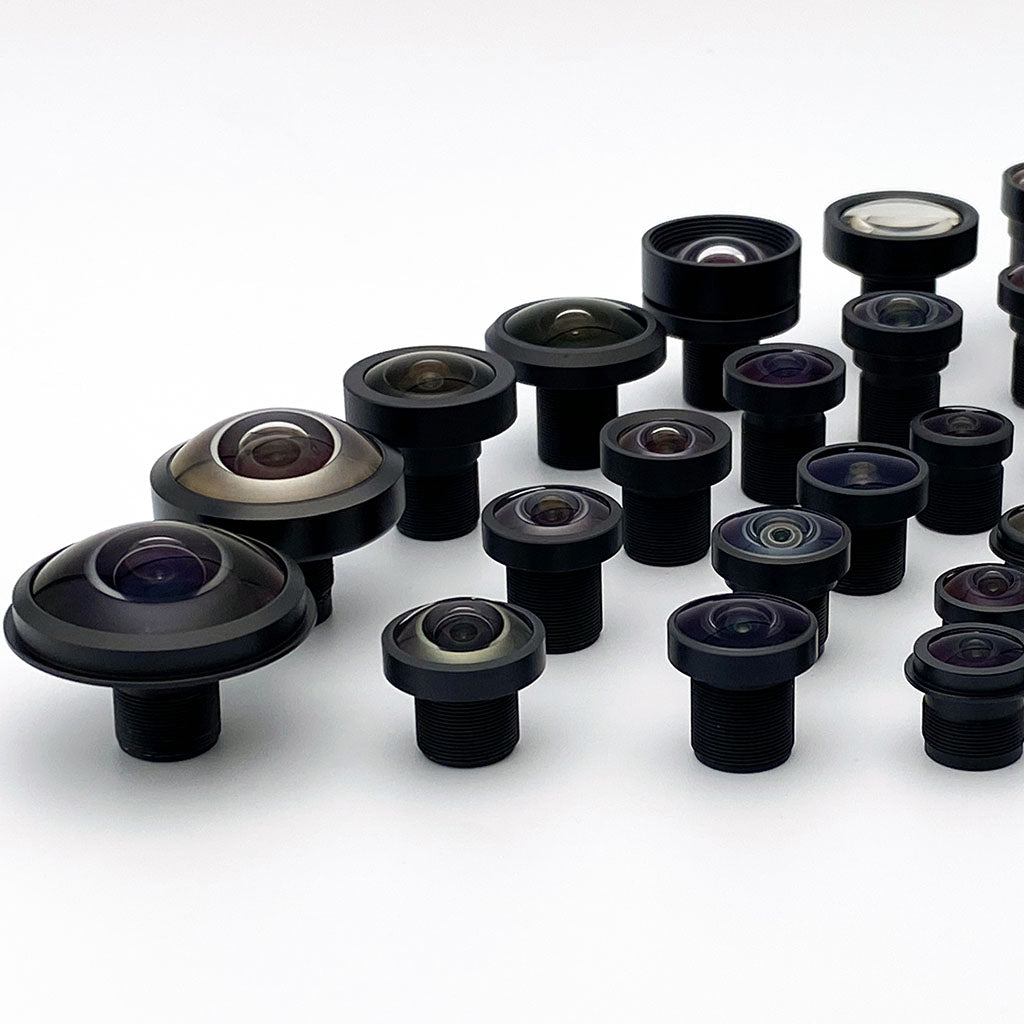

Nine M12 Lens Options for Industrial Machine Vision
An application shortlist covering individual lenses, product families, suppliers, and a development kit. Compare their published specifications, documentation, and prices, then test the candidates that fit your system.

This Commonlands shortlist includes individual lenses, product families, suppliers, and a development kit for different applications. It is based on published specifications and documentation, without matched-design testing or a performance score. Use it to identify candidates for testing on your sensor. Commonlands products appear alongside other suppliers, so consider our commercial interest when reading the selections.
- Commonlands CIL034 3.2mm: a wide-field option, 0.07% TV distortion and an IP67 variant at $39
- Commonlands CIL059 6mm F/1.7: a large-aperture option for 1/1.8" sensors
- Edmund Optics TECHSPEC Blue Series: a catalog lens family, $115 to $137 per unit
- Computar MVS series: an 8MP-rated lens family for 1/1.8" sensors
- Lensation low-distortion M12 lenses: options for low-distortion imaging
- Sunex: an OEM supplier for automotive programs, samples $69 to $99
- Commonlands CIL062 6.2mm: a $19 option
- Arducam M12 lens kit: a Raspberry Pi prototyping option
- Commonlands CIL250 25mm IR-corrected: a telephoto option for day/night imaging
Commonlands figures below come from published, MTF-verified product data. Competitor figures and prices come from each maker's published pages as of August 2026.
1. Commonlands CIL034 3.2mm M12 Lens: Wide-Field Option
EFL 3.2mm · F/2.3 (F/2.7 and F/4.2 variants) · 102° and 0.07% TV distortion at the 8.0mm reference circle · 7.8mm image circle (8.2mm max) · $39 · IP67 variant · In US stock
The CIL034 is Commonlands' best-selling M12 lens: a 3.2mm wide-angle design with 0.07% TV distortion and a 102° field at the 8.0mm reference circle, at $39 across all eleven variants. The M12A mechanical variant carries an IP67 rating under IEC 60529, which covers the tested variant as mounted against dust and temporary immersion in water.
A 102° field that stays this straight is why it outsells everything else in the line. Perception and measurement stacks get wide coverage without heavy software correction, and straight lines render straight. The same optical design serves indoor cells and sealed outdoor housings, and every unit is MTF-tested before it ships from San Diego.
The image circle is the honest limit: 7.8mm as designed (8.2mm maximum) covers 1/2"-class sensors, not the 1/1.8" parts the CIL059 serves. F/2.3 is moderate rather than fast, and a wide field is the wrong tool for reading detail at distance. When the job needs a larger format, more speed, or reach, step down the list.
2. Commonlands CIL059 6mm F/1.7 M12 Lens: General-Purpose and Low-Light Option for 1/1.8" Sensors
EFL 5.9mm · F/1.7 · 76° @ 8.8mm image circle · -4% rectilinear distortion @8.8mm · $49 · In US stock
The CIL059 is a 6mm low-distortion M12 lens (5.9mm EFL) at F/1.7, priced at $49. The image circle measures 9.0mm as designed and 10.4mm maximum, and the design started life covering stereo vision cameras built on sensors such as the OX08B40 and AR0820.
F/1.7 is the fastest aperture among the specific lenses named in this shortlist, collecting about three times the light of an F/3.0 lens at the same exposure time. That headroom lets a logistics or robotics camera keep exposure times short and gain low as lighting drifts, and the 76° field at the 8.8mm image circle suits general scene coverage. Like every Commonlands lens, each unit ships MTF-tested.
-4% rectilinear at the 8.8mm image circle is the cost: fine for detection and monitoring, and enough to send measurement work to the CIL034 instead. The two figures do not subtract, since rectilinear and TV distortion are referenced to different things, so check each against your own field height and geometric tolerance. F/2.8 through F/5.6 variants exist for builds where depth of field matters more than speed.
3. Edmund Optics TECHSPEC Blue Series: Established Catalog Line for Factory Automation
Focal lengths 2mm to 35mm · Sensor coverage varies by model · $115 to $137 per unit ($144 to $167 Rugged Blue) · Per Edmund's published listings
Edmund Optics' TECHSPEC Blue Series is a family of finite-conjugate M12 imaging lenses spanning 2mm to 35mm focal lengths, including ruggedized Rugged Blue variants, with sensor format and megapixel ratings published per model.
The line offers an established catalog and detailed documentation. Finite-conjugate designs are specified at the short working distances inspection stations actually use, and the documentation runs deep. Edmund's distribution reach makes the series easy to buy worldwide, which counts for a factory automation integrator standardizing on one optics vendor.
Price is the plainest tradeoff. Blue Series units list at $115 to $137 each at single-unit quantities on Edmund's product pages as of August 2026, and Rugged Blue variants run $144 to $167. Edmund's published Qty 50+ tier still sits at $91 to $131 per unit. Every Commonlands lens in this shortlist lists between $19 and $99 at quantity one, and three of the four are $49 or less.
The published format ceiling is the second limit: the series' stated coverage tops out below the 1/1.8" class that current parts like the IMX678 occupy. Programs moving to newer, larger-format sensors will outgrow it.
4. Computar MVS Series: 8MP Lens Family for 1/1.8" Sensors
E0828KY, E1228KY, E1628KY · 1/1.8", 8MP class · Distortion -0.20% to +0.29% · Pricing not published · Per Computar's published pages
Computar's MVS series is the newest line here: the E0828KY, E1228KY, and E1628KY, built around 1/1.8" 8MP sensors. Per Computar's published pages, the E0828KY is an 8mm F/2.8 design, and the model numbering continues at 12mm and 16mm.
Computar lists distortion from -0.20% to +0.29% across this line without identifying the convention on the pages reviewed. Request the definition and field height before comparing those values with TV or rectilinear distortion. They do not establish an equivalent bound on measurement error.
Commonlands fields the same three focal lengths from US stock today: the CIL078 7.8mm F/2.0 with -1.1% TV distortion at 8.8mm for $59, the IR-corrected CIL122 12mm with under 2% TV at 9.2mm for $59, and the CIL160 16mm F/1.9 with -0.5% TV at 8.9mm for $39. The distortion conventions differ, so these percentages do not establish a performance ranking. Compare aperture, spectral correction, measured MTF, price, and availability for the specific candidates.
Newness cuts the other way for Computar. Three focal lengths with no wide end keep the series to normal and narrow fields, Computar's pages list no per-unit prices, and a line this new means the field track record is short. As of August 2026, Computar lists the 16mm E1628KY as coming soon. Confirm model availability first.
5. Lensation Low-Distortion M12 Lenses: German-Engineered Option for Robotics
Lensagon low-distortion M12 lines · 464-item S-mount catalog · Robotics and industrial vision focus · Prices not published (quote per order) · Per Lensation's published pages
Lensation is a German optics company whose Lensagon S-mount catalog lists 464 items, including low-distortion M12 lines for robotics and industrial vision, with specifications published per model.
For a European robotics program, Lensation is the natural counterpart to this list's US entries: engineering support in-region, low-distortion designs matched to the navigation and inspection work M12 dominates, and no transatlantic freight.
Two practical cautions before designing one in. Lensation publishes no prices: every product page ends in a quote request, so budgeting starts with an email. And model turnover is visible on Lensation's own pages: its clearance page lists 27 Lensagon models as "discontinued or no longer available," and individual product pages carry discontinuation banners, including last-buy and low-stock notices on models with no named successor.
Check the lifecycle status of any Lensagon model before committing a multi-year build. The Commonlands entries in this shortlist publish prices on the page and ship from US stock.
6. Sunex: OEM Supplier for High-Volume Automotive Programs
25+ years of OEM M12 design · 100M+ lenses shipped · Samples $69 to $99 via the Optics-Online webstore · Volume by quote · Per Sunex's published pages
Sunex has designed M12 optics for OEM programs for more than 25 years and reports over 100 million lenses shipped, an average of several million units a year. Automotive is one of the markets Sunex names in its published positioning, alongside embedded vision, robotics, and medical. Shipment volume is a record of scale, not evidence that a particular design or quality system meets a given vehicle program's requirements: qualification runs per part and per program, and the documentation for it comes from the supplier.
For a volume program, that record is the point. A camera platform heading to seven-figure annual quantities wants an optics partner that has shipped at vehicle-program scale, and Sunex's 100 million units say it has.
Off-the-shelf buying runs through Sunex's Optics-Online webstore, where samples in quantities of 1 to 99 units list at $69 to $99 per lens as of August 2026 and volume pricing goes by quote. That sample band sits above most Commonlands single-unit prices here ($19 to $59 for the wide and normal lenses in the price table), and the quote cycle adds a step that on-page pricing avoids. Prototype where the data and the price are published, then bring Sunex in when program-scale volume justifies the engagement.
7. Commonlands CIL062 6.2mm M12 Lens: Budget Option at $19
EFL 6.2mm · F/2.8 (F/4.0 and F/5.6 variants) · 60° @ 7.2mm image circle · -2% rectilinear distortion @8.8mm · $19 · In US stock
At $19, the CIL062 undercuts everything else in this shortlist: a rectilinear 6mm design (6.2mm EFL) at F/2.8, with a 60° field at a 7.2mm image circle and -2% rectilinear distortion at 8.8mm. All eight variants, spanning F/2.8, F/4.0, and F/5.6 with 650nm IR-cut or no-filter options, hold the same $19 price from US stock.
Nineteen dollars changes the math on multi-camera systems. Lensing a four-camera inspection cell costs less than one imported catalog unit, and the F/4.0 and F/5.6 variants extend depth of field for fixed-focus stations without adding a cent. The rectilinear correction keeps it usable for alignment and positioning work as well as monitoring.
The tradeoff is speed. At F/2.8 it collects roughly a third of the light of the F/1.7 CIL059, which rarely matters under controlled lighting and matters a lot outdoors at night. For dim or uncontrolled scenes, the CIL059 is worth the extra $30.
8. Arducam M12 Lens Kit: Raspberry Pi Prototyping Kit
M12 lens kits for Raspberry Pi HQ and Global Shutter cameras · Multiple focal lengths per kit · Kit pricing varies · Per Arducam's published listings
Arducam sells M12 lens kits for the Raspberry Pi HQ and Global Shutter cameras: several focal lengths in one box at prototyping money, with the mounts and adapters Pi camera builds expect.
Nothing beats a kit for bracketing field of view empirically. Screwing in four focal lengths over an afternoon answers the framing question faster than any calculator, and the kit price makes wrong guesses cheap.
Per-lens optical data is thin: kit listings publish little distortion or MTF documentation, so treat the kit as an experiment, not a specification. When the prototype becomes a product, re-spec to a single documented lens. The Raspberry Pi section below names the candidates.
9. Commonlands CIL250 25mm IR-Corrected M12 Lens: Telephoto and Day/Night Option
EFL 25.0mm · F/2.0 · 20° @ 8.8mm · Distortion under 3% · From $99 · In US stock
A 25mm telephoto at F/2.0, the CIL250 is an all-glass design weighing 6g, with a 9.4mm image circle and a 20° field at 8.8mm. Pricing starts at $99, and the lens is IR corrected for day/night cameras, covering 8MP to 10MP on 1/1.7-inch sensors, including 1/1.8" parts such as the IMX678.
IR correction is what separates it from generic telephoto board lenses. Focus holds from visible light through near-infrared, which covers the chromatic side of a day/night switch. The filter swap is a separate requirement: swinging the IR-cut glass out changes the optical path length, so the switcher needs a matched-thickness clear plate in the night position, built-in compensation, or a refocus step. A CDB850 dual-band filter variant (CIL250-F2.0-M12ADB850, $129) pairs the 650nm IR-cut passband with an 850nm NIR band for day/night builds that also use active 850nm illumination.
A 20° field is for reach, not coverage. Distortion is published as under 3% with no convention stated, fine for identification and reading tasks at distance, but the CIL034 stays the measurement pick. Pair the CIL250 with a wide lens rather than asking one camera to do both jobs.
How We Selected These Options
The comparison records six kinds of information an engineer can check before buying. Where a maker does not publish a figure, the comparison table says so instead of guessing.
| Criterion | Why it counts |
|---|---|
| Measured distortion | TV or rectilinear distortion at a stated image circle. This is the spec that separates measurement optics from monitoring optics. TV distortion, rectilinear (optical) distortion, and F-Theta departure from a fisheye projection are referenced to different things, so figures rank against each other only when the definition and field height match. |
| Image circle versus sensor format | A rectilinear lens must cover the sensor diagonal with margin, or corners vignette regardless of every other spec. |
| MTF data availability | Published MTF data lets a buyer verify resolving power instead of trusting a megapixel label. |
| US stock and lead time | In-stock inventory and same-day dispatch shorten prototype loops. Ocean freight and quote cycles stretch them. |
| Unit price | The price of one lens, bought today, without a volume commitment. |
| Documentation depth | Datasheets, distortion data, mechanical drawings, and 3D models an engineer can design against. |
The Commonlands team selected these examples from published specifications. We did not test competitor samples or normalize performance by focal length, sensor format, or design distance. The entries serve different purposes, and their order does not indicate measured performance. Confirm current specifications and test each candidate under your application's conditions.
Full Spec Comparison Table
All nine entries in one table. Cells hold published figures only.
| Rank | Lens | Mount | EFL | F# | Distortion | Sensor coverage | Price |
|---|---|---|---|---|---|---|---|
| 1 | Commonlands CIL034 | M12 | 3.2mm | F/2.3, F/2.7, F/4.2 | 0.07% TV @8.0mm | 7.8mm image circle (8.2mm max) | $39 |
| 2 | Commonlands CIL059 | M12 | 5.9mm | F/1.7 | -4% rectilinear @8.8mm | 9.0mm image circle (10.4mm max) | $49 |
| 3 | Edmund Optics TECHSPEC Blue Series | M12 | 2mm to 35mm | varies by model | varies by model | varies by model | $115 to $137 |
| 4 | Computar MVS series | M12 | 8mm, 12mm, 16mm | F/2.8 (E0828KY) | -0.20% to +0.29% | 1/1.8", 8MP | not published |
| 5 | Lensation Lensagon M12 (464-item S-mount catalog) | M12 | varies by model | varies by model | varies by model | varies by model | not published |
| 6 | Sunex OEM M12 | M12 | varies by model | varies by model | varies by model | varies by model | $69 to $99 samples |
| 7 | Commonlands CIL062 | M12 | 6.2mm | F/2.8, F/4.0, F/5.6 | -2% rectilinear @8.8mm | 9.0mm image circle | $19 |
| 8 | Arducam M12 lens kit | M12 | multiple per kit | varies by kit | not published | Pi HQ and GS cameras | varies by kit |
| 9 | Commonlands CIL250 | M12 | 25.0mm | F/2.0 | under 3% | 9.4mm image circle | $99 |
Commonlands values come from current commonlands.com product pages and are measured at the stated image circle. Competitor values and prices are per each maker's published pages as of August 2026. Distortion cells quote each maker's own metric, and TV, rectilinear, and F-Theta figures are not directly comparable. “Varies” means the line spans multiple designs. “Not published” means the maker's pages list no figure.
M12 Lens Price Comparison: Commonlands vs Edmund Optics vs Sunex
Single-unit price is the cleanest cross-maker comparison, and it splits this list into tiers. Commonlands publishes every price on the product page. Edmund Optics publishes single-unit and Qty 50+ tiers. Sunex publishes a sample price and quotes volume. Lensation publishes no prices at all.
| Maker | Single-unit pricing | Volume path | Basis |
|---|---|---|---|
| Commonlands | $19 to $99 across this shortlist ($19 CIL062, $39 CIL034 and CIL160, $49 CIL059, $59 CIL078 and CIL122, $99 CIL250, with the CIL250 dual-band variant at $129) | Volume pricing published on product pages and by quote. Same-day US dispatch before 12 PM PT | commonlands.com product pages |
| Edmund Optics | Blue Series $115 to $137. Rugged Blue $144 to $167 | Published Qty 50+ tier at $91 to $131. Larger quantities by quote | edmundoptics.com product pages, August 2026 |
| Sunex | Samples $69 to $99 (quantities 1 to 99) | Volume by quote only | Optics-Online webstore, August 2026 |
| Lensation | Not published | Quote request per order | lensation.de, August 2026 |
Competitor prices observed on each maker's public pages on 2026-08-25 and subject to change. Comparable focal lengths: an 8mm inspection lens runs $59 at Commonlands (CIL078), $115 at Edmund (Blue Series), and $144 in Edmund's Rugged Blue line.
M12 Lens Examples by Application
Choose by sensor coverage, field of view, working distance, and required image quality. The examples below show how those requirements can lead to different lens choices.
Industrial Machine Vision and Inspection
For wide-field machine vision and measurement, the Commonlands CIL034 3.2mm M12 lens is the pick: its specified 0.07% TV distortion describes line bowing across a 102° field. Dimensional measurement still needs the distortion mapping, perspective geometry, and calibration. The lens lists at $39. For inspection stations that need a tighter field at standoff distance, the CIL078 7.8mm (-1.1% TV at 8.8mm, $59) and CIL160 16mm (-0.5% TV at 8.9mm, $39) concentrate pixels where the part is.
Fixed-focus M12 builds also leave fewer adjustable parts to drift: set focus once at integration, thread-lock it, and one drift path is closed. Calibration stability itself comes from the lock design, barrel and mount stiffness, vibration qualification, and thermal behavior rather than from mount size or the absence of an iris, so a properly locked C-mount assembly can hold as well. For low-light cells, the CIL059 is the fallback with an F/1.7 head start.
Surveillance and Security Cameras
For day/night surveillance and security cameras, use the Commonlands CIL046 4.4mm M12 lens. RGBIR correction holds focus from visible through near-infrared, so the image stays sharp when the camera drops to NIR at night, provided the filter switcher compensates its own path-length change, and the 100° field at an 8.9mm image circle covers a doorway or yard from one mount. F/2.0 keeps night exposures workable, and the lens runs $79 with an optional 650nm IR-cut filter.
When the job is reach rather than coverage, the CIL250 25mm IR-corrected telephoto puts identification-grade pixel density on a gate or plate at distance, on the same day/night sensor class. Most installations pair the two rather than compromising with one.
Raspberry Pi HQ Camera
For the Raspberry Pi HQ camera, an Arducam M12 lens kit is the right first purchase: several focal lengths in one inexpensive box. Swapping through them on the HQ camera's IMX477 sensor settles framing faster than computing fields of view one candidate at a time.
For a single production-grade lens on the M12 version of the HQ camera, the Commonlands CIL059 6mm F/1.7 is the pick: its 9.0mm image circle clears the IMX477's 7.9mm diagonal, distortion is published at a stated image circle, and every unit is MTF-tested. The CIL160 16mm adds reach on the same sensor for $39. Prototype with the kit, then ship with a documented lens.
Wide-Area Coverage and Robotics
Wide-area coverage and robotics navigation belong to the Commonlands CIL023 2.2mm M12 lens: a 121° field at a 7.2mm image circle with -5% TV distortion (4:3), at F/2.2 for $39. Low distortion at that field width is what makes it useful to perception stacks, since straight lines stay near straight without heavy software correction.
When one camera must see everything, the CIL213 fisheye covers 230° at a 4.5mm image circle, F/2.3, with -9% F-Theta distortion against its fisheye projection, for $129. A beyond-hemisphere view trades rectilinear geometry for total coverage, which suits SLAM and situational awareness more than measurement.
Harsh Environments
Harsh environments call for the CIL034's IP67-rated M12A mechanical variant, the same $39 optical design in this shortlist. Sealing at the lens level matters when the front element faces the weather directly instead of sitting behind a housing window. IP67 under IEC 60529 covers the tested variant as mounted against dust and temporary immersion. It does not cover jets, wind-driven rain, condensation, UV, or chemicals, and the housing, connector, and cable need ratings of their own.
At 5.7g in a hybrid glass-plastic construction with an aluminum barrel, it also suits weight-limited outdoor builds such as drones and trail equipment. F/2.7 and F/4.2 variants extend depth of field for fixed-focus outdoor scenes, and an 850nm bandpass variant serves NIR illumination.
Other Optical Requirements
Some applications need optics outside this shortlist. Opto Engineering offers telecentric measurement lenses, while Kowa and Fujinon offer large-format lens families. Liquid-lens autofocus modules also require a different comparison, including their controller, tuning range, and temperature behavior.
Edmund Optics offers lenses, mounts, and test targets in one catalog. The comparison in Edmund Optics alternatives for imaging lenses covers when each model serves better.
How to Match an M12 Lens to Your Sensor
Three checks match an M12 lens to a sensor. First, image circle: the lens's image circle must cover the sensor diagonal with margin, or the corners vignette. Second, chief ray angle: the lens's CRA curve should track the sensor's microlens design, or color shading appears at the edges. Third, aperture against pixel pitch: stopping down too far runs into diffraction sooner as pixels shrink.
The field of view calculator computes framing for any lens and sensor pair, and the image sensor hub lists diagonals and pixel pitches for common sensors. The M12 lens guide covers thread, mount, and holder mechanics, and the mount comparison guide settles M12 versus C-mount.
For edge color shading, the chief ray angle article explains how to read a CRA curve. For sealing, the IP rating guide scopes what each code certifies. And for vibration and temperature, the ruggedized lens article goes deeper than this shortlist. Use those guides to check the requirements that apply to your installation.
Low-Distortion M12 Lenses in Stock
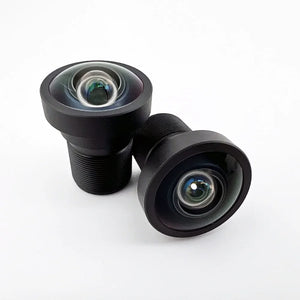
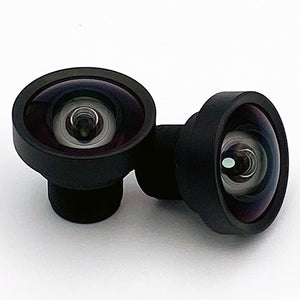
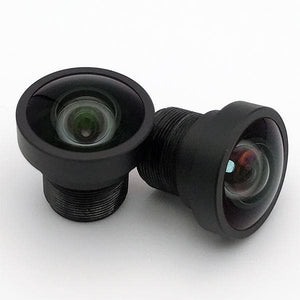
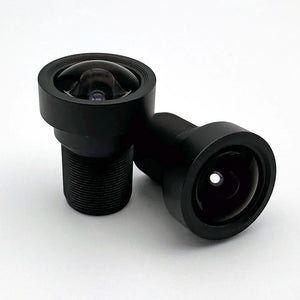
The four cards below come from the low-distortion M12 collection. All ship from US stock with same-day dispatch for in-stock orders placed before 12 PM PT.
Technical references
Frequently Asked Questions
What are the best M12 lenses for industrial machine vision applications?
There is no single best M12 lens for every application. The CIL034 is one wide-field option, while the CIL059 suits a different field and aperture requirement. Compare sensor coverage, MTF, working distance, distortion mapping, and mechanical fit. The other entries include lens families, suppliers, and a prototyping kit, so this list is a starting point for testing rather than a performance ranking.
What is the best M12 lens for the Raspberry Pi HQ camera?
For a single production-grade lens on the M12 version of the Raspberry Pi HQ camera, the Commonlands CIL059 6mm F/1.7 is the strongest pick: its 9.0mm image circle clears the IMX477 sensor's 7.9mm diagonal, with distortion and MTF data published per lens. The CIL160 16mm telephoto ($39, -0.5% TV distortion at 8.9mm) adds reach on the same sensor. An Arducam M12 lens kit is the better buy for early prototyping, when trying several focal lengths matters more than optical documentation.
Who makes M12 lenses in the USA?
Commonlands designs its M12 lenses in San Diego and inspects them there. Most lenses in the online catalog are manufactured in China. Design, assembly, inspection, and country of manufacture are different claims, so confirm the origin and process for the specific part when procurement requirements depend on them.
How much does a good M12 lens cost?
$19 to $137 covers most single-unit industrial M12 lens pricing in 2026. Commonlands lenses in this shortlist run $19 (CIL062) to $99 (CIL250 telephoto), with the wide-field CIL034 at $39. Sunex samples list at $69 to $99 on its Optics-Online webstore, and Edmund Optics Blue Series units list at $115 to $137, with Rugged Blue at $144 to $167. Published volume tiers drop Edmund units to $91 to $131 at 50+ pieces. Sunex quotes volume pricing. Lensation publishes no prices and quotes each order.
What is the best M12 lens for surveillance cameras?
The Commonlands CIL046 4.4mm M12 lens is one option for day/night surveillance. Its RGBIR correction reduces visible-to-NIR focus shift at F/2.0 with a 100° field on an 8.9mm image circle for $79. For long-reach identification, the CIL250 25mm IR-corrected telephoto covers a 20° field on the same sensor class from $99.
Are M12 lenses good enough for industrial machine vision?
Yes, within sensor-format limits. Modern M12 designs cover sensors up to 1/1.8" with measured MTF and distortion data, select designs reach 2/3", and fixed-focus builds remove a failure point on the factory floor. C-mount still wins above that format ceiling, or when the application needs an adjustable iris for depth-of-field control. The M12 versus C-mount lens mount guide covers the tradeoffs in detail.
What is the best M12 lens for low distortion?
The Commonlands CIL034 3.2mm is a wide-field option with specified TV distortion: 0.07% TV distortion across a 102° field at the 8.0mm reference circle, with an IP67 variant, for $39. For larger 1/1.8" sensors, the CIL078 7.8mm holds -1.1% TV distortion at an 8.8mm image circle for $59. The full low-distortion M12 collection filters by sensor format and field of view.
What is the best M12 lens for the GMAX2505 sensor?
For the Gpixel GMAX2505 global-shutter sensor (6.5 × 5.4mm active area, 8.45mm diagonal, 2.5µm pixels), the Commonlands CIL042 4.2mm F/1.9 low-distortion lens covers the full active area with its 8.8mm designed image circle, giving roughly 76° horizontal and 91° diagonal field of view for inspection and motion capture. The wider CIL030 3mm (8.8mm circle) also covers it. Check the measured FOV and CRA data on each product page before committing.
Need Help Choosing Between These Lenses?
Commonlands engineering can check image circle coverage, CRA match, and F-number against your sensor before you commit to hardware. US-based engineers, 25,000+ lenses in US stock.