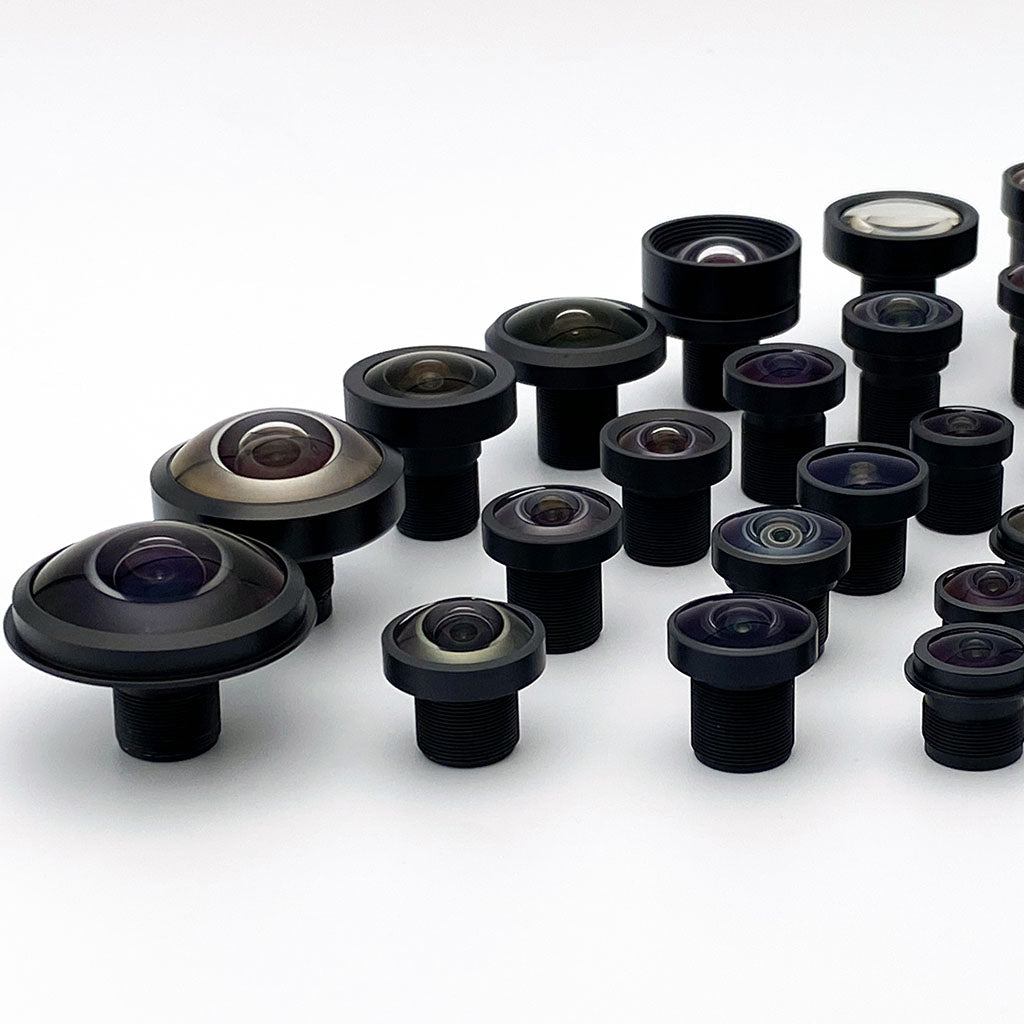

What Is F-Number in Machine Vision? Aperture, Depth of Field, and Diffraction Explained
F-number sets light throughput, depth of field, and diffraction. This guide explains why engineers call low F-numbers fast, then covers numerical aperture, the entrance pupil, and low-light lens selection.

F-number (written f/#) is the ratio of a lens's focal length to the diameter of its entrance pupil: a 25mm lens with a 12.5mm entrance pupil is an F/2 lens. In machine vision, f-number is the control knob for the core imaging tradeoff: light throughput versus depth of field versus diffraction-limited sharpness.
F-number is not focal length: two lenses with the same EFL can have different apertures, and two lenses at the same f-number can frame different scenes.
What is the f-number of a lens?
F-number (f/#) is the ratio of a lens's focal length to its entrance pupil diameter. It is dimensionless. It appears on every machine vision lens datasheet and largely sets how much light reaches the sensor per unit time. A lower F# means a larger aperture and more light. A higher F# means a smaller aperture, less light, and more depth of field.
The standard stop sequence (F/1.4, F/2, F/2.8, F/4, F/5.6, F/8, F/11, F/16) advances one stop per step: the f-number rises by √2, the entrance pupil diameter falls by √2, and the light halves. F/2.8 to F/5.6 is two stops, a quarter of the light.
Why low F-numbers are called fast
Engineers call an F/1.4 lens fast and an F/8 lens slow, and the vocabulary is about exposure length, not glass. A wider aperture collects the same light in less time, so early photographers could expose a plate faster. The words carry over directly: on a moving line, a fast lens reaches the target signal level inside the motion-blur window.
Many lenses reach their flattest performance one to two stops down from wide open, but the crossover depends on the design and the pixel size. The only reliable confirmation is MTF data measured at the working aperture, across the field.

How does f-number affect depth of field?
A higher f-number widens the in-focus range. At a fixed focal length, working distance, and blur budget, geometric depth of field grows in proportion to the working f-number, so F/2 to F/8 buys roughly four times the depth. That proportionality is a low-magnification approximation: exact near and far limits are nonlinear, and diffraction trims the usable gain at small apertures. Stopping down is still the first tool to try when parts show height variation, at the cost of light.
The full treatment, including the circle of confusion, hyperfocal distance, and the diffraction limit, lives in the Commonlands depth of field guide.
For working numbers, run the depth of field calculator with your focal length, F#, working distance, and pixel pitch. It also compares the light between two F# values, so one pass answers both the sharp-zone and the exposure question.
How does f-number affect light throughput and exposure time?
Image-plane irradiance scales roughly with 1/(f/#)². Transmission (measured as a T-stop), vignetting, pupil aberration, and the paraxial working f-number N(1+|m|/P) at finite conjugates, where P is exit-pupil diameter divided by entrance-pupil diameter all shift the real number. Each full stop still halves the light, so F/1.4 to F/8 costs about a factor of 32, recovered with longer exposure, brighter illumination, or higher gain.
Each recovery path has a cost. Longer exposure increases motion blur: at conveyor speeds of 200–500mm/s, an extra 1ms of exposure adds 0.2–0.5mm of smear at the object. More illumination power means more heat and larger drive electronics. Higher gain amplifies noise along with signal.
Machine vision has one structural advantage over photography: illumination is usually programmable. LED rings, backlights, and strobes turn up when the aperture is stopped down, which makes small apertures practical. The lighting budget still has to be designed, not assumed.
When does diffraction limit resolution?
Diffraction lowers MTF continuously as f-number rises, so there is no single hard threshold. A common bookkeeping marker is the aperture where the Airy disk, the smallest spot even a perfect lens can form, spans two pixel pitches. It is a flag, not a criterion: spot diameter and the contrast a sensor holds at Nyquist are different measures, so judge the working aperture from system MTF at Nyquist. At 550nm the Airy diameter is about 1.34 × N micrometers, so 3.45µm pixels reach the marker near F/5.1.
The disk grows linearly with f-number, so every stop of depth bought by closing the iris eventually costs resolution, and larger pixels tolerate more. The pixel-pitch table and the sensor-side math are worked through in the Commonlands spatial resolution guide.
What is numerical aperture?
Numerical aperture (NA) is the angular measure of the light cone an optical system accepts: NA = n × sin(θ), where n is the refractive index of the medium and θ is the half-angle of the acceptance cone. In air, NA = sin(θ), below 1.0 for camera lenses.
NA and f-number describe the same acceptance cone from different directions: NA as an angle in the medium, f/# as a ratio of focal geometry. Machine vision datasheets and iris rings use F#. Microscopy and fiber optics use NA, partly because immersion media with n > 1 push microscope NA above 1.0. Convert once and stay in one convention.
NA is not an image quality score: it says nothing about MTF, distortion, or relative illumination. The Commonlands EFL calculator documents the f/# = f/D definition and its paraxial link to NA.
What is the entrance pupil of a lens?
The entrance pupil is the image of the aperture stop seen from the object side of the lens. Look into the front of a lens against a bright background and the circular bright opening is the entrance pupil. A front group with 1.5× pupil magnification turns a 10mm iris opening into a 15mm pupil, which is why published f-numbers derive from pupil size, not the iris blade opening.
| Term | What it is | Why engineers care |
|---|---|---|
| Aperture stop | The physical element (usually the iris assembly) that limits ray bundle diameter | Its diameter, scaled by front-group magnification, sets entrance pupil size |
| Entrance pupil | Image of the stop seen from object space | Defines f/# = f / D_EP |
| Iris diameter | Clear aperture of the physical iris blades at a given setting | Generally not the entrance pupil in lenses with a front group. Use the diameter of the stop's image as seen through the front optics, rather than the physical stop diameter. Pupil magnification normally means exit-pupil diameter divided by entrance-pupil diameter |
To recover the pupil diameter from datasheet values, invert the definition: D_EP = f / f/#. The Commonlands CIL532 12mm C-mount lens has a pupil of about 5.9mm at F/2.05. The CIL544 25mm lens at F/1.8 has a pupil of about 13.9mm. Each iris position is a different entrance pupil diameter.
How do you choose a lens for low-light machine vision?
A low-light machine vision lens collects enough photons per frame for an acceptable signal-to-noise ratio without an exposure time that causes motion blur. The lens contributes aperture, transmission, and stray-light suppression. The rest is pixel size, target velocity, and illumination strategy.
Aperture is the primary optical lever. Moving from F/2.8 to F/1.4 quadruples the photons collected per unit time, and SNR in a shot-noise-limited sensor improves with the square root of photon count. Transmission matters too: coating quality and the number of air-glass surfaces set how much light arrives.
Pixel size sets the sensor side of the budget: a 4.2µm pixel collects far more photons than a 1.85µm pixel under matched exposure, F-number or T-stop, spectrum, quantum efficiency, and fill factor, on a common output-resolution basis. Confirm the image circle covers the sensor diagonal before comparing f-numbers. See the CMOS sensor size guide.
The motion budget closes the loop. Blur is a sensor-plane quantity, so convert before dividing: a pixel's footprint at the object is the pixel pitch divided by the magnification. At 0.1x a 4µm pixel covers 40µm of the part, which a 1m/s target crosses in 40µs. When even an F/1.4 lens cannot clear the noise floor in that window, the answer is illumination, not more aperture: pulsed LEDs deliver peak intensity far above their continuous rating.
NIR illumination at 850nm or 940nm can help when ambient light is dim or variable. Choose filtering for the unwanted light present. A camera using one narrow NIR band can be focused for that band. Visible-to-NIR correction matters when the camera must retain one focus setting across both bands. See the NIR imaging guide.
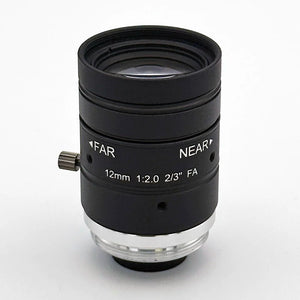
Why does an adjustable iris matter for machine vision lenses?
An adjustable iris lets you change f-number after the lens is installed. Many C-mount lenses carry an iris ring spanning wide open to F/16: a setup-time dial for the depth-of-field-versus-light tradeoff. M12 apertures are typically fixed, chosen at purchase.
When part-height variation or a changeover brings a different reflectance or height profile after commissioning, a C-mount system stops down and turns up the LED drive, while a fixed-aperture system changes hardware.
Fixed aperture is not a defect. It is part of what makes the M12 format compact, light, and economical for embedded systems. For consistent targets at a fixed distance, a well-chosen fixed F# does the same job with fewer parts.
Aperture starting points by application
Treat each starting point below as a first F# to refine against your depth requirement and pixel pitch, not a fixed rule.
| Application | Starting F# | What drives the choice |
|---|---|---|
| Flat targets | F/2.8–F/4 | Set for field uniformity across the plane. |
| 3D parts with height variation | Smallest F# that covers the depth range | Keep it below the diffraction limit for the pixel pitch. If depth and diffraction cannot both be met, change the working distance or focal length instead. |
| Barcode and text reading | F/4–F/8 | Stops down for depth while staying below the diffraction limit for the pixel pitch. |
Top lenses for aperture control and low light
The Commonlands M12 rows run from wide-angle to telephoto, with fixed apertures from F/1.6 wide open to an F/8.0 telephoto variant. The multi-variant lenses let the DOF budget pick the stop at order time. The C-mount rows reach F/1.4–F/1.8 maximum, and the 25mm CIL544 has an adjustable iris. Every aperture below is the figure published on the linked product page. These are examples, not the full range: browse the machine vision lens collection for current options.
| Rank | Lens | Mount and EFL | Aperture | When to choose it | Link |
|---|---|---|---|---|---|
| 1 | CIL019 | M12, 1.8mm | F/1.6 fixed | Wide-angle low-light scenes. IR-corrected and low distortion, so it holds focus when NIR illumination takes over at night. | CIL019 |
| 2 | CIL339 | M12, 4mm | F/1.6 fixed | Wide-angle automotive builds that need maximum throughput at a fixed stop. | CIL339 |
| 3 | CIL359 | M12, 5.9mm | F/1.6 fixed | Automotive and drone cameras at a normal field of view, where a fast fixed stop keeps exposures short. | CIL359 |
| 4 | CIL059 | M12, 5.9mm | F/1.7, F/2.8, F/4.0, F/5.6 variants | Low distortion with four fixed apertures: the DOF budget picks the stop at order time, no iris needed. | CIL059 |
| 5 | CIL142 | M12, 14.2mm | F/2.6, F/4.1, F/5.2 variants | Telephoto reach with three fixed stops to trade light against depth of field. | CIL142 |
| 6 | CIL121 | M12, 21.8mm | F/2.8, F/5.9, F/8.0 variants | The longest M12 reach here. The F/8.0 variant maximizes depth of field where illumination allows it. | CIL121 |
| 7 | CIL521 | C-mount, 8mm | F/1.5 maximum | 2/3" 5MP at a short focal length with a bright maximum aperture. | CIL521 |
| 8 | CIL523 | C-mount, 16mm | F/1.4 maximum | The fastest maximum aperture in this list, for short exposures on 2/3" 5MP sensors. | CIL523 |
| 9 | CIL544 | C-mount, 25mm | F/1.8 adjustable iris | 1.1" 25MP measurement work. Sweep the iris to find the depth-of-field and diffraction optimum. | CIL544 |
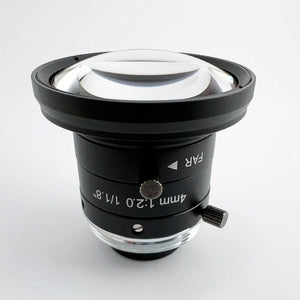
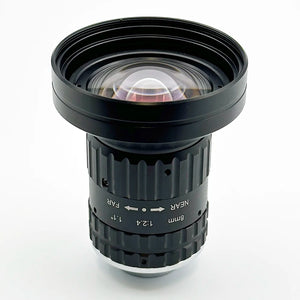
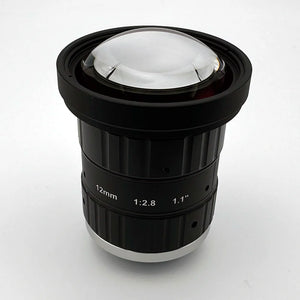
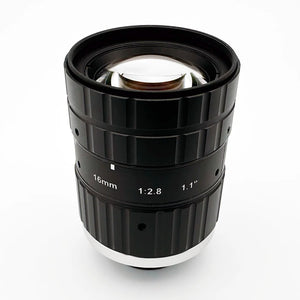
Frame the scene with the field of view calculator and confirm the working aperture against your pixel pitch before ordering.
Commonlands stocks a broad range of M12 lens variants in the US, with C-mount, filter, and holder inventory alongside. Orders placed before 12 PM PST ship same day from San Diego, CA. ISO 9001:2015 certified.

Frequently asked questions
Every lens Commonlands stocks lists its F-number on the product page.
What is the f-number of a lens?
F-number (f/#) is the ratio of a lens's focal length to its entrance pupil diameter: f/# = f / D_EP. A 25mm lens with a 12.5mm entrance pupil is F/2. A lower F# admits more light per unit time. A higher F# extends depth of field and eventually runs into diffraction.
How does f-number affect depth of field?
A higher f-number widens the in-focus range: at a fixed focal length, working distance, and blur budget, geometric depth of field grows in proportion to the working f-number, though diffraction trims the usable gain at small apertures. Stopping down is the first tool to try when parts show height variation, at the cost of light reaching the sensor.
What is numerical aperture?
Numerical aperture (NA) is the angular measure of the light cone a lens accepts: NA = n × sin(θ), where n is the refractive index of the medium and θ is the half-angle of the acceptance cone. In air, the image-side NA of a lens focused at infinity is ≈ 1/(2 × f/#). A lens at F/1.8 has image-side NA ≈ 0.28.
What is the entrance pupil of a lens?
The entrance pupil is the image of the aperture stop as seen from the object side of the lens. Its diameter sets the f-number (f/# = f / D_EP). In multi-element lenses it is not the same as the physical iris opening, because elements in front of the stop magnify or demagnify its image.
What makes a machine vision lens good in low light?
A machine vision lens performs well in low light when it collects enough photons per frame for a usable signal-to-noise ratio without an exposure time that causes motion blur. Aperture (f-number), lens transmission, sensor pixel size, and the option of NIR illumination together determine whether the system produces a usable image.
Need help choosing an aperture?
Send the Commonlands engineering team your sensor format, pixel pitch, working distance, and depth requirement. We will work through the f-number, illumination, and diffraction budget with you.