

How to specify a surveillance camera lens
Get four decisions right and the fixed-versus-varifocal and mount-format choices follow directly: day/night IR-cut switching, NIR wavelength, low-light aperture, and whether mounting distance is fixed at install time.
Day/night imaging and IR correction
Use an IR-corrected lens whenever the camera has a mechanical IR-cut filter switcher. During the day the switcher inserts an IR-cut filter so the sensor sees only visible light and colors render correctly; at night it swings the filter out so the sensor can use near-infrared (NIR) illumination for a monochrome low-light image. The lens has to hold focus registration through that transition, or the image goes soft every time the switcher toggles.
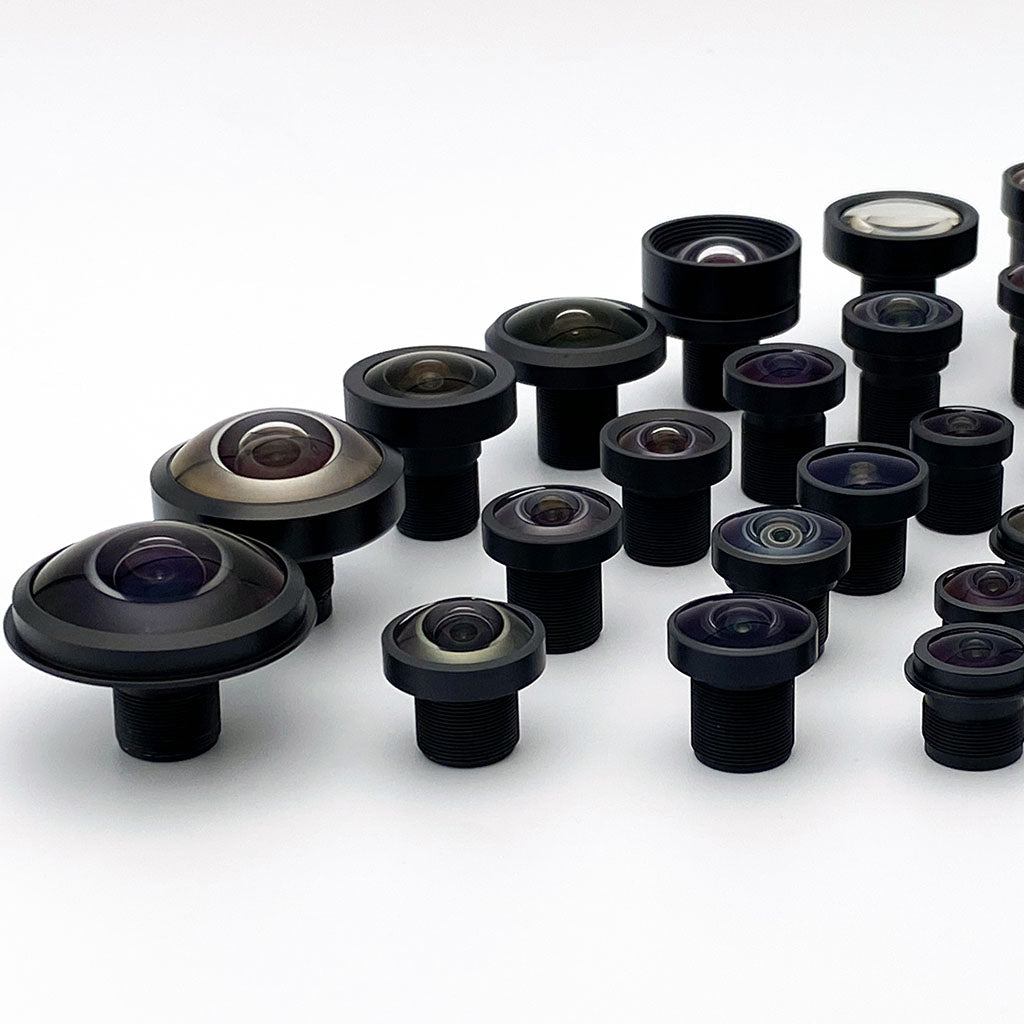
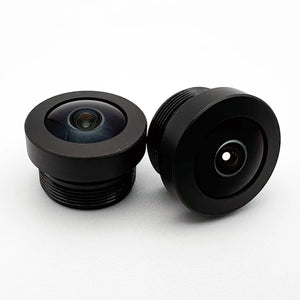
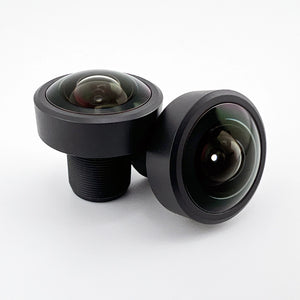
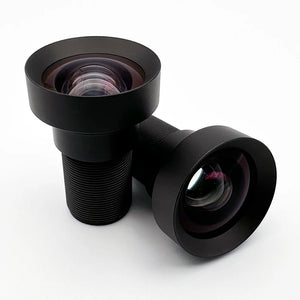
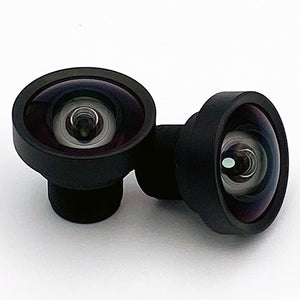
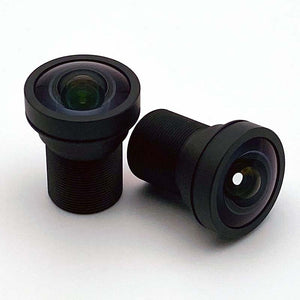
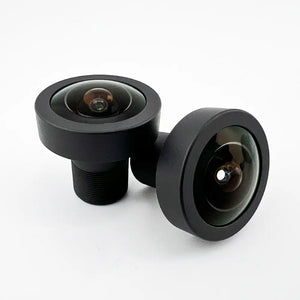
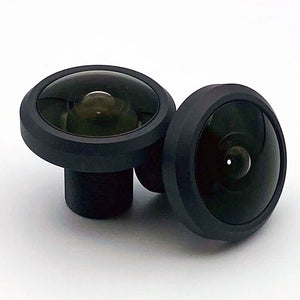
Commonlands stocks IR-corrected M12 lenses for exactly this: the CIL046 4.4mm M12 lens is RGBIR-corrected at F/2.0 for 1/1.7" sensors up to 8MP, and the CIL290 1.9mm M12 fisheye is IR corrected with an optional 660nm IR-cut filter variant for 1/2.7" sensors up to 5MP. Both ship in versions with and without the cut filter installed.
Ordinary glass has different refractive index at visible wavelengths than at NIR wavelengths, so a lens optimized only for visible light forms its sharpest image at a slightly different plane once NIR light dominates the scene. An IR-corrected lens design compensates the glass prescription so the focus plane stays consistent across both bands. See the IR-corrected lens guide and the day/night filter-switcher detail in the bandpass filter guide for the full mechanism.
If the deployment has no switcher (a fixed daytime-only color camera, or a fixed NIR-only night camera), a standard non-IR-corrected lens is adequate, since the design is optimized for a single band and never has to cross over. Bench-testing a day/night build should exercise both the daytime (IR-cut) and nighttime (NIR) states rather than relying on a single static focus check under one lighting condition.
850nm versus 940nm NIR illumination
850nm and 940nm are the two common NIR wavelengths for surveillance, and the choice trades range against covertness. 850nm illuminators produce a faint visible red glow, but most CMOS sensors retain meaningfully more quantum efficiency at 850nm, which means more usable signal and often longer range at the same illuminator power. 940nm is close enough to invisible that most people never notice it, but sensors typically respond less strongly, so image quality or range drops unless the sensor and lens are selected for 940nm.
The lens's role here is narrower than illumination selection itself: an IR-corrected lens needs to hold focus across whichever NIR band the illuminator uses, and the lens coating and glass transmission should be checked against that specific wavelength rather than assumed. A lens validated for 850nm performance is not automatically equally corrected at 940nm. See the 850nm versus 940nm guide for the sensor-side quantum efficiency comparison.
Choose 850nm when maximum detection range and image quality are the priority and a faint illuminator glow is acceptable. Choose 940nm when the installation requires the illuminator to be effectively unnoticeable, and confirm the sensor datasheet's quantum efficiency at 940nm before committing, since it varies significantly between sensor models.
Low-light aperture selection
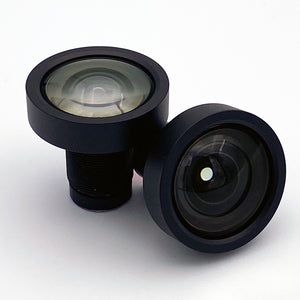
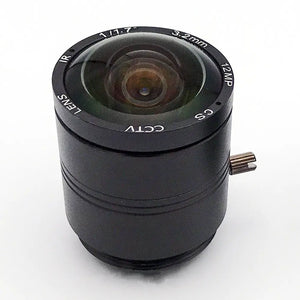
A faster lens, meaning a lower F-number, collects more light per unit time at a given exposure and gain setting, which is the main lever for nighttime image quality once illumination power is fixed. The CIL542 12mm C-mount lens ships with an adjustable iris from F/2.8 to F/16, so the same lens runs wide open at night and stops down in daylight for glare control and depth of field. M12 low-light options are fixed at a single aperture set at manufacture; the CIL046 ships at a fixed F/2.0.
Stopping down has its own cost that grows with F-number: diffraction. At 550nm, the Airy disk diameter is roughly 10.7µm at F/8 and 14.8µm at F/11; under 850nm NIR illumination both grow by roughly 1.5 times. That is already 4 to 6 times the 2.5µm pixel pitch of the 25MP 1.1" sensors the CIL542 pairs with, well past the point where the aperture itself limits resolution.
In practice, small-pixel C-mount surveillance lenses hit the diffraction ceiling around F/5.6 to F/8. Stop down for daylight glare and depth of field only as far as that ceiling allows, not to the smallest available aperture. See the low-light lens selection guide.
Fixed versus varifocal
Fixed focal length lenses are the simpler, more compact, and often less expensive option, and they are the practical choice once mounting distance and required coverage are known before installation. A camera mounted at a fixed height over a fixed doorway rarely needs the field of view to change after commissioning, so a fixed lens removes a mechanical adjustment and a potential failure point.
Varifocal lenses let an installer adjust focal length, and therefore field of view, on site without swapping the optic. That flexibility earns its cost when the exact mounting distance is not finalized until the installer is on the roof or pole, or when the coverage requirement itself may change after commissioning. Commonlands' current M12 and C-mount lineup is fixed focal length. For the full comparison, see the fixed versus varifocal lens guide.
Range versus coverage
A wide-coverage lens and a long-range lens solve different problems, and no single lens does both well at the same sensor resolution. Wider focal lengths capture more scene width but spread the sensor's pixels across that wider scene, reducing pixels on any one target. Longer focal lengths concentrate pixels onto a narrower scene, improving resolvable detail on a distant target at the cost of overall coverage.
The same rectilinear relationship used throughout machine vision applies directly: EFL = (working distance × sensor width) / scene width. This linear form holds when the working distance is much longer than the focal length, as it is in typical surveillance mounting. This formula excludes fisheye lenses such as the CIL290: a 190° fisheye's coverage follows the lens's own distortion mapping instead. Verify the geometry for a specific installation with the field of view calculator.
Decide which tier of detail the installation actually needs at the farthest distance in the coverage plan, then size focal length and sensor resolution to hit that pixel density at that distance, rather than picking a focal length first and hoping detail follows. Multi-camera layouts that pair one wide-coverage camera with one or more longer-focal-length cameras aimed at specific chokepoints are a direct consequence: the wide camera handles situational awareness, and the narrower camera handles the tier that actually requires identification-grade detail.
Traffic and ITS applications
Intersection monitoring, license plate capture, and roadway ITS cameras push both ends of the surveillance envelope at once: long working distance and day/night operation. Plates sit tens of meters from the pole, so the focal length has to concentrate pixels on a target the width of a car, and night capture runs under NIR illumination, so the lens has to hold focus across the visible-to-NIR transition.
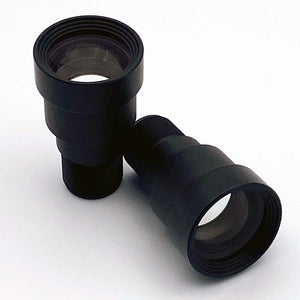
The CIL595 35mm IR-corrected C-mount lens is built for that combination: telephoto reach on 1.1" high-resolution sensors, F/1.8 for the night exposure budget, and IR correction so plate focus survives the switch to NIR illumination. Size the required focal length against your mounting distance with the field of view calculator, and see the ITS lens guide for the full application.
Sensor format and resolution matching
For rectilinear lenses, the image circle has to cover the sensor diagonal with margin, or the image vignettes at the corners regardless of how well the rest of the specification matches. Fisheye lenses are the exception: a fisheye's circular image is deliberately cropped by the sensor rather than sized to clear the diagonal.
Common surveillance formats run from 1/2.9" to 1/1.7" in compact M12 IP camera modules, and up to 2/3" or 1.1" in higher-resolution C-mount builds. The CIL046 covers up to 1/1.7" at 8MP, the CIL290 fisheye's 5.8mm image circle pairs with 1/2.7" sensors, and the CIL542 covers 1.1" sensors at 25MP with 2.5µm pixel pitch.
The lens has to resolve at least as finely as the sensor's pixel pitch, or the optical blur becomes the limiting factor and the extra megapixels add little usable detail. When in doubt between two adjacent lens image-circle ratings, the larger one is the safer default for coverage, but resolving power and CRA compatibility against the specific sensor still need to be verified, not assumed. See the spatial resolution guide and the sensor size and lens compatibility guide.
Environmental sealing for outdoor cameras
A lens needs its own ingress protection rating only when it is directly exposed to weather rather than sitting behind a sealed camera housing dome or window. Board-level and open-frame designs, where the lens front element faces the environment directly, are where a lens-level rating matters on its own. Commonlands stocks select M12 lenses rated for direct outdoor exposure: the CIL290 is IP67 rated in addition to being IR corrected.
An IP67 rating on the lens covers the lens assembly itself against dust and temporary water immersion. It does not extend to the camera body, connector, or cable unless those are separately rated. Confirm ratings at the system level, not just the lens level, before committing to a fully exposed outdoor mount. See the IP rating guide and the ruggedized lens guide.