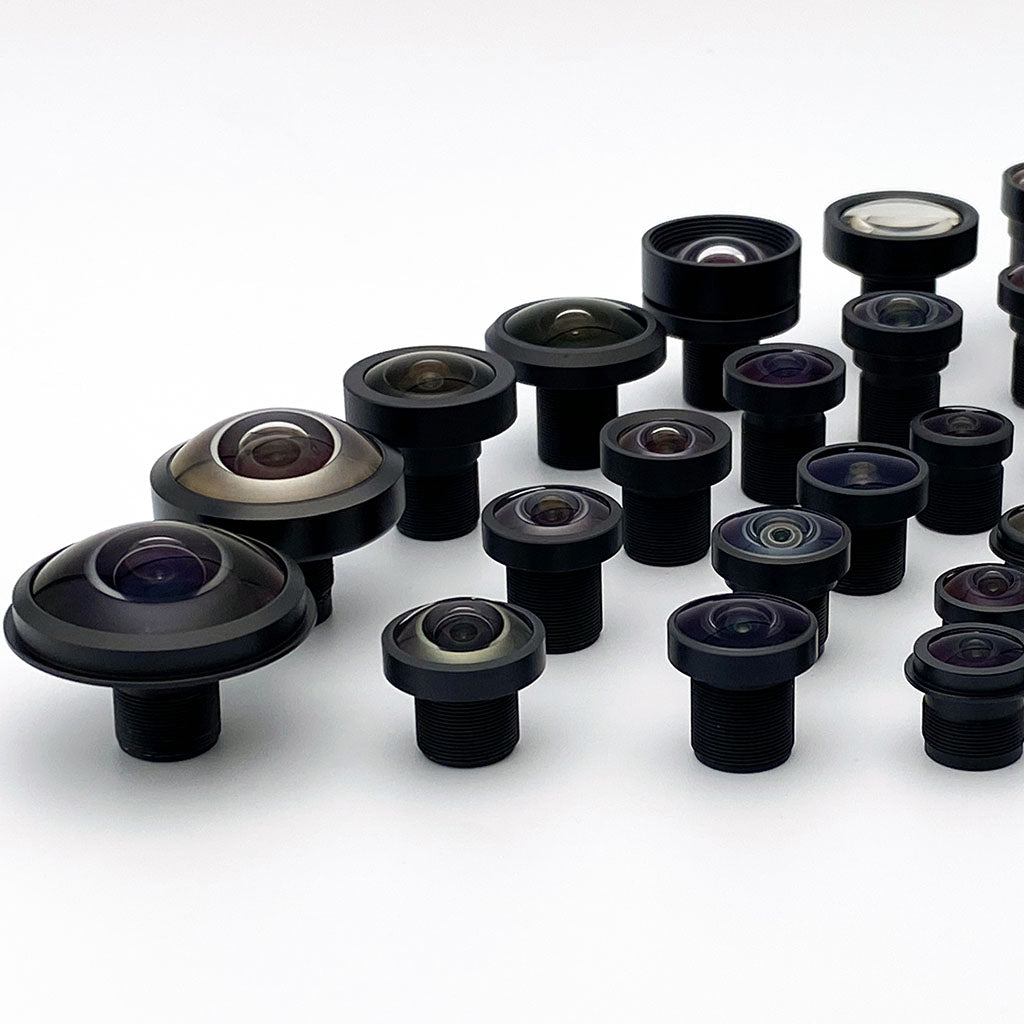

Lenses for Robotics: Choosing Machine Vision Optics by Robot Task and Mount Format
This guide picks lenses for navigation, manipulation, inspection-on-arm, and stereo depth sensing. It covers M12 vs C-mount tradeoffs, distortion, vibration, and matched-pair requirements for stereo cameras.

Robot vision splits into three optical problems, not one. Navigation needs wide field of view to see the surroundings. Manipulation needs the right working distance and depth of field to place a gripper accurately, and inspection-on-arm needs resolution and low distortion at a fixed standoff. For any camera that moves with the robot (end-of-arm tooling, wrist-mounted, or mobile platform), M12 lenses are the default format at 3g-15g. For fixed-station and gantry inspection where weight is not a constraint, C-mount gives more resolution headroom and an adjustable iris.
Below: lens choice by task, the specs that matter (distortion, CRA, vibration), M12 vs C-mount tradeoffs, and stereo depth-sensing cameras. It also covers why matched lens pairs matter.
What lens should I use for each robot vision task?
Robot vision breaks into three optical problems: navigation, manipulation, and inspection-on-arm. Each has a different primary constraint, so the right lens follows from the task, not the robot platform. A single robot often carries more than one camera, each running a different lens for a different job.
Navigation: wide field of view for situational awareness
Mobile robots and AMRs run fisheye or ultra-wide M12 lenses in the 150-200 degree range to see a wide area with fewer cameras. High distortion is fine here, since obstacle avoidance is not a millimeter-precision task.
Manipulation and pick-and-place: working distance and distortion
Robot arms picking parts need the lens matched to working distance and depth of field, not just field of view. Overhead bin-picking cameras commonly run 300mm-800mm. Coordinate accuracy then depends on distortion, since several percent of barrel distortion at the corner can be the difference between a successful grasp and a miss.
Inspection-on-arm: resolution and low distortion at a fixed standoff
Inspection cameras need resolution to resolve the defect size at the working distance, plus distortion low enough that image-coordinate measurements are trustworthy. On the arm itself, M12 is the default, since the lens rides the end effector and its weight counts against payload. When the inspection camera sits at a fixed station and the arm presents the part to it instead, C-mount becomes practical: no payload penalty, and an adjustable iris to hold focus across parts of varying height.
| Robot task | Lens format | Primary optical need | What to avoid |
|---|---|---|---|
| Navigation / AMR surround-view | M12 fisheye or ultra-wide | 150-200 degree field of view, small form factor | Telephoto. Unnecessary sealing indoors |
| Manipulation / pick-and-place | M12 low distortion | Working distance match, low distortion for coordinate accuracy | Fisheye without a distortion model in software |
| Inspection-on-arm | M12 (end-of-arm) or C-mount (fixed station) | Resolution at working distance, low distortion | C-mount weight on a moving end effector |
| Stereo depth sensing | Matched M12 or C-mount pair | Consistent focal length and distortion between both lenses | Assuming same SKU means identical optics |
The table is a starting point. Real robots mix roles: a mobile manipulator might carry a fisheye for navigation and a low-distortion lens on the arm for grasping. See the lenses for embedded vision guide for board-level integration common to all three roles.

M12 vs C-mount lenses by robotics task
M12 lenses use an M12x0.5mm thread with no standardized flange focal distance, and they dominate embedded vision boards: many Jetson modules and most other MIPI-CSI2 modules use M12 holders, typically with a fixed aperture. The official Raspberry Pi HQ Camera covers both cases: it ships in a C/CS-mount version with a C-mount adapter in the box and in a native M12-mount version.
C-mount lenses use a 1"-32 UN thread with a standardized 17.526mm flange, working with GigE Vision, USB3 Vision, and CoaXPress industrial cameras. The adjustable iris ring gives depth-of-field control, useful for gantry stations imaging parts of varying height.
| Factor | M12 | C-mount |
|---|---|---|
| Weight | 3g-15g | 50g-200g |
| Camera compatibility | Embedded boards (Jetson, Raspberry Pi) | Industrial cameras (GigE, USB3, CoaXPress) |
| Aperture | Fixed | Adjustable iris |
| Flange standard | No standard | 17.526mm, standardized |
| Typical sensor coverage | Typically to 1/1.8", select designs to 2/3" | Larger formats, up to 1.2" and beyond |
| Best for | Navigation, end-of-arm, mobile platforms | Fixed station, gantry, conveyor inspection |
The decision follows the camera's mounting, not a preference for one format. If the camera moves with the robot, M12 wins on weight and board-level integration. If it is fixed while parts move through the field, C-mount is worth the size for resolution headroom and iris control. Neither is lesser.
They are different optical systems: turning the ring on an adjustable C-mount lens may drive the whole cell in a helicoid, a front group alone, or internal groups riding a cam. The mechanism belongs to the design rather than the mount, as does near-limit image behavior, and some C-mount lenses ship fixed-focus.
Before an end-of-arm or fixed-station layout commits to a short working distance, confirm the mechanism and focus travel on the datasheet or with Commonlands engineering. Many fixed-focal M12 lenses move as one assembly, while M12 varifocals can move internal groups. The thread standard does not determine the focus mechanism.
Chief ray angle (CRA) matching
CRA describes the angle at which off-axis light exits the lens and strikes the sensor. Small-pixel CMOS sensors use microlens arrays tuned to a specific CRA curve. A mismatch produces color shading and corner falloff toward the edges, a sensor angular-response effect rather than optical vignetting, that depends on the lens's pupil geometry and the sensor's angular response. Focal length alone does not predict compatibility.
Verify CRA compatibility between lens and sensor rather than assuming it based on mount type alone. See the chief ray angle and mismatch guide for the verification method.
Lenses for stereo vision and depth sensing
A stereo camera uses two lenses separated by a known baseline to capture the same scene from slightly different viewpoints, then estimates depth from disparity, the pixel offset between where a given point appears in the left and right image. The relationship is Z = (f × B) / d, where Z is scene depth, f is focal length in pixels, B is baseline, and d is disparity.
Disparity sits in the denominator and shrinks with distance, so precision falls off with range: a fixed disparity error produces a depth error that grows with the square of distance. A 1-pixel error at 500mm costs far less absolute depth than the same error at 2000mm.
The equation also assumes both views are captured at the same instant. Rolling-shutter sensors read out row by row, so on a moving arm or AMR each row pair sees the scene from a slightly different position, skewing the geometry the disparity search depends on. Global shutter removes the skew, since every row integrates at once. Hardware sync does not: it aligns the two sensors' row timing so left and right rows pair correctly, but each row still samples its own instant and the motion distortion survives.
Longer focal length increases disparity sensitivity and depth precision but narrows field of view and shrinks the overlap volume both cameras share. A wider baseline improves depth discrimination but pushes out the nearest distance both cameras can see. Choose baseline and focal length together against the working volume you need to cover, and verify shared coverage with the field of view calculator before committing to hardware.
Why matched lens pairs matter for disparity accuracy
Stereo depth assumes both lenses behave consistently: the same scene geometry should produce proportionally equivalent image geometry in each camera. If the left lens has a slightly longer effective focal length than the right, objects at a given depth image at different magnification, which per-camera calibration largely corrects, with any residual set by calibration quality and lens stability. Two lenses under the same SKU still differ measurably in focal length and distortion from manufacturing tolerances, so characterize both individually for demanding stereo rather than trusting the catalog number.
Stereo rectification uses each camera's calibrated lens model to align corresponding points on the same image row. Different distortion profiles can be corrected independently. Residual errors arise when the models are inadequate, calibration is inaccurate, or the assembly changes afterward. Asymmetric corner MTF does the same: comparing a sharp patch against a blurred one lowers match confidence in that region.
M12 vs C-mount for stereo builds
M12 is the practical choice for compact embedded stereo: two lenses fit on a small sensor pair without adding meaningful mass. M12 covers sensors up to 1/1.8 inch typically, with select designs to 2/3 inch, with both low-distortion and strongly distorted wide-angle designs available. Check the projection and distortion mapping of the actual lens against the stereo software's supported models. C-mount becomes better once the sensor exceeds that, the path needs a rigid mechanical reference, or depth-of-field control matters.
The fixed 17.526mm flange sets axial lens registration and nothing more. Baseline between optical centers, camera pose, sensor tilt, and the rest of the stereo extrinsics still come from your mechanics and your calibration. You pay for the format in size and price.
In the table below, field-of-view angles are the full diagonal across the stated image-circle diameter, and distortion is signed (negative is barrel) in each lens's published convention.
| Lens | Mount | EFL | FoV | Distortion | Price | Stereo use case |
|---|---|---|---|---|---|---|
| CIL062 | M12 | 6.2mm | 60° @ 7.2mm | -2% rectilin. @8.8mm | $19 | Compact embedded stereo, budget builds |
| CIL085 | M12 | 8.2mm | 57° @ 8.8mm | -0.9% TV @8.8mm | $49 | Higher-resolution compact stereo, lower distortion |
| CIL561 | C-mount | 6.0mm | 76° @ 9.3mm | -2% | $149 | Rigid industrial stereo rig, adjustable iris |
For interpreting lens contrast as a function of spatial frequency and field position, see how to read MTF curves.
Top lenses for robotics by task
The best robotics lens follows the task, not the robot: an M12 fisheye for navigation, a low-distortion M12 for pick-and-place, a C-mount for fixed-station inspection, and a matched M12 pair for stereo. The six Commonlands picks below are all published-spec parts. Size each against your own sensor and working distance with the field of view calculator. Specific figures come from the product page. Ranges and qualitative entries are flagged in the footnote.
| Robot task | Lens | Mount | EFL | Distortion | Weight | Why this pick |
|---|---|---|---|---|---|---|
| Navigation / SLAM (wide FoV) | CIL232 | M12 | 3.1mm | High, fisheye | 12g | 181° coverage from one camera cuts the sensor count for perimeter awareness. IP67 covers dust and water immersion under IEC 60529. Vibration and thermal stability are separate qualifications the rating does not establish. |
| Mobile robot / AMR (indoor) | CIL391 | M12 | 3.25mm | Barrel, uncorrected | 5g | Lightest wide option for indoor AMRs that skip sealing. 154° and all-glass at 5g. |
| Pick-and-place | CIL052 | M12 | 5.2mm | -0.1% | 13.1g | Low distortion keeps grasp coordinates accurate without a per-frame software correction. |
| Inspection-on-arm | CIL034 | M12 | See product page | <1% (display spec) | 5.7g | The sealed variant's metal barrel carries IP67 for dust and water immersion under IEC 60529. That rating covers ingress only. Qualify vibration and thermal drift separately for arm mounting. Published distortion is under 1% without a stated metric, so verify against your pixel budget. |
| Stereo pair (embedded) | CIL062 | M12 | 6.2mm | -2% | <15g | Low-cost matched pair for compact disparity rigs. Characterize both units, since same-SKU lenses still vary in EFL and distortion. |
| Fixed-station / gantry inspection | CIL556 | C-mount | 50mm | -0.02% | 96g | 25MP resolution and an adjustable F/2.8-16 iris for high-magnification defect inspection where weight is not a payload cost. |
Fisheye and wide-angle distortion is barrel by design and specified against a different reference, so it does not compare directly to the low-distortion figures. Entries marked under 15g are M12 models inside the 3g to 15g band. Confirm exact mass on the product page.
One caveat on stereo: an integrated depth camera can reduce integration work. Compare its measured depth error, range, field of view, and lighting limits with a custom stereo pair. Custom optics are useful when you need control over baseline, spectral band, packaging, or calibration, but do not automatically provide better accuracy.
Whichever route you take, verify chief ray angle against the sensor before you commit, then browse the full M12 lenses and C-mount lenses ranges for focal lengths not shown here.
Products by robotics use case
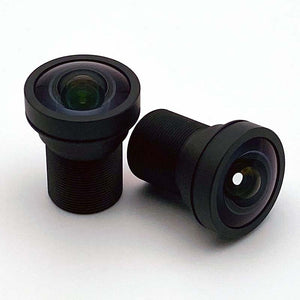
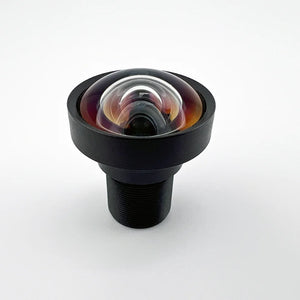
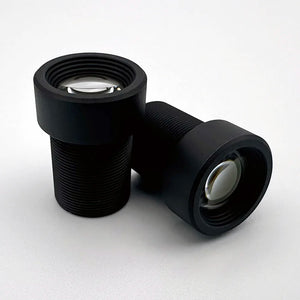
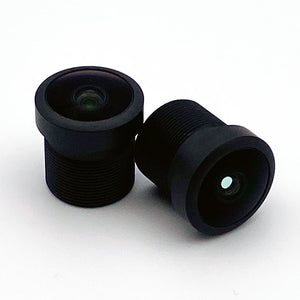
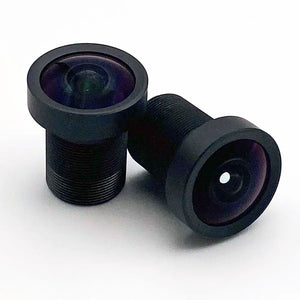
In-stock Commonlands M12 and C-mount lenses spanning navigation, manipulation, and stereo builds. Same-day shipping on orders placed before 12 PM PST.

Technical references
Frequently asked questions
What lens should I use for a pick-and-place robot?
For overhead bin picking at 300mm-800mm working distance, the CIL052 (5.2mm, -0.1% distortion, $79) is the better default. Pick-and-place is a coordinate-accuracy task, and its low distortion keeps position error out of the grasp calculation. If coverage of a full bin matters more than coordinate accuracy and you are correcting distortion in software, the CIL391 (3.25mm, 154-degree FoV, $39) gives more field of view. Both are M12 format and mount directly on Jetson and Raspberry Pi camera boards that use M12 lens holders.
What is the best lens for NVIDIA Jetson robot vision?
Jetson platforms typically pair with MIPI-CSI2 cameras on small sensors (1/2.7 inch to 1/3 inch) through M12 lens holders. A 3mm-5mm M12 lens, such as the CIL034, covers general-purpose robot arm and mobile robot vision at these sensor sizes. For wider obstacle-avoidance coverage, a 150-200 degree fisheye M12 lens like the CIL232 is a common pairing. Always verify chief ray angle compatibility against your sensor module.
Should I use an M12 or a C-mount lens for robotic applications?
If the camera moves with the robot (on an end-of-arm tool, wrist, or mobile platform), M12 is usually the right format at 3g-15g versus 50g-200g for C-mount. That payload margin matters against a robot arm's rated capacity. If the camera is fixed and the part moves to it (gantry, conveyor, or fixed station), C-mount gives more resolution headroom and an adjustable iris for depth-of-field control.
How do I calculate the right focal length for my robot camera?
Start with sensor width, required scene width, and camera distance. At a distant focus with rectilinear projection, EFL ≈ sensor width × distance / scene width. Check the distance reference and use finite-conjugate geometry at close range. Then verify coverage, distortion, MTF, clearance, and focus over the robot's full operating range.
Can I use a fisheye lens for robot guidance and manipulation?
Fisheye lenses have high barrel distortion by design, which is fine for navigation and obstacle detection where wide coverage matters and precise position measurement does not. For manipulation tasks that localize a part or read a fiducial from image coordinates, use a low-distortion rectilinear lens instead. Correcting fisheye distortion in software adds processing overhead and has its own accuracy limits.
Need help choosing a lens for your robot?
Send us your robot task: navigation, manipulation, inspection-on-arm, or stereo depth sensing. Include your sensor and working distance. Commonlands optical engineers can recommend focal length, distortion tolerance, and mount format, and confirm CRA compatibility before you commit to a design.