
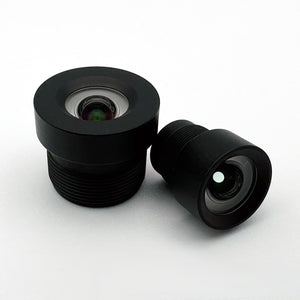
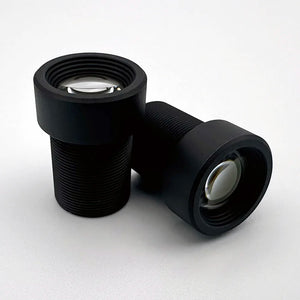
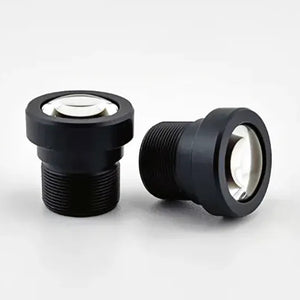
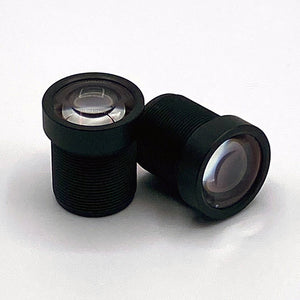
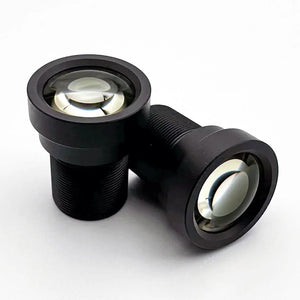
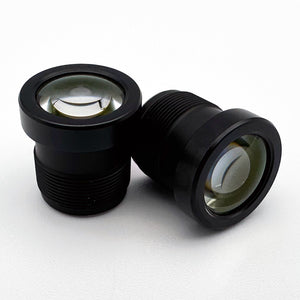
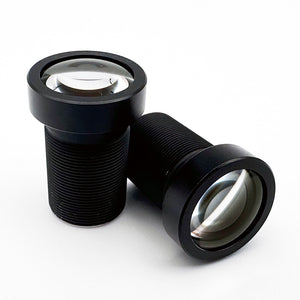
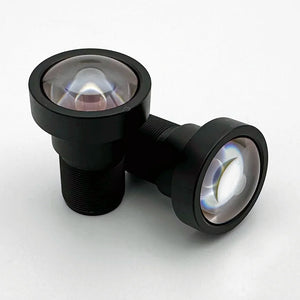
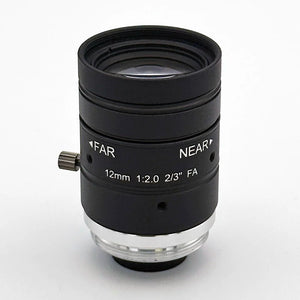
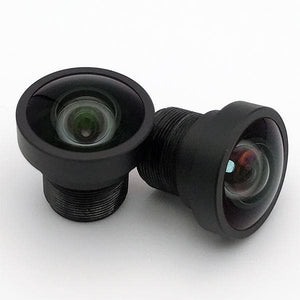
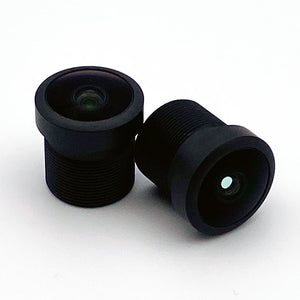
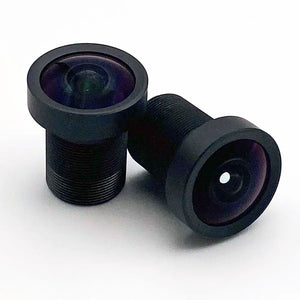
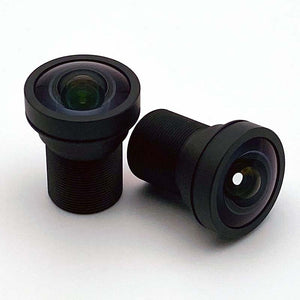
M12 lenses for drones and aerial robotics

Lightweight M12 and M8 lenses for UAV camera systems. Low distortion optics for mapping, wide angle for FPV, compact form factors that won't kill your flight time.

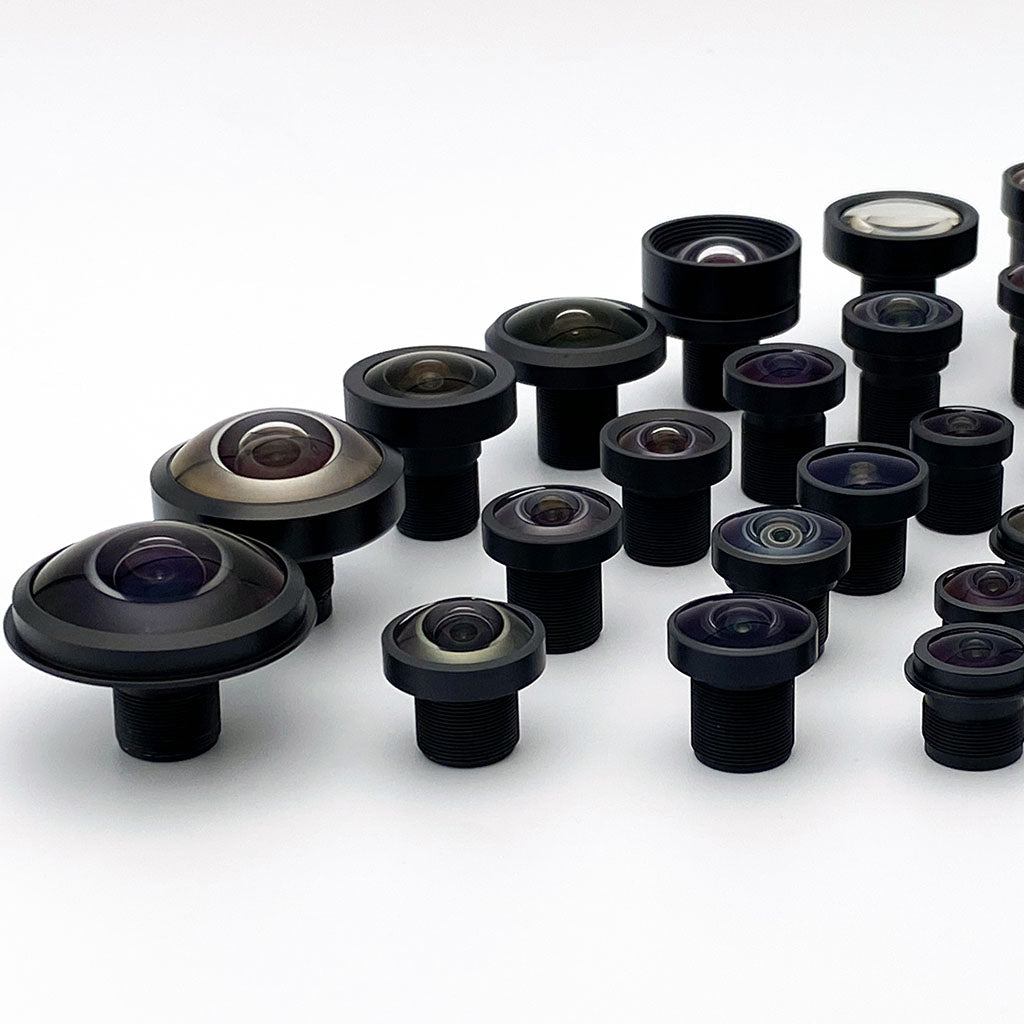
Drone camera lenses have constraints that ground-based systems don't. Weight matters because it comes straight out of your battery budget. Vibration from props can blur images if the lens isn't secured. And you need the right field of view for your mission, whether that's a 180° fisheye for obstacle avoidance or a tight 50° for inspection detail. We stock over 30 M12 lenses and M8 lenses suited for aerial robotics, all shipping same-day from San Diego.

30+ Drone-suited lenses
0.5g–8g Weight range
2°–195° FOV range
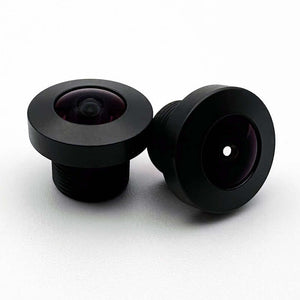
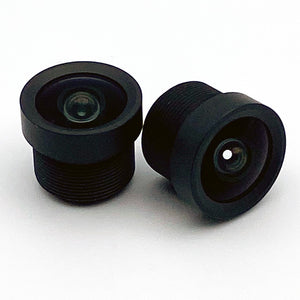
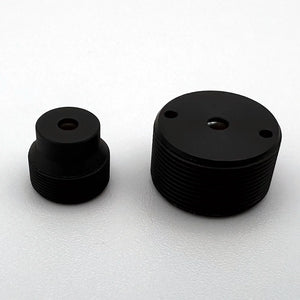
M12 lenses for drone cameras: compact optics for UAV aerial robotics applications

Obstacle Avoidance

Small M7 and M8 lenses for monochrome global-shutter navigation stacks

Vision-based avoidance stacks are usually built on small monochrome global-shutter sensors in the 1MP class, with an M7 or M8 lens such as the CIL818 in front of each one. At that size the optics stop being a payload question. A full set of avoidance lenses weighs less than one mapping lens.

Worth saying plainly: these designs are less prevalent than they were a few years ago. Many drone programs have moved away from computer-vision obstacle avoidance, and the small-format catalog reflects that. If your platform still flies it, the M7 and M8 range covers the usual 1MP global-shutter sensors.

Doorbell Camera Miniature M8 Fisheye Lens D

195°@5.2mm Fisheye Lens

$29.00

Download .STPView Product
2mm M12 Lens stereographic

Small 1.9mm M12 Lens

$39.00

Download .STPView Product
M8 lens for Raspberry Pi Pinhole

Small 6mm Lens

$39.00

Download .STPView Product
M8x0.35 Lenses for IMX415

Small 2.8mm Lens

$29.00

Download .STPView Product

Browse M8 and M7 Lenses for Tiny Cameras

Long Range Imaging

Telephoto M12 lenses for standoff observation and detection

Long range work inverts the obstacle-avoidance priorities. Pixels on target becomes the figure that governs the mission, which makes focal length the leading spec, though field of view still matters for search and acquisition coverage, for pointing error and image overlap, and for the stabilization and exposure margin the payload has to hold. Ground sampling distance scales inversely with focal length, so a 75mm lens samples the ground three times finer than a 25mm lens at the same altitude. Whether that finer sampling turns into three times the resolved detail depends on the sensor, focus, diffraction at the working aperture, motion, atmosphere, SNR, and lens MTF keeping up.

That ratio decides whether an operator can recognize what the sensor found or only detect that something is there. Work the altitude, sensor, and object size through the ground sampling distance calculator before choosing a focal length, since the required lens follows from the detection threshold you need to hit.

IR Corrected 12mm M12 Lens

IR Corrected 12mm M12 Lens

$59.00

Download .STPView Product
IR Corrected 16mm M12 Lens

IR Corrected 16mm M12 lens 8MP

$70.00

Download .STPView Product
16mm M12 Lens CIL160 global shutter

Telephoto 16mm M12 Lens

$39.00

Download .STPView Product
25mm M12 Lens S Mount Lens

IR Corrected 25mm M12 Lens

$99.00

Download .STPView Product

Browse Telephoto

Inspection

Machine vision lenses for asset inspection from close standoff

Inspection flights hold position a few meters from a structure and resolve defects on it: corrosion on a tower weld, a cracked insulator, delamination on a turbine blade. That is a machine vision problem carried aloft, so the requirements come from machine vision rather than aerial survey. Low optical distortion keeps a crack measurable at the frame edge, not just the center, and IR-corrected designs hold focus when the airframe flies visible light by day and near-infrared after dark. The IR-corrected lens guide covers that focus shift.

14mm M12 Lens CIL142

Telephoto 14.2mm M12 Lens

$59.00

Download .STPView Product
20mm M12 lenses for finite conjugate

Telephoto 21.8mm M12 Lens

$70.00

Download .STPView Product
5mm Lens AR2020 Low Distortion

Low Distortion 5mm M12 Lens

$79.00

Download .STPView Product
12mm C Mount Lens Kowa Lucid Vision

12mm C-Mount Lens 2/3" 12MP

$149.00

CIL532-F2.0-CMANIR — 39 in stock

Download .STPView Product

Browse Machine Vision Lenses

Wide-Angle Viewing Cameras

Single-camera setups for footage a person actually watches

When the camera exists for human viewing, one lens usually does the job. Target somewhere around 100 to 120 degrees horizontal. Think of the four below as GoPro-equivalent fields of view in an M12 thread.

Which one lands in that band depends on the sensor behind it, so run your format through the field of view calculator before committing. One lens we get asked about and do not suggest here is the CQ0801. In our opinion it is simply too big for a drone.

A 2.8mm M12 lens with a wide angle and no distortion for the RPi HQ Camera.

Low Distortion 2.6mm M12 Lens

$39.00

Download .STPView Product
3.5mm M12 Lens for IMX226 AR0821 IMX537

Large Format 3.5mm M12 Lens

$29.00

Download .STPView Product
3mm Wide-Angle M12 Lens

Wide-Angle 2.7mm M12 Lens

$39.00

Download .STPView Product
Wide Angle M12 Lens

Wide-Angle 4.5mm M12 Lens

$49.00

Download .STPView Product

Browse Drone Viewing Lenses

Gimbal Payloads and Multi-EFL Zoom

Pairing two or three fixed lenses into a hybrid digital and optical zoom

There is no single drone lens answer; it depends on the use case, and zoom gimbals are where that shows most. Gimbal payloads usually pair 2-3 cameras behind different fixed focal lengths and switch between them, with digital zoom covering the range in between. The EFL ratio between adjacent cameras sets how much digital zoom the operator sits in before the next camera takes over, so pick the step by how much cropping the mission tolerates.

Digital zoom is a crop. It never adds detail, it only magnifies what the active camera resolved, so ground sampling distance is set entirely by whichever lens is live. Larger steps mean the picture gets noticeably soft just before each switch.

Three-Camera Architectures

Wide Mid Long Steps Optical range
CIL062 6.2mm CIL121 21.8mm CIL075 75mm ~3.5X each 12X
CIL034 3.25mm CIL122 12mm CIL051 50mm 3.7X then 4.2X 15X
CIL083 8mm CIL121 21.8mm CIL051 50mm 2.7X then 2.3X 6.3X
CIL034 3.25mm CIL198 20mm CIL075 75mm 6.2X then 3.8X 23X

The first set holds a steady ~3.5X per step, which is the balanced pick. The CIL083 set trades total range for tighter steps, so the picture stays cleaner near each switch. The last row is the extreme-range option; a 6.2X first step is a lot of digital zoom to sit in, and you accept it to get a 23X optical spread. The CIL054 (5.4mm) is a new release that swaps in for the CIL062 when you want a slightly wider bottom end.

Past 75mm there is the 100mm CIL100, but it gets really heavy and large for most gimbals. We rarely see it fly.

Two-Camera Architectures

Two cameras cover plenty of missions if the step is honest. Pairs we see built: CIL083 + CIL350 (8mm to 35mm, 4.4X), CIL062 + CIL250 (6.2mm to 25mm, 4.0X), CIL054 + CIL198 (5.4mm to 20mm, 3.7X), and CIL034 + CIL083 (3.25mm to 8mm, 2.5X) as a wide surveying pair.

Matching cameras across a gimbal

A switch between cameras only looks clean if color and focus behave the same way on each. Specify the same IR cut filter across the set, and pull the lenses from one production lot to narrow unit-to-unit spread. Lot matching narrows the spread rather than replacing the per-camera work: each camera still needs its own focus set, radiometric and color matching through its ISP, distortion and intrinsic calibration, and registration against the others.

Ask about lot matching

Quick spec comparison

Published specs for the lenses in the mission sets above

Lens EFL F/# Field of view Distortion Mount Best for Price
CIL818 1.75mm F/2.05 190° -10% (F-Θ) M8 Obstacle avoidance, surround coverage $29
CIL819 1.9mm F/2.0 160° -22% TV M8 Obstacle avoidance on micro airframes $39
CIL821 2.1mm F/2.4 150° @ 6.5mm -19% TV @ 6.7mm M12 Wide situational awareness $39
CIL825 2.5mm F/2.4 115° @ 6.4mm -11% TV @ 6.0mm M12 Forward view with less edge stretch $39
CIL829 2.8mm F/2.5 100° @ 6.6mm -1% from rectilinear M8 and M12 Navigation where geometry must stay usable $29
CIL334 3.5mm F/2.2 141° @ 8.0mm -7% F-Θ @ 8.0mm M12 Wide camera on a gimbal, large-format sensors $29
CIL054 5.4mm F/2.8 Datasheet pending Low distortion M12 Wide camera on a reach-biased gimbal $49
CIL083 8.0mm F/2.8 52° @ 7.6mm -0.5% TV M12 Inspection, medium step on a gimbal $19
CIL250 25mm F/2.0 20° @ 8.8mm <3% M12 Long range detection, IR corrected $99
CIL350 35mm F/2.4 16° @ 10.0mm 0.4% TV @ 10.0mm M12 Long step on a coverage-biased gimbal $59
CIL076 75mm F/3.4 6° @ 7.8mm -0.4% TV @ 9.3mm M12 Maximum reach for identification $129

Field of view figures are quoted at the image circle shown, so they change with sensor format. Verify against your sensor with the FOV calculator and the sensor size chart. Optical, TV, and F-Θ distortion are measured against different references and are not directly comparable. CIL054 is newly released and its full datasheet is still being published.

How to pick an M12 lens for your drone

Drone optics are different from ground-based systems. Every gram you add to the airframe comes out of your flight time budget. Vibration from spinning props can blur images if the lens isn't locked down. And the FOV you need depends entirely on whether you're racing through gates or surveying a construction site. Here's how to think through the tradeoffs.

Weight constraints

On a small quad, payload weight directly affects flight time and maneuverability. A 5g lens versus a 2g lens means a measurable difference in battery drain. M8 lenses are generally lighter than M12, with some under 1g total. The CIL829 (M8, 2.8mm) weighs about half a gram. For micro builds and solar-powered fixed wings, that matters.

The tradeoff is selection. M12 lenses offer more focal length options, faster apertures, and more low-distortion designs to choose from; the larger barrel gives the designer more room, though any single lens's performance comes from its design and tolerances, not its diameter. If your drone can handle 5-10g of lens weight, M12 gives you more flexibility. The CIL036 (3.3mm, $19) weighs about 2g and shows up in a lot of consumer drone builds for that reason.

Vibration and shock

Prop vibration is the enemy of image sharpness. High-frequency vibrations blur frames even when the drone is hovering steady. Hard landings can shift a lens that wasn't secured properly. Two things help: use threadlock on the M12 threads, and make sure the lens barrel isn't extending past any protective housing where it could take impact.

Some drone builders pot the lens in place after focusing so it cannot rotate in flight. Treat the adhesive as an engineering decision rather than a dab of whatever is on the bench: uncured silicone byproducts can outgas and fog the lens or sensor, cure shrinkage and creep can shift focus, and a potted lens is hard to rework. Use a low-outgassing compound qualified for optical assemblies and keep it off the glass. If you're doing a lot of takeoffs and landings, consider a recessed mount that keeps the lens barrel inside the airframe profile.

Field of view for different missions

FOV requirements vary dramatically by application. FPV racing wants maximum coverage, 140° to 180° or more, so pilots can see gates and obstacles in peripheral vision. The 195° M8 fisheye is popular here. Distortion doesn't matter because you're not measuring anything, just flying.

Inspection drones need the opposite. Narrower FOV (40° to 60°) gives you more pixels on target at standoff distances. The CIL083 (8mm, 52° FOV) is built for this. You're trading coverage for detail.

Mapping sits in the middle. You need enough coverage to capture overlapping swaths efficiently, but low distortion to avoid warping your orthomosaics. 70° to 100° is typical. The CIL335 (3.5mm, 92°) works well for this. Use the FOV calculator to match your sensor format.

Distortion matters for photogrammetry

Barrel distortion is the curved warping you see in wide-angle images, where straight lines bow outward. For FPV, it's irrelevant. For photogrammetry and mapping, uncorrected distortion throws off ground control point alignment and creates errors in your orthomosaics and 3D models.

Photogrammetry software estimates distortion as part of its camera model, so stable, calibrated distortion is routinely corrected; the correction is only as good as your calibration. A lens with a low published figure, like the CIL083 (-0.5% TV; TV and optical distortion use different references, so compare like with like), leaves less for the model to carry and less residual when the solve is imperfect. Distortion sits in the error budget alongside resolution, overlap, shutter timing, and ground control rather than outranking them. To work the numbers for a specific sensor and altitude, use the drone mapping lens guide, which includes a GSD and object detection calculator.

Sensor compatibility

Every lens has an image circle. If that circle is smaller than your sensor's diagonal, you get dark corners. Common drone sensors and their diagonals:

  • IMX477 (1/2.3", 7.9mm diagonal): Raspberry Pi HQ Camera, needs larger image circle lenses
  • IMX462 (1/2.8", 6.4mm diagonal): popular for low-light drones
  • AR0234 (1/2.6", 6.9mm diagonal): global shutter, good for fast motion
  • OV9281 (1/4", 4.6mm diagonal): common stereo/depth sensor

Check the lens datasheet for image circle size, or reference our sensor size chart. If you're building around a Jetson Nano or Raspberry Pi compute module, the sensor is usually IMX477 or IMX219. ArduCam and e-con have good module options with M12 mounts.

Day, night, and IR operation

Some drones fly at dusk or use NIR illumination for night ops. How much near-infrared an M12 lens passes, and how well it holds focus there, depends on its glass, coatings, and any integrated filter, so check the transmission data or specify a no-IR-cut variant rather than assuming. You may also need to remove the IR-cut filter from your camera or add a dedicated IR-pass filter. Fast apertures (F/1.4 to F/2.0) help in low light by gathering more photons per exposure.

Thermal imaging is a different story. LWIR (8-14 micron) lenses use germanium or chalcogenide glass, not standard optical glass. Standard M12 lenses won't work for thermal. If you need LWIR, you're looking at specialized cores from FLIR or Seek.

Regulatory considerations

FAA Part 107 governs commercial drone operations in the US. If you're flying for photogrammetry, inspection, or any commercial purpose, you need reliable optics that produce consistent results. For BVLOS (beyond visual line of sight) waivers, regulators want to see that your sense-and-avoid system has adequate coverage and reliability.

This isn't a lens spec, but it matters for lens selection. Cheap optics with inconsistent quality control can fail at the wrong time. We test every lens before shipping and can provide individual MTF test reports for critical applications. For fleet deployments where you need matched optics across multiple aircraft, let us know and we'll pull from the same production lot.

Not sure which lens?

Send us your sensor datasheet and flight profile. We'll recommend a lens that fits your weight budget and FOV requirements.

Contact engineering

Plan the mission before you pick the lens

Guides and calculators that turn altitude, sensor, and detection requirements into a focal length

Mapping and photogrammetry guide

Ground sampling distance from first principles: the GSD formula, focal length tables by mission and altitude, and how lens distortion enters the orthomosaic error budget. Includes an interactive GSD calculator with common drone sensor presets.

Ground object detection

How many pixels it takes to detect, recognize, and identify people and vehicles from the air, using the Johnson criteria. Converts object size and altitude into a required GSD and focal length for security, search and rescue, and ISR payloads.

Platform and payload tradeoffs

Weight budgets, M8 versus M12, vibration and rolling shutter, thermal stability at altitude, and IR filter selection for NDVI and night operations. The companion guide for everything on this page that is not GSD.

Common questions from drone builders

What we get asked most when engineers are picking lenses for aerial systems

What focal length is best for a drone camera?

It depends on the mission. FPV racing drones typically use 2mm to 2.5mm lenses for maximum field of view (140° to 180°). You want to see gates and obstacles in your peripheral vision.

Inspection drones need longer focal lengths, 6mm to 8mm, to resolve detail at standoff distance. The CIL083 (8mm) gives you 52° FOV for that application.

Mapping and photogrammetry work best with 3.5mm to 5mm lenses that balance coverage with low distortion. Use the FOV calculator to match focal length to your sensor.

M12 vs M8 for drones: which should I use?

M8 lenses are smaller and lighter. M8 names the 8mm thread diameter, and the pitch varies by holder (both M8 x 0.5mm and M8 x 0.35mm exist, so check yours before ordering), while M12 holders use M12 x 0.5mm. Some M8 lenses weigh under 1g, which matters on micro quads where every gram affects flight time.

M12 gives you more options: wider apertures for low light, more focal lengths to choose from, and a deeper catalog of well-corrected designs. The larger barrel gives the designer more room, though any single lens's optical quality comes from its design and tolerances, not its diameter. If your camera has an M12 mount and weight isn't critical, M12 is more flexible.

Many FPV cameras are M8-native. If that's what you have, stick with M8 rather than adapting.

What lens works best for drone photogrammetry and mapping?

Low distortion is the priority. Uncorrected barrel distortion warps your orthomosaics and throws off GCP alignment. Look for lenses with under 1% distortion. The CIL083 (8mm, -0.5% TV) and CIL829 (2.8mm, -1% from rectilinear) are good options; the two figures are measured against different references, so compare like with like.

Focal length depends on your altitude and the ground sampling distance you need. Work both through the GSD calculator rather than guessing. Most mapping setups use 4mm to 8mm on 1/2.7" or 1/2" sensors. Wider than that and distortion becomes a problem. Narrower and you need more passes to cover the same area.

Are these compatible with Jetson or Raspberry Pi on a drone?

Yes. The M12 x 0.5mm thread fits M12 camera modules from ArduCam, e-con Systems, Leopard Imaging, and others, and Raspberry Pi sells the official HQ Camera in a native M12-mount version alongside the C/CS-mount one (which needs an M12-to-CS adapter instead).

NVIDIA Jetson works with M12 camera boards carrying IMX477, IMX462, AR0234, and similar sensors. Thread fit is only the first check: confirm the lens image circle covers your sensor diagonal, and that the holder height, back focus clearance, and the sensor's chief ray angle spec work with the lens. Our sensor size reference has the dimensions.

Can I get IP67 lenses for outdoor drone use?

Yes. For outdoor drone builds we supply sealed IP67 variants: the CIL034 (IP67, low distortion) and the CIL217 (200° fisheye, IP67) are popular for agricultural and inspection drones. A sealed lens makes flying without a protective dome an architecture option, contingent on validating the full installed assembly against the exposure the aircraft actually sees.

IP67 under IEC 60529 means the tested lens variant, as mounted, is dust-tight and rated for temporary immersion; it does not cover rain or jet spray, steam, detergents, or the rest of the camera, and condensation inside a sealed cavity is a humidity and thermal-cycling problem no IP digit addresses. Skipping the dome saves weight, but the camera board, connector, and mount interface still need whatever sealing the airframe design calls for.

How much do M12 lenses weigh?

Most M12 lenses weigh 2g to 8g. M8 lenses are lighter, typically under 1g. The CIL829 (M8, 2.8mm) weighs about 0.5g.

For weight-critical builds, remember that lens weight trades directly against battery capacity. A 5g lens versus a 2g lens is measurable in flight time on a small quad. Solar-powered fixed wings are even more sensitive. We list weights on each product page.

Need help picking a lens?

We work with drone teams every day, from first prototype to fleet production. Single-lens samples ship same day. No minimum order.